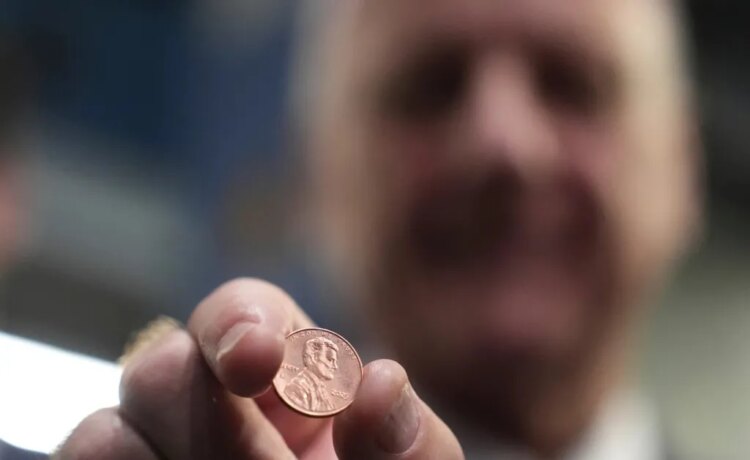
The last Lincoln penny was recently struck at the U.S. Mint in Philadelphia. Its removal from circulation marks just one of many changes that American currency has undergone since 1792, when the dollar was officially established as the monetary unit of the United States.
Abraham Lincoln is one of 40 deceased presidents who have appeared on U.S. coins, yet only a baker’s dozen has been featured on paper notes.
The story of American money is rooted in the colonial era when a patchwork of foreign coins and early colonial issues circulated throughout the colonies.
Because England forbade the colonies from minting coins, early settlers relied mainly on British pounds and Spanish dollars in commerce, the latter serving as the principal tender. To make change, the Spanish coin was divided into eight equal pieces, or bits, so a quarter was commonly referred to as “two bits.” When the colonies faced a shortage of circulating coins, they filled the void with paper money.
The Massachusetts Bay Colony issued the first note in the Western world in 1690, and other areas soon followed. Printed currency was often short-lived because excessive production caused inflation, rendering the bills nearly worthless. The Continental Congress in 1775 introduced the first countrywide paper bucks. By the end of the Revolutionary War, it had lost its value, giving rise to the phrase “not worth a Continental.”
In the country’s early years, there was widespread opposition to placing the images of famous leaders on currency, as it echoed Britain’s practice of embellishing money with monarchs. As a result, the principal figure on America’s earliest coins was the allegorical Lady Liberty, while the reverse commonly displayed the heralded eagle.
It took several generations before the likeness of a president appeared on American money. Presidents first appeared on paper dollars, roughly half a century before they were depicted on coins.
Initially by custom, and now by federal law, commanders in chief must be deceased for at least two years before they can appear on circulating currency. In 1926, before that requirement, Calvin Coolidge became the first and only sitting president to be portrayed on a coin during his lifetime, minted for the sesquicentennial celebration of American independence.
The genesis of today’s paper bills began in 1861 when the federal government financed the Civil War by issuing paper currency instead of minting more coins. A wide variety of notes with differing values emerged and became known as “greenbacks” because of their color and the absence of substantial government backing.
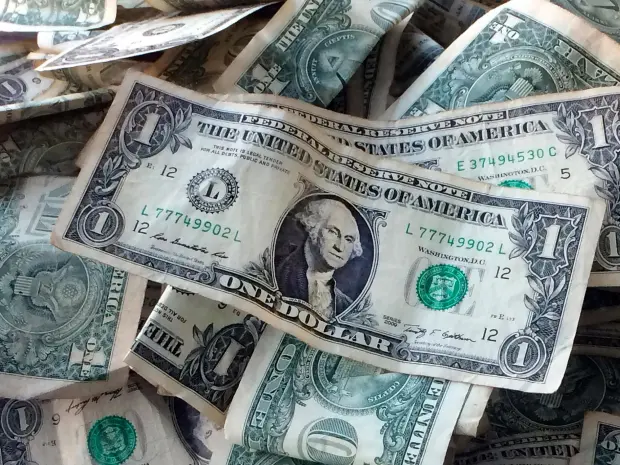
Since that time, the categories, units, design and size of paper money have been revised many times. Although several bills have been discontinued, nearly all featured deceased presidents, and some appeared on more than one denomination. Perhaps the world’s most recognizable banknote is the United States’ $1 bill. It first appeared in 1862 with Secretary of the Treasury Salmon Chase on the front. Seven years later George Washington replaced him. Through numerous redesigns of both its face and reverse, the first president has kept his premier position.
An intriguing historical fact is that Washington’s wife, Martha, was the first and only woman to serve as the primary portrait on a U.S. paper note. In the 1880s, her likeness appeared on a $1 silver certificate, which was discontinued in 1957.
Seven years after the introduction of the dollar bill, the treasury removed Thomas Jefferson’s rival, Alexander Hamilton, from the prominent $2 bill and replaced him with the third president. In 1914, the first $5 bill featured Abraham Lincoln. This was not Lincoln’s first appearance on paper currency. In the 19th century, he also appeared on a 50-cent fractional note and a $100 gold certificate.
The $20 banknote introduced in 1914 displayed Grover Cleveland and a train and steamboat on the reverse. Fifteen years later, Cleveland was replaced by Andrew Jackson, and the White House became the backdrop. After considerable political debate, Jackson is scheduled to be replaced in 2030 by abolitionist Harriet Tubman, echoing Cleveland’s earlier removal.
Ulysses Grant’s portrait on the $50 note has remained unchanged since its debut in 1914. In 1929, the size of the bill was reduced, and the reverse shifted from allegorical artwork of Panama to a depiction of the U.S. Capitol.
Several chief executives appeared on now-discontinued denominations: John Quincy Adams and later William McKinley on the $500 note, Cleveland again on the $1,000, James Madison on the $5,000, Andrew Jackson on the $10,000, and Woodrow Wilson on the $100,000 gold certificate.
Presidents did not appear on circulating coins until the 20th century.
In 1909, marking the centennial of his birth, Lincoln became the first president to appear on a circulating coin, the 1-cent piece. In 1932, Washington was placed on the quarter to commemorate his 200th birthday. Six years later, Jefferson’s profile, along with Monticello, appeared on the redesigned nickel. Franklin Delano Roosevelt was honored with the dime following his death, and after the assassination of John F. Kennedy, his likeness was placed on the half-dollar.
A 2005 congressional act ensured that every deceased president would eventually appear on a U.S. minted coin, authorizing a series of presidential dollar coins that initially circulated widely and later became primarily collector items.
The retirement of the Lincoln penny is the newest chapter in the long history of America’s changing money. From colonial bits to modern banknotes, each shift reflects the nation’s evolving identity and economic needs. As the penny departs, it joins a long line of transformations that continue to shape the story of U.S. currency.
Jonathan L. Stolz is a resident of James City County.