Unlock the Editor’s Digest for free
Roula Khalaf, Editor of the FT, selects her favourite stories in this weekly newsletter.
The UK has become the most expensive country in the world to build a nuclear power station because of a bewildering and unnecessary array of environmental, safety, and bureaucratic processes, according to a government review.
The Nuclear Regulatory task force, set up by Prime Minister Sir Keir Starmer in February, delivered a scathing assessment of the UK’s approach on Monday and set out 47 recommendations to streamline and speed up both civil and military nuclear programmes.
“What surprised me the most was how poor business is at thinking about cost control, standardisation and efficiency,” said John Fingleton, who leads the task force and previously ran the Office of Fair Trading.
“Everything has got to be a bespoke solution and nobody seems to push back, they just accept the high cost,” he added.
The UK currently operates nine nuclear reactors across four sites, providing 15 per cent of the country’s electricity, but with all but one due to retire by 2030.
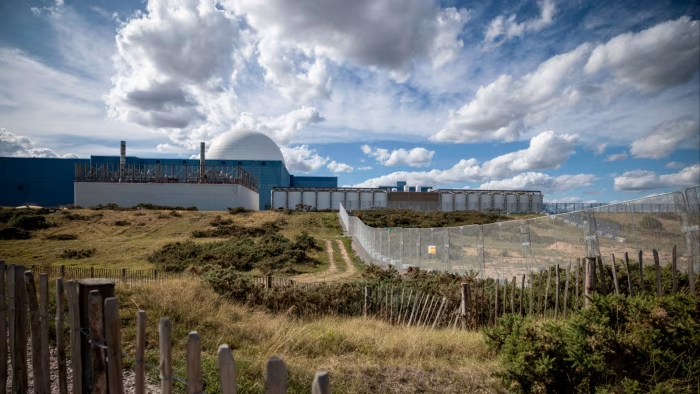
Two new power stations that are under construction, Hinkley Point C in Somerset and Sizewell C in Suffolk, are estimated to cost as much as £48bn and £38bn respectively, in 2024 prices, while the government has provided £2.5bn for the initial development of a small modular reactor design by Rolls-Royce in Anglesey in north Wales.
“It is significantly cheaper to build exactly the same reactor in, in France than it is in the UK,” said Mustafa Latif-Aramesh, an infrastructure lawyer and one of the report’s authors.
“It is several orders of magnitude cheaper in Korea and the UAE. They must be doing something differently from us to get a different result with the same reactors. There’s enough blame to go around,” he said.
The task force criticised what it described as the UK’s excessive focus on eliminating risk, including an approach to radiation that was “overly conservative” and had “no meaningful health and safety benefit”.
“We have now got to a stage where everybody drives on the motorway at three miles an hour to be safe,” said Fingleton, who urged the government to regulate radiation risk in line with international standards.
“We have just basically allowed the system to tell everybody to drive slower, drive slower, drive slower until everybody is going so slowly that it’s just a joke.”
Among the task force’s proposals is the creation of a Commission for Nuclear Regulation, an independent body with authority to take all final decisions regarding nuclear projects.
“We’re proposing a one-stop decision maker that sits across all the regulators — planning, environmental, and nuclear — that has the power to make quick decisions,” said Fingleton.
Instead of cumbersome environmental impact assessments, which ran to 31,401 pages for Hinkley Point C and 44,260 pages for Sizewell C, the review recommends that nuclear developers indemnify themselves by paying a large fixed fee into a nature protection fund.
Fingleton argued that this would divert money away from regulatory and legal wrangling into protecting the environment.
He cited a series of cases in which environmental challenges had significant effects on projects.
“The discovery of one Arctic tern in Anglesey 10 years ago was one of the factors that scuppered Hitachi’s AP1000 [reactor] being built there. There were other problems as well, but that was the straw that broke the camel’s back,” he said.
In 2019, the Planning Inspectorate concluded it was impossible to demonstrate beyond reasonable scientific doubt that a small colony of Arctic terns would not be disturbed by the construction of the Hitachi reactor.
The overall planning process, the report noted, has become dramatically more onerous over time. Roughly four times as many documents, twice as many hearings and more than a hundred times more written questions were required for planning permission for Sizewell C compared to Hinkley Point C.
Fingleton said his optimism for Britain’s nuclear sector “depends on how the government responds”. He said there was growing unease in some departments, particularly over the reaction of environmental groups, about adopting the full set of proposals.
“There’s a real test here for the government,” he said. “Are they serious about dealing with these issues and about having [data centre] hyperscalers invest in the UK on the basis that we can actually do this, or are they going to fudge it?”
The government plans to respond to the report in the Budget on November 26.
Energy secretary Ed Miliband said: “This government is delivering a golden age of new nuclear as we drive for energy sovereignty and abundance. A crucial part of that is delivering the reforms we need to drive forward new nuclear in a safe, affordable way.”