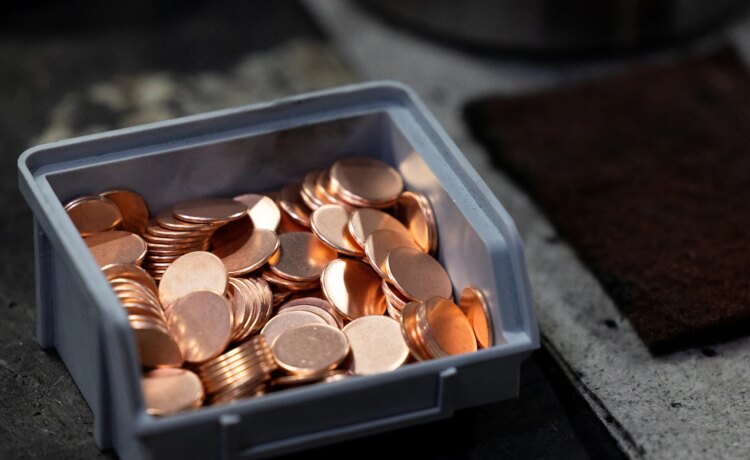
- The U.S. Treasury Department has stopped producing the penny after more than 230 years.
- It now costs 3.69 cents to produce a single penny, which is significantly more than its face value.
- Pennies will remain legal tender and will continue to be accepted by retailers nationwide.
- Many Americans no longer use cash for transactions, and billions of pennies are currently stored in homes.
The U.S. Treasury Department halted production of the penny on Nov. 12, ending more than 230 years of minting the nation’s smallest denomination and signalling the copper-colored coin’s gradual exit from American currency.
If you’re someone with jars or piggy banks full of pennies, there’s no need to worry; the coin will remain in circulation. And while it costs more to make a penny than the coin is actually worth (3.69 cents to be precise) — and billions of them already sit idle in drawers across the country — the penny is far from worthless.
Beyond simply cashing them in at the bank to boost your account balance, we spoke with a Jacksonville numismatist — a person who studies or collects currency, including coins, paper money, tokens, and medals — at A-Coin, to learn if pennies are still worth collecting/selling and what the end of production means for collectors and the general public.
Are pennies worth collecting or investing in 2025? Here’s what local experts say.
Just because pennies are being discontinued doesn’t mean their value has increased. “There are billions and billions of pennies in circulation, and while they may be newsworthy due to the halt in production and their historical value, they still aren’t a strong investment,” says Doug Riley, a numismatist at A-Coin for 10 years. However, according to Riley, “buying pennies is a poor investment choice. I advise [customers] to buy silver and gold instead.”
Where to buy or sell pennies in Jacksonville: Prices and tips.
You can buy or sell pennies in Northeast Florida at specialized coin dealers like A-Coin & Stamp Gallery or Edgewood Coin, which both have locations in Jacksonville and are known for buying and selling collectable coins. Other local coin and precious metals dealers, pawn shops, or national online marketplaces can also be options for selling. For buying, coin dealers are a primary source for specific pennies or collections.
A-Coin, known as “Northeast Florida’s Trusted Valuables Buyer,” buys and sells pennies — but only those dated before 1958. “We don’t buy any pennies from 1958 and older. We buy them for 3 cents and sell them for 4 cents, so we make one cent for profit. You can tell it’s not a great investment,” says Riley.

Why did the U.S. stop making pennies? Are pennies going away?
According to the Treasury, there are an estimated 114 billion pennies currently in circulation, many of which are stored away in coin jars, junk drawers, or forgotten containers. Despite the vast supply, the coins are “severely underutilized,” officials said. Adding to the decision is the fact that it costs more to produce the coin than the coin’s market value. The decision comes amid growing concerns over the cost of production and declining consumer use.
Will pennies still be in circulation? Can I still use pennies?
Yes, the penny will remain legal tender and will still be accepted at retailers nationwide, but its long-term phaseout marks the end of an era for the copper-colored coin.
How much does it cost to make a penny?
President Donald Trump ordered the halt in production, citing the coin’s inefficiency. It costs nearly 3 cents to produce each penny — well above its face value. The government also loses nearly 9 cents for every nickel minted, raising concerns that eliminating the penny may inadvertently increase losses by pushing more nickel usage.
Do Americans still use pennies today?
Though once a staple of everyday transactions, pennies have become a nuisance to many Americans. A 2023 Federal Reserve study found that just 16% of consumer payments were made in cash, while a 2022 Pew Research Center survey reported that 40% of Americans never use cash at all.
The average household is estimated to be sitting on $60 to $90 in coins, often discarded or left unused. Americans reportedly throw away millions of dollars in change each year.
What does the end of production mean for collectors, and why do people collect pennies despite their declining value?
Riley says collectors may be upset that their favorite coin will no longer be produced, forcing them to shift their focus to something else. He notes that silver dollars are currently the main coins people seek to have evaluated, as they tend to hold more value and suggests silver is a better investment. So, why do people continue to collect pennies despite their declining worth?
It’s simple, “Because collectors like a complete set of what they are collecting — every year and every location where it’s made,” Riley says. Pennies were once produced annually at multiple mints, including Philadelphia, Denver, and San Francisco, and collectors “strive for completeness in their collections.”
Another reason, according to Riley, is the hope that the law prohibiting the melting of U.S. coins might eventually be lifted. If that were to happen, some collectors believe they could melt their pennies for their copper value, which now exceeds the face value of the coin. This possibility, however, applies only to pennies minted between 1959 and 1981, excluding those produced in 1982. Beginning in 1982, the U.S. Mint shifted from making copper pennies to using a zinc core coated with a thin layer of copper.
As a result, any pennies made in recent years — including this year and last — contain only plated copper, making them unworthy for their copper, says Riley. Still, while the copper content may not matter now, 100 years from now, the halt of production of this year’s pennies as a whole might become relevant for its antiqueness rather than its copper value.
Can you melt pennies to turn them into copper and sell the copper?
No. U.S. law prohibits melting pennies. The regulation — found in the Code of Federal Regulations and based on 31 U.S.C. 5111(d) — bans the unauthorized melting, treatment, or export of 1-cent and 5-cent coins to protect the nation’s coinage. Violators can face penalties of up to a $10,000 fine and/or up to five years in prison.
What can I do with old pennies? What about collector pennies?
Still, some groups are encouraging Americans to look at their coins more closely. Coin collectors and experts recommend using resources like “The 2026 Red Book: A Guide Book of United States Coins” to assess potential value. Coins can also be authenticated and graded through services such as the Numismatic Guaranty Company and the Professional Coin Grading Service.
Which 1943 penny is worth $1,000,000 today?
A 1943 copper (bronze) penny is worth millions of dollars today; these coins are extremely rare because they were mistakenly made from bronze instead of zinc-coated steel during World War II. The highest prices are paid for those with specific mint marks, and the finest known examples have sold for over $1 million.
What makes a 1943 copper (bronze) penny so valuable?
- Minting error: During the war, copper was needed for ammunition, so pennies were made of steel coated with zinc. Due to a mistake, a few of the 1942 bronze planchets were accidentally used to strike pennies in 1943.
- Rarity: Only an estimated 20 to 30 of these copper pennies are known to exist.
- Value: Their value depends on condition and mint mark, with a high-grade “1943-S” (San Francisco mint) example selling for a record $1.7 million in 2010, and other high-quality examples selling for over $1 million.
How to identify a valuable 1943 copper (bronze) penny?
- Check the metal: A valuable 1943 penny will be made of bronze, not steel.
- Magnet test: Steel is magnetic. If your 1943 penny is magnetic, it’s a common steel penny, not the valuable error coin. A true copper 1943 penny will not be magnetic.
- Weight difference: A 1943 bronze penny weighs slightly more (3.11 grams) than a steel one (2.7 grams).
Beyond monetary value, pennies may still have practical uses. According to Farmers Bank, older copper pennies can act as natural fungicides to keep flowers fresh or serve as makeshift tools and household fixes — from weighing down curtains to creating cold packs using an old sock filled with frozen coins.
While the humble penny may soon stop rolling off the mint’s machines, its impact — and utility — could endure long after its final press.
Contributing Manahil Ahmad, Breaking-Trending Reported New Jersey