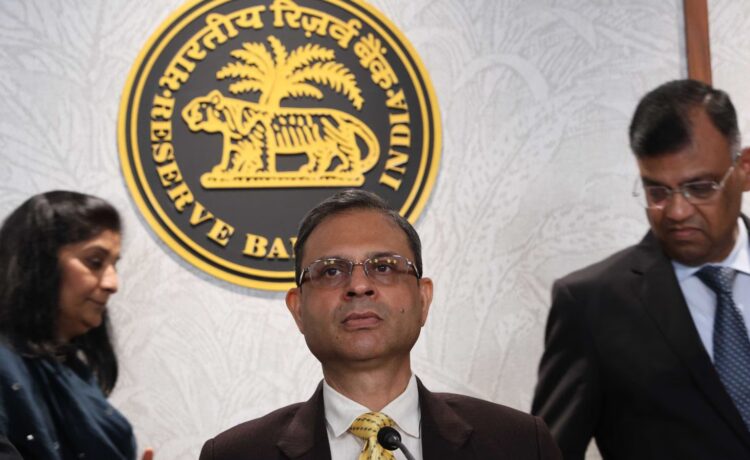
Even as the rupee depreciated by over 5 per cent to beyond 90 against the dollar, Reserve Bank Governor Sanjay Malhotra on Friday said the central bank was well placed on the currency front, stating that “this volatility does happen, can happen” and that the market is very “efficient” and “deep.”
After cutting Repo rates by 25 basis points to 5.25 per cent on Friday, Malhotra said, “we allow the markets to determine, I mean, we don’t target you any price levels or any bands.”

“We allow the markets to determine the prices. We believe that the markets, in the long run especially, are very efficient. It’s a very deep market. We saw this earlier in February. The rupee to dollar had climbed to almost 88 and within a period of three months, it came back to below 84 so these fluctuations, this volatility does happen, can happen,” Malhotra said at a press conference.
“Our effort has been always to reduce any abnormal or excessive volatility, and that is what we will continue to endeavour… in our external sector, as I also mentioned in my statement, is very strong going forward, we do believe that we are having sufficient reserves,” Malhotra said. A five per cent depreciation leads to 35 bps rise in retail inflation, he said.
He said the current account is very manageable, at about one per cent or so, and given the strong fundamentals of our country, we should get good capital flows going forward. “So, I think we are in a very comfortable situation insofar as the external sector position is concerned,” Malhotra said.
The rupee which crossed 90 mark again in mid-session on Friday recovered marginally and was quoting at 89.95 at around 12.30 pm IST.
Malhotra said on the external front, services exports are likely to remain strong, while merchandise exports face some headwinds. “External uncertainties continue to pose downside risks to the outlook, while speedy conclusion of various ongoing trade and investment negotiations present upside potential,” Malhotra said.
Story continues below this ad
A Bank of Baroda research report said that a 5 per cent depreciation in the rupee is likely to push up inflation by 15-25 basis points on an annualized basis, with gold, edible oils and pulses likely to see the major impact. The depreciation seen in the rupee in recent days is not unusual as there has been a tendency for the currency to depreciate historically as well. This is not a unique phenomenon for India only, as exchange rate movements of a majority of developing countries also shows a similar trend. “This is due to several factors including high inflation, large trade deficits, limited foreign flows and vulnerabilities to external shocks including financial system and commodity price risks,” it said.
According to Aditi Gupta, Economist, Bank of Baroda, between 2010-2024 (calendar year), on a point-to-point basis, the rupee has depreciated 13 times, losing about 48 per cent of its value. Even narrowing the range to the last 10 years, there is only a single year i.e 2017, in which the currency appreciated. The average depreciation in the rupee in the period is 2.9 per cent. However, in 7 out of the 10 years, the actual depreciation was lower than the average.
In fact, barring 2018 and 2022, the movement in the exchange rate has largely been within the long-term average trend. Even last year, the currency depreciated by just 2.8 per cent. This was notwithstanding a 7 per cent increase in the value of the dollar. This year the situation is quite different. The rupee has depreciated by over 5 per cent since December 31, 2024, even as the dollar has weakened, Gupta said.