
Halliburton (NYSE:) reported Q1 2026 adjusted earnings of $0.55 per share against a FactSet consensus of $0.50, with revenue of $5.40 billion exceeding analyst expectations of $5.31 billion.
The result highlights a structural divergence within the business, where international drilling strength is offsetting North American completion weakness, limiting the translation of higher into near-term activity growth.
|
$37.15 HAL CLOSE Apr 18, 2026 |
$0.55 ADJ. EPS Q1 vs $0.50 est. |
$5.40B Q1 REVENUE vs $5.31B est. |
$461M NET INCOME +126% YoY |
$36.30 50-DAY SMA Structural floor |
$41.18 52W HIGH Current -9.7% |
$19.22 52W LOW Current +93% |
$44.00 GS TARGET Buy rating |
Halliburton’s first quarter of 2026 produced a headline beat that requires disaggregation to interpret. Net income of $461 million, or $0.55 per diluted share, compared to $204 million, or $0.24 per share, a year earlier, when results were weighed by $356 million in impairment and other one-off charges. Adjusted earnings of $0.55 per share exceeded the FactSet consensus estimate of $0.50, while revenue of $5.40 billion declined year-over-year but remained above analyst expectations of $5.31 billion. The result highlights a structural divergence within Halliburton’s business, where international drilling strength is offsetting North American completion weakness, limiting the translation of higher oil prices into near-term activity growth.
The segment breakdown makes the divergence concrete. Completion and production, which encompasses stimulation, cementing, and pressure control services, posted revenue of $3.02 billion, a decline of 3.3% year-over-year. Drilling and evaluation, which includes wireline, drill bits, and formation measurement, generated $2.39 billion, an increase of 3.9%. The gap reflects different demand drivers rather than company-specific execution issues. Completion intensity in North America has plateaued as producers treat the current price environment as a supply signal requiring capital discipline rather than acceleration. Drilling complexity, by contrast, tends to sustain demand for high-margin measurement and directional services irrespective of short-cycle commodity price movements. Management has previously indicated that international markets account for more than 60% of total revenue, underscoring the segment’s strategic importance to the earnings mix.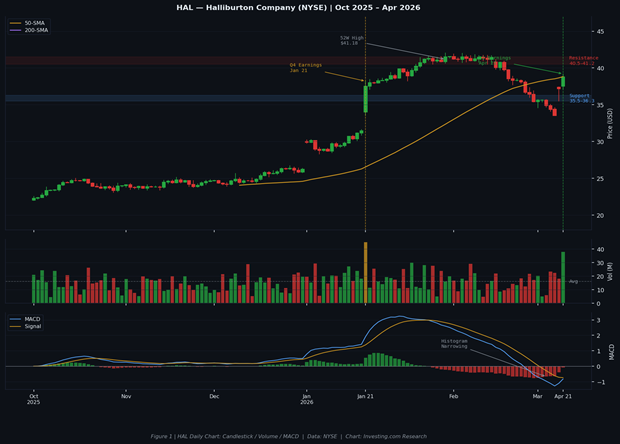
The price structure entering the Q1 earnings session reflects post-peak consolidation rather than trend reversal. After the Q4 2025 earnings event on January 21 produced a gap advance toward $37.50, HAL extended the move toward the $40.50 to $41.18 resistance zone before retreating to close at $37.15 on April 18. The 50-day SMA at $36.30 has functioned as a key structural reference during this consolidation phase, acting as support across two distinct pullbacks without yielding to a lower structure. After closing at $37.15 on April 18, the stock rebounded toward the $39 to $40 range into April 21, approaching the lower bound of the $40.50 to $41.18 resistance zone noted in Figure 1. The MACD histogram narrowing visible in the lower panel indicates declining upside momentum without reversing trend direction. The MACD signal line is converging with the MACD line, a setup that typically precedes either a breakout or an extended range. The absence of a decisive break below the 50-day SMA during a broader pullback across oilfield services peers suggests the level appears to act as a structural reference. A Q1 beat of the magnitude reported may be sufficient to retest the $40.50 to $41.18 resistance zone, though macro headwinds from oil price softness remain the primary variable capable of suppressing that attempt.
The structural test for HAL is whether the $40.50 to $41.18 resistance zone, where prior selling pressure emerged, yields on an earnings-driven attempt.
The more significant analytical finding in the Q1 result is the disconnect between higher oil prices and flat completion activity. Capex decisions operate on 12- to 18-month planning cycles, leading producer behavior to suggest that geopolitically driven oil price spikes are being treated as temporary rather than as signals for immediate activity increases. The disruption linked to Iran-related tensions provided a sharp late-quarter rise in crude prices, yet Halliburton’s completion and production revenue still declined, reflecting the lag between price signals and capital deployment decisions. North American independent producers have been explicit in investor communications about prioritizing cash returns over production growth in the current environment. The implication for Halliburton’s completion segment is that near-term volumes are unlikely to inflect higher even if WTI remains elevated, as stimulation demand typically tracks well completion activity rather than commodity price levels directly.
International drilling markets present a different exposure profile. The complexity of well construction in deepwater and unconventional formations tends to sustain demand for measurement-while-drilling and wireline services across commodity cycles. The Vaca Muerta contract with YPF, a multibillion-dollar long-term agreement announced in April 2026, illustrates the pipeline of international complexity that underpins the D&E segment and provides revenue visibility beyond the current quarter. The D&E growth trajectory has also attracted upward analyst target revisions: Goldman Sachs maintained a buy rating with a $44.00 price target, alongside targets of $45.00 from Citi and $43.00 from RBC following recent contract developments. Morgan Stanley carried an overweight rating with a $40.00 target as of mid-April 2026. The analyst community has broadly incorporated the international D&E growth narrative into forward targets, leaving execution on margins and guidance stability as the principal variables for near-term multiple expansion.
Venezuela represents a long-duration option rather than a near-term catalyst. Analysts and company executives estimate that oilfield rehabilitation in the country could require approximately $10 billion annually over multiple years, largely benefiting service providers given the deteriorated state of Venezuelan infrastructure after years of underinvestment. However, timelines remain uncertain, as sanctions policy, infrastructure capacity, and political risk combine to limit any contribution to near-term revenue consensus estimates. The market has partially priced the optionality: Halliburton’s 52-week high of $41.18 was reached in an environment of elevated geopolitical risk and rising energy sector sentiment, suggesting that the Venezuela upside scenario is incorporated into analyst price targets rather than into base earnings estimates.
The forward path for Halliburton depends on which demand driver assumes primacy in H2 2026. If North American producers revise capex guidance upward in response to sustained oil prices, the completion and production segment carries sufficient operating leverage for a rapid revenue recovery, and HAL may retest the $41.18 resistance zone with analyst targets of $43 to $45 representing credible upside. If producers maintain capital discipline and oil price strength proves temporary, the burden of earnings growth shifts to international markets and margin improvement, a slower path that may constrain the stock to the $36 to $40 consolidation range established since January. Downside pressure toward the mid-$30s range, with the 200-day SMA at $30.88 as a secondary reference, would likely require a sustained deterioration in both segments, most plausibly driven by a significant reduction in producer activity guidance. Investors and analysts should monitor Q2 2026 completion and production revenue guidance, management commentary on Venezuela rehabilitation timelines, and any shift in North American rig count trajectory as the leading indicators of which scenario is taking hold.