Euro
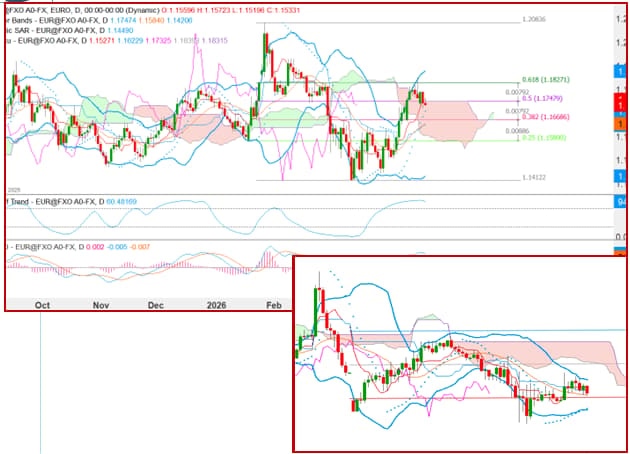
The euro gain ends at exactly the 62% retracement level, as shown on the daily chart. A pullback from there is normal in FX. We usually get another surge over the 62% line unless sentiment changes.
The 60-minute euro insert (from eSignal) shows the gap down yesterday between 4 and 5 pm ET, the period when Trump announced the extension of the ceasefire. The movements afterwards are a classic whipsaw.
We may not know today (or tomorrow) whether markets persist in believing this will all end well. Traders are loathe to panic—it’s exhausting, usually loses money, and besides, Trump will TACO.
The key to resumption of the euro upmove will be to test and surpass the previous high at 1.1849 from last week (4/17).
Outlook
As noted above, the ceasefire extension was released after the futures market closed and while spot was shutting down. The Trump tweet was at 4:09 pm and CNBC had it at 4:13, but the news was not widely spread until after 5 pm. Traders do not want to read Trump’s social media messages to determine their trades.
The WSJ calls it a high-stakes game of chicken. Many analysts and opinion writers say the Con Man in Chief has met his match. Iran is turning out to be resistant to bullying, bribery and especially insults. Today Iran is said to see “some signs” the US will lift the blockade on Iranian ports. This is necessary for Iran to return to the table, so not unlikely, and besides, Trump will TACO.
When Trump lifts the blockade, it will be his second concession to Iran, after extending the ceasefire.
This is clearly what markets expect—that Trump is going to back down on plenty of Iranian demands, perhaps including the demand for reparations. As Bloomberg’s Authers points out, markets can tolerate a closed Strait of Hormuz, but they can’t tolerate a resumption of a shooting war. See the clever chart.
He cites analysis on drawdowns from long ago (2020) from London’s Longview Economics:
In almost all pullbacks, equity indices retest their lows from the initial “wave” of selling… the history of stock market pullbacks has a compelling message: Since 1978, there have been 15 S&P 500 corrections in bull markets in which the initial pullback was 10% or greater. In 13 of those corrections, the index retested its low (i.e. 87% of the time).
The stock market is not the economy and the stock market is not FX, but traders are traders. If we apply this idea to the euro, we need to expect a retest of the low. Which one?! On the daily chart, that’s 1.1411 from March 13.
This is an observation, not a forecast.
Forecast
We have seen quite a few technical indicators showing the currencies vulnerable to a pullback, although the main dollar gains so far are in the peso and yuan.
Vulnerable is a judgement, not a decision. The range of possible outcomes is far too wide—1.1411 to 1.1849. We can expect whipsaws within that range. A trend-following system like ours doesn’t have a favorable outlook, and imposing discretionary judgment doesn’t have a good track record. We are torn between what should be factual risk-off favoring the dollar and wishful thinking holding it down. Again, logic does not win.
This is one of those times when trend-following will deliver big losses but the alternative, hourly day-trading, may not be any better when it’s the erratic loser Trump running the show and popping up at any moment to deliver a Shock. Bottom line—don’t take our advice, or take it only in tiny amounts.
This is an excerpt from “The Rockefeller Morning Briefing,” which is far larger (about 10 pages). The Briefing has been published every day for over 25 years and represents experienced analysis and insight. The report offers deep background and is not intended to guide FX trading. Rockefeller produces other reports (in spot and futures) for trading purposes.
To get a two-week trial of the full reports plus traders advice for only $3.95. Click here!