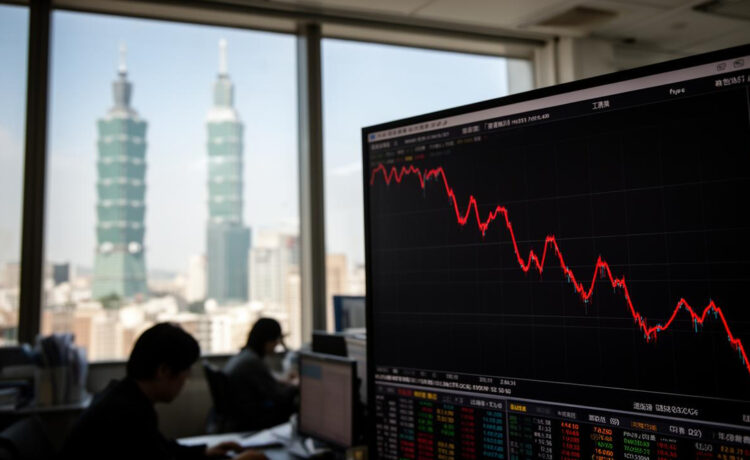
Taipei’s foreign exchange market saw the Taiwan dollar weaken against the U.S. dollar on heavy volume Wednesday (September 2), closing at NT$31.728, down 9.5 cents from the previous session, with trading volume reaching $2.858 billion (approximately NT$91 billion) — the third consecutive session exceeding $2 billion. Foreign investors dumped NT$91.35 billion worth of Taiwanese stocks, the Taiwan Weighted Index plunged 1.67%, and major Asian currencies broadly softened, compounding downward pressure on the Taiwan dollar.
The renewed US-Iran conflict was the trigger for this round of currency market volatility. After the U.S. military launched a new round of strikes against Iran, international oil prices surged, safe-haven flows boosted the dollar, and global bond yields rose in tandem, weighing on equities. With the exception of the Japanese yen and South Korean won, Asian currencies broadly extended their depreciation on Wednesday, and the Taiwan dollar was no exception.
The Taiwan dollar traded at an intraday high of NT$31.650 against the U.S. dollar in interbank trading, before sliding to NT$31.804 in the afternoon session. The currency pared some losses into the close, ending down 9.5 cents. Foreign investor positioning in Taiwanese stocks swung sharply from net buying of NT$26.7 billion the previous day to net selling of NT$91.35 billion, with capital outflow pressure directly reflected in the exchange rate.
Just one session earlier, the Taiwan stock market had surged 820.25 points, with foreign investors buying a net NT$26.707 billion, driving the Taiwan dollar higher against the trend to close at NT$31.633 — standing out among Asian currencies. At that time, the US Dollar Index rose 0.12%, while the South Korean won fell 0.33%, the Japanese yen slipped 0.26%, and the Chinese yuan edged down 0.04%, leaving the Taiwan dollar as the sole gainer with a 0.1% appreciation.
However, within a single day, foreign investor positioning completely reversed. The Taiwan Weighted Index closed down 1.67% on Wednesday, and foreign investors expanded their net selling of listed stocks to NT$91.35 billion. The force of hot money exiting was clearly visible in the currency market, as the Taiwan dollar quickly retreated from the previous day’s high above the NT$31.6 level back above NT$31.7.
Foreign exchange bankers noted that after exporters’ month-end dollar-selling demand concluded, support weakened noticeably. Although the central bank provided liquidity adjustment during the session, heavy foreign selling pressure made it difficult for the Taiwan dollar to hold the NT$31.6 level. Market participants said the Taiwan dollar is expected to trade in a range of NT$31.5 to NT$31.9 in the near term, with foreign investor buying and selling and hot money flows remaining the key drivers.
Maybank’s latest report noted that the dollar’s structural depreciation trend will persist, but the path of weakness has become more circuitous. The report analyzed that a hawkish Federal Reserve and persistently elevated inflation can support the dollar at the tactical level, but weakening labor market momentum and the increasingly adverse impact of fiscal factors pushing up U.S. Treasury yields are gradually capping the dollar’s medium-term upside.
The report maintained its medium-term bias toward selling dollar rallies, but acknowledged that near-term upside risks for the dollar are elevated ahead of the September Federal Open Market Committee (FOMC) meeting. If the Fed hikes rates in September, the dollar could see further tactical gains, particularly if the Fed simultaneously signals the possibility of additional tightening.
Fed Chair Jerome Powell delivered a hawkish message at last week’s global central bank symposium, stating that if policymakers cannot gain sufficient confidence that inflation is declining toward the 2% target, then the Fed “has more work to do.” These remarks boosted market bets on a September rate hike, with rate futures markets now pricing in a roughly 60% probability, up from around 40%.
Former Fed official Robert Kaplan, now vice chairman of Goldman Sachs, also said that barring unexpected developments, he leans toward the view that the Fed will raise rates in September, while remaining open-minded.
The Taiwan dollar experienced a strong rebound in August, appreciating 62.6 cents for the month — a gain of approximately 1.94% — snapping a two-month losing streak. In June and July, the Taiwan dollar had depreciated 45.3 cents and 45.5 cents respectively, marking two consecutive months of monthly declines, before August delivered a powerful turnaround driven by returning foreign hot money.
Entering September, market focus has shifted back to Federal Reserve policy direction. With key economic indicators including the ISM Manufacturing Purchasing Managers’ Index and nonfarm payrolls data due this week, the market has broadly turned cautious. If U.S. inflation data remains elevated, dollar strength and foreign capital flows could both become important variables shaping the Taiwan dollar’s September trajectory.
Foreign exchange bankers believe Taiwan’s fundamentals remain supported by AI exports and capital momentum. If foreign investors return to position in Taiwanese stocks, it would drive capital inflows and provide important support for the Taiwan dollar. However, in the near term, before the Fed’s rate decision becomes clear, the Taiwan dollar’s appreciation is likely to be constrained. With the US Dollar Index finding support at the 99.5 level and Asian currencies broadly weak, there is limited room for the Taiwan dollar to stand out excessively on its own.