Image Source: Getty Images
During his recent visit to Sri Lanka, India’s Foreign Secretary, Vikram Misri, finalised an agreement for an INR-denominated credit line worth US$350 million to support the island nation’s recovery and reconstruction following Cyclone Ditwah. This development closely followed Mr. Misri’s visit to Bhutan, where both countries signed an EXIM credit line worth INR 4,000 crore. These latest developments underscore India’s interest in offering INR-denominated financial assistance to neighbours and build on its steady expansion of rupees beyond its borders as instruments of regional statecraft. While INR-denominated assistance eases lending-related costs, the neighbours’ ability to repay in INR will depend on several factors. For India, however, this will further its strategic interests through interdependence.
A Timely Transition
Since independence, India has offered assistance to its immediate neighbours and the broader Global South through grants, community development projects, and technical and economic cooperation. Buoyed by its economic growth and global ambitions, India began providing concessional financial assistance through EXIM credit lines and currency swaps from the early 2000s, denominated in USD. Given its close ties with and dependence on India, Bhutan remained the only country to receive credit and currency swap assistance in INR, and was also exempted from the standard EXIM credit lines.
Since 2025, however, India has shown a growing preference for offering INR-denominated EXIM credit lines to its South Asian neighbours: over INR 4,850 crore to the Maldives, INR 4,000 crore to Bhutan, and INR 3,300 crore to Sri Lanka — adding up to an estimated 1.27 billion USD in less than two years alone.
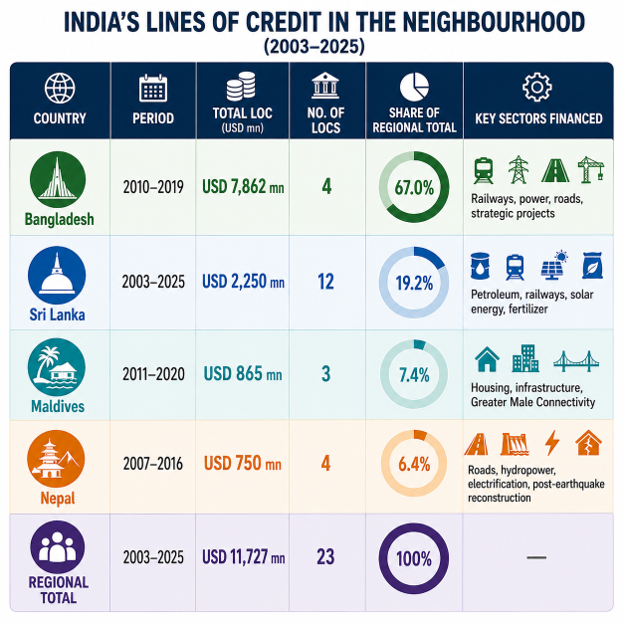
Between 2001 and July 2026, EXIM Bank has extended over 300 Lines of Credit to 68 countries, covering over 600 projects in railways, roads, agriculture, industry, sports, ports (airports and maritime), health, energy, IT, and disaster relief. The majority of these credit lines have been denominated in US dollars, worth a cumulative US$25 billion. South Asia has been a major recipient of this assistance, borrowing over US$11.7 billion since 2003 (as Table 1 below shows). Since 2025, however, India has shown a growing preference for offering INR-denominated EXIM credit lines to its South Asian neighbours: over INR 4,850 crore to the Maldives, INR 4,000 crore to Bhutan, and INR 3,300 crore to Sri Lanka — adding up to an estimated 1.27 billion USD in less than two years alone.
Table 1: India’s Dollar-Denominated Lines of Credit to South Asian Neighbours (EXIM Bank, 2003–2025)
Source: EXIM Bank
A similar push for INR-denominated assistance is visible with currency swaps. Following the 2009 financial crisis, India announced its Framework on Currency Swap Arrangement in 2012 to help neighbours with financing arrangements and liquidity concerns. Under the framework, the Reserve Bank of India (RBI) could offer swaps of up to US$2 billion in INR, USD, or Euros to all South Asian countries. Bhutan, Sri Lanka, and the Maldives sought multiple swaps from India. While neighbours preferred USD swaps (Bhutan being the exception), India announced a new framework in 2024 (2024-2027), opening an additional window for a swap of INR 25,000 crore (estimated at US$2.6 billion). In recent years, in fact, India has increasingly preferred lending through this INR window. For instance, when the Maldives recently settled its US$400 million swap with India, India replaced it with an INR 30,000 crore swap (estimated at US$357 million). For Bhutan, an additional INR 1,500 crore has been availed through this swap.
Regionalising The Rupee
This preference for INR-denominated assistance stems from several factors. In an increasingly multipolar international order, India recognises that, as a major economic pole, it cannot rely on the USD alone. It has, accordingly, continued to internationalise the INR, particularly within the region. This is driven partly by China’s growing footprint in South Asia — through Yuan-denominated credit lines, bilateral swap agreements, and the Cross-Border Interbank Payment System (CIPS) — all aimed at building financial dependencies. The Yuan’s share of global trade settlement has grown steadily and is increasingly used in trade and transactions with third countries, compelling India to regionalise the INR and adopt a similar template of its own. Western sanctions against Russia following its invasion of Ukraine, and the weaponisation of the dollar, have further pushed India to double down on shaping an INR-based financial architecture.
Similarly, with USD-denominated assistance, India must first purchase foreign exchange reserves in order to lend, and at the time of repayment, the borrower must convert its own currency into USD. This generates exchange-rate risk, reserve management costs, transaction expenses, and dual-conversion costs. With INR denomination, however, both countries are shielded from depreciation against the USD, reducing unpredictability, time, and the costs of dual-currency conversion and overall borrowing. For countries that trade significantly with India and maintain close economic and financial ties with it, INR-denominated assistance eases these complexities.
At a time when South Asian countries are struggling to maintain their foreign reserves, repay their loans, and address structural issues while remaining vulnerable to economic shocks, lending in USD could prove risky for India. INR lending, by contrast, mitigates this risk by offering greater flexibility and control over the currency.
Finally, at a time when South Asian countries are struggling to maintain their foreign reserves, repay their loans, and address structural issues while remaining vulnerable to economic shocks, lending in USD could prove risky for India. INR lending, by contrast, mitigates this risk by offering greater flexibility and control over the currency. Besides, it has also widened the pool and window for assistance by not entirely ruling out assistance in USD — India has, in fact, recently restructured its older USD-denominated credit lines to the Maldives and Sri Lanka. These factors have sustained India’s continued assistance at a time when others, including China, remain hesitant to offer large-scale loans and assistance, wary of South Asian countries’ ability to service and repay borrowed money.
Risky Gambit or a Strategic Asset?
India’s increasing INR-denominated assistance has also raised questions about its neighbours’ ability to repay or service these loans. India’s neighbours can generate INR inflows through four major channels: exports to India, tourism receipts from Indian visitors, remittances from workers based in India, and investments. Another source of INR earnings is the credit lines and currency swaps themselves. These interactions are further being eased by the adoption of UPI and RuPay; the introduction of Special Rupee Vostro Accounts (SRVAs) with limited RBI intervention; the easing of regulatory clearances related to international trade in INR; and an RBI framework allowing Authorised Dealer banks to lend in rupees to residents of Nepal, Bhutan, and Sri Lanka. These developments deepen rupee circulation and build the payment infrastructure needed to expand the pool of rupee-denominated economic activity.
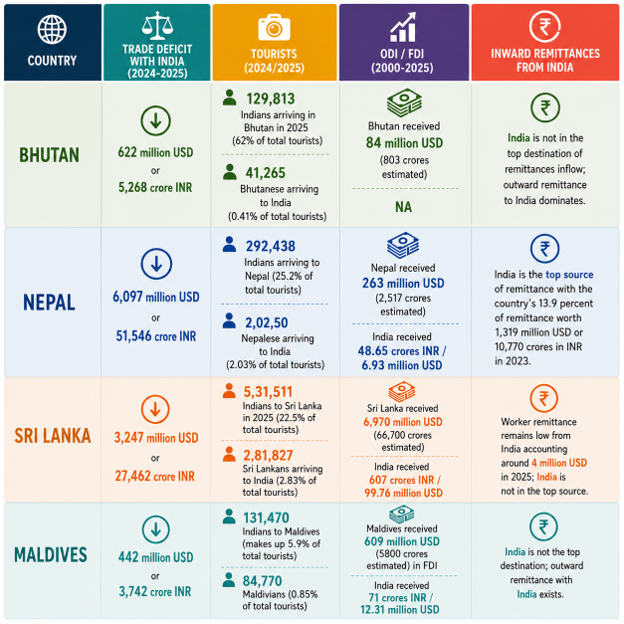
A critical challenge, however, is that South Asian neighbours are net spenders rather than earners of rupees, as Table 2 demonstrates — largely a result of their sizeable trade deficits with India. Investments from the region into India have remained scant. While India remains a primary investor in the region, the scope and nature of its investments are constrained by investors’ distrust, regional instability, unfriendly policies, and protectionism, among other factors. The absence of a sizeable diaspora in India (barring Nepal’s) has also limited the generation of INR. Tourism appears to hold the most promise for generating INR for South Asian nations, particularly since India remains a major source market. That said, spending also remains high, with South Asian tourists spending their INR on leisure, health, shopping, and other forms of tourism within India. For instance, Maldivian tourists are estimated to spend over 128 million USD (12 billion INR) in India annually.
Table 2. INR Earning Prospects of South Asian Neighbours
Source: Authors’ collation from Ministry of Commerce, Tourism statistics, Department of Economic Affairs, Department for Promotion of Industry and Internal Trade, Observer Research Foundation, and others.
Neighbouring governments must, therefore, find ways to generate and service INR-denominated assistance. INR-denominated assistance thus creates a structural incentive to export more to India, attract more Indian tourists and capital, formalise remittance flows through Indian banking infrastructure, invest in India or draw more Indian investment, and adopt Indian payment systems such as UPI and RuPay. When India’s bilateral lending, trade, and payment systems all operate in rupees, the financial architecture of South Asia becomes India-centred by design.
India’s rupee lending, therefore, functions as a long-term strategic investment — one through which it buys financial integration, political influence, and much-needed bilateral interdependence in a volatile region.
This is precisely why rupee lending is strategically valuable to New Delhi, independent of whether the loans are commercially profitable for it. A neighbourhood more financially integrated with India through rupee borrowing is also a neighbourhood more commercially integrated with it through trade and investment. India’s rupee lending, therefore, functions as a long-term strategic investment — one through which it buys financial integration, political influence, and much-needed bilateral interdependence in a volatile region.
India’s shift from dollar-denominated lines of credit to rupee lending represents the most consequential change in its development finance architecture in recent times. Shaped by both internal and external factors, India is now working to regionalise the rupee. This continues to fuel India’s development assistance and reduces immediate costs for both lender and borrower. Whether this INR-denominated assistance is repayable by its neighbours will depend on several factors, including how far their trade, tourism, investment, and remittances with India increase. For India, however, this carries strategic implications of its own — creating stronger interdependence and serving as an instrument of influence and stability in the neighbourhood.
Aditya Gowdara Shivamurthy is an Associate Fellow with the Strategic Studies Programme at the Observer Research Foundation.
Madhav Raman is a Research Intern with the Strategic Studies Programme at the Observer Research Foundation.
Disclaimer: The authors acknowledge the use of Grammarly for language refinement. ChatGPT 5.5 was used to generate infographics and tables.
The views expressed above belong to the author(s). ORF research and analyses now available on Telegram! Click here to access our curated content — blogs, longforms and interviews.