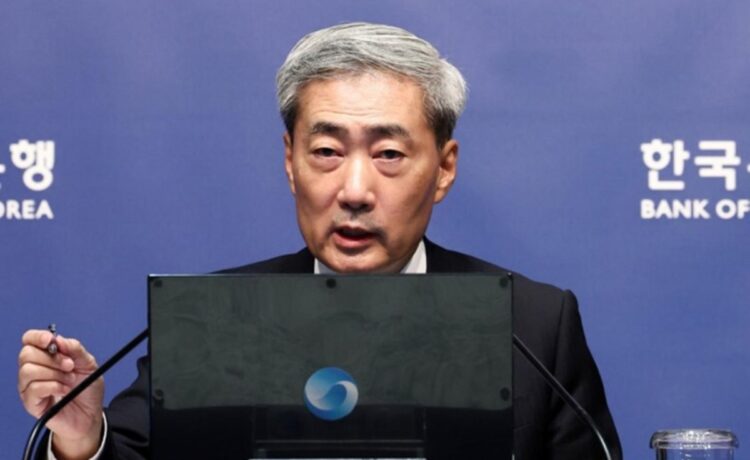
Bank of Korea Governor Shin Hyun-song attends a press conference at the central bank headquarters in Seoul, South Korea, 27 August 2026. Photo by YONHAP / EPA
Sept. 3 (Asia Today) — Growing demand for dollar-backed stablecoins could have a more direct effect on South Korea’s won-dollar exchange rate if corporations and foreign investors gain broader access to the domestic cryptocurrency market, the Bank of Korea said Thursday.
At present, increased demand for dollar stablecoins in South Korea is reflected primarily in domestic stablecoin prices.
But changes in the market structure could strengthen the transmission of stablecoin demand into actual foreign exchange transactions, the central bank said.
The findings were published in a Bank of Korea Issue Note titled “Linkages Between Dollar Stablecoins and the Foreign Exchange Market.”
Researchers examined data from 2019 through 2025 covering 12 currencies, including the euro and Turkish lira, and compared market conditions before and after the global cryptocurrency exchange Binance began supporting trades involving those currencies.
Buying a dollar stablecoin with another currency is economically similar to using that currency to purchase a dollar-denominated asset.
When Binance supports such trading, global intermediaries including liquidity providers and professional market makers can supply stablecoins in response to demand and then adjust resulting positions in fiat currencies through foreign exchange markets.
That process can translate stablecoin transactions into actual foreign exchange trades.
The study found that after Binance began supporting trading, the premium between dollar stablecoin prices and spot foreign exchange rates narrowed by 0.33 to 0.38 percentage points.
Researchers attributed the decline to greater participation by global intermediaries, which made stablecoin supplies more readily available.
At the same time, the degree to which stablecoin demand shocks were transmitted to foreign exchange rates increased.
For currencies supported on Binance, greater net buying pressure for dollar stablecoins was associated with an increase in the exchange rate against the dollar, indicating depreciation of the local currency.
For unsupported currencies, by contrast, increased stablecoin demand primarily pushed up the stablecoin premium while having a more limited effect on the foreign exchange rate.
The South Korean won currently is not supported for direct dollar stablecoin trading on Binance.
Corporate and foreign participation in South Korea’s domestic cryptocurrency market also remains restricted, limiting the role of global intermediaries that could connect cryptocurrency transactions with the foreign exchange market.
As a result, increased dollar stablecoin demand in South Korea has tended to appear in stablecoin premiums rather than directly in the exchange rate.
Researchers said that could change if corporations and foreign investors receive broader access to domestic cryptocurrency exchanges.
“If the domestic market structure changes in the future, including through expanded participation by corporations and foreign investors in local virtual asset exchanges, the linkage between the stablecoin market and foreign exchange market could strengthen,” said Cho Sang-heum, an official with the Bank of Korea’s International Finance Research Team.
The central bank said South Korea should also pursue greater international use of the won and improvements to the structure of its foreign exchange market to help absorb possible shocks.
— Reported by Asia Today; translated by UPI
© Asia Today. Unauthorized reproduction or redistribution prohibited.
Original Korean report: https://www.asiatoday.co.kr/kn/view.php?key=20260903010001351