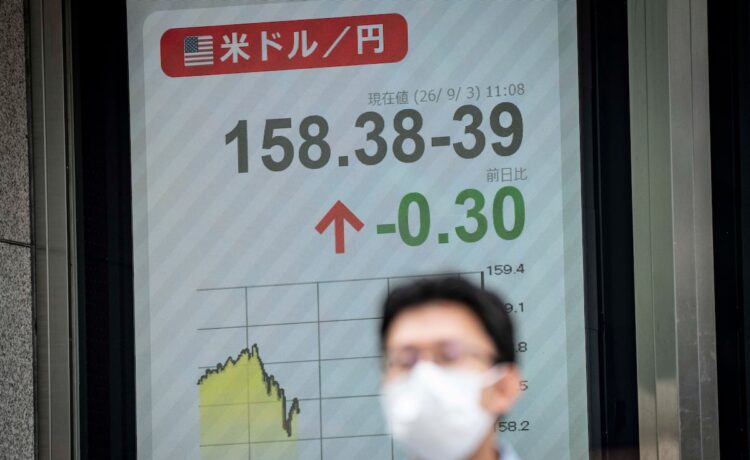
A man walks past an electronic quotation board displaying the foreign exchange rate of the Japanese yen against the US dollar in Tokyo on Sept. 3.YUICHI YAMAZAKI/AFP/Getty Images
Six weeks after hitting a four-decade low against the dollar, the tide appears to be turning for the battered yen as a host of factors finally smoke out traders who have spent years betting against the Japanese currency.
While central bank rate hikes and record currency intervention have failed to provide lasting support for the yen, new tailwinds from capital repatriation, unwinding carry trades and U.S. political pressure are now giving short speculators cause to rethink their long-term game.
The yen is on track for a roughly 2-per-cent surge against the greenback this week – the most since a rare joint U.S. and Japan intervention at the end of July to lift the yen.
“The market psychology around the yen appears to be changing,” said Rong Ren Goh, a fixed income portfolio manager at Eastspring Investments. “Investors seem increasingly reluctant to aggressively short the JPY (yen), particularly with the prospect of a BOJ rate hike in September adding another layer of risk to the trade.”
The Bank of Japan is expected to lift its key rate by 25 basis points (bps) this month and markets are also contemplating the possibility of a 50-bps hike or a series of rapid increases in coming months.
Nevertheless, a 50-bps September hike is still seen as extremely unlikely, particularly under Governor Kazuo Ueda’s cautious leadership.
All the same, the shift in mood is backed up by money flows. Data from Citigroup indicate positioning on the yen has flipped from bearish to bullish since the start of August, with interbank flow data showing leveraged funds, banks and real-money investors all net-buying yen this week.
The convergence of central bank policy, investment flows and speculative positioning is adding to volatility. The yen is also up almost 2 per cent against the euro and Australian dollar this week .
Stephen Jen, CEO and co-CIO of Eurizon SLJ Asset Management, said the risk of a rapid unwind of yen-based carry trades is rising, in a similar way to 1998 when the collapse of Long-Term Capital Management forced banks and hedge funds to rapidly deleverage.
The yen has long been the favoured currency for the carry trade, where investors borrow cheaply in yen to invest elsewhere.
“When a currency is so extremely undervalued, and positioning is so extended, movements like this one will occur increasingly frequently before a big move,” Jen said. “It’s a bit like earthquakes. The tectonic plates are grating on each other with great forces.”
Interventions and the fed
The yen’s years-long weakening trend accelerated this year as fiscal concerns mounted around stimulus plans by Japanese Prime Minister Sanae Takaichi and a strong belief that the BOJ was “behind the curve” in tightening monetary policy.
Tokyo unleashed record solo intervention in April-May when the yen weakened beyond the 160 per dollar line.
But a key moment came in July-August when Tokyo was joined by Washington in a rare bout of co-ordinated action after the currency weakened to 163.99, a level not seen since 1986.
U.S. Treasury Secretary Scott Bessent has long believed rate hikes were the right medicine for the weak yen, and he pressed the BOJ at a Group of 20 finance chiefs meeting this week. That was followed by a speech by BOJ board member Hajime Takata, the sole dissenter to a July decision to keep rates steady, who raised the spectre of 50-bps moves or hikes in quicker succession.
“His (Takata’s) remarks about consecutive rate hikes and sharper margins were dramatic,” said Yoshio Iguchi, chief strategy officer at Traders Securities. “If this becomes consensus, it could be a game changer for the yen.”
Odds are now 97 per cent that the BOJ will raise its key rate by 25 bps to 1.25 per cent, according to Tokyo Tanshi data, up from 52 per cent a month ago. The figures show a 27-per-cent chance of a rate increase in October and 56-per-cent odds in December.
Meanwhile, there are signs a sudden lurch higher in Japanese government bond yields to historic levels is compelling domestic institutional investors to repatriate money.
Global markets shuddered in July when Japan floated the possibility of a pivot by its US$1.80-trillion Government Pension Investment Fund back into domestic assets. Official data show Japanese investors are shedding foreign bonds at the fastest pace in four years.
“The immediate story behind the yen’s gain is the suggestion that the BOJ could raise more than expected, and that seemed to catch everybody’s attention,” said Bart Wakabayashi, branch manager at State Street in Tokyo.
“But if you take it a step back further, the biggest single factor is the possibility that Japanese investors are more inclined to invest domestically, including liquidating overseas assets.”
Real money short underweight positions on the yen are at the highest in five years according to State Street’s proprietary data, Wakabayashi said, setting the scene for a potential “reversion” to neutral or overweight levels.
The Federal Reserve is another component. Traders trimmed U.S. rate hike bets this month after dovish comments by Fed Governor Christopher Waller, giving the BOJ a chance to narrow a rate gap that has been a major factor in yen weakness.
The shrinking advantage of overseas rates will also act to unwind yen carry trades.
A reversal of short bets could have a dramatic effect. JPMorgan estimates that since Prime Minister Takaichi took office last October, yen shorts have accumulated up to around 17 trillion yen.
“If this position were to be fully unwound, USD/JPY could fall to the 142–146 range,” JPMorgan analysts Junya Tanase and Ikue Saito wrote in a note.