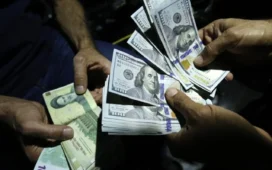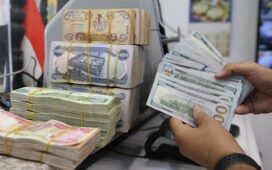
The U.S. dollar is the world’s primary reserve currency and the most widely used unit of account for trade, funding and cross-border financial transactions. However, its dominance is in question due to recent geopolitical shifts, making de-dollarization an increasingly salient issue for investors and corporates alike. Could the dollar be dethroned — and if so, what could replace it?
-
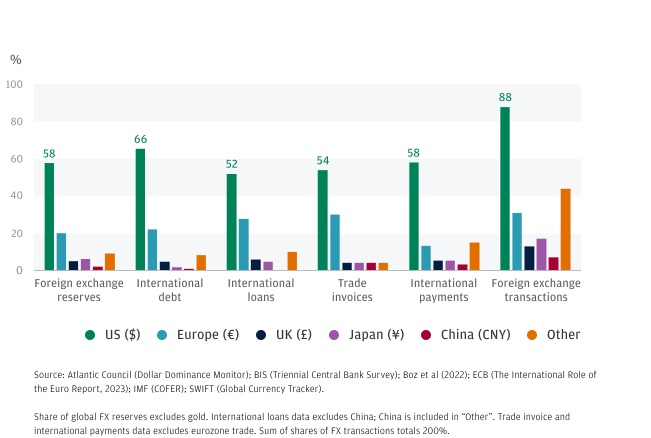
While the U.S.’s share of global trade has declined, the dollar’s transactional dominance is still evident in areas including FX volumes and trade invoicing.
-
While there are currently no scalable alternatives to the dollar, China is settling more trades in yuan, while BRICS nations are exploring a common currency to reduce their dependence on the dollar.
-
Currently, the dollar-centric system gives the U.S. significant geopolitical leverage beyond cheaper funding costs, including the ability to impose sanctions and control payment systems.
The U.S. dollar is the world’s primary reserve currency and the most widely used unit of account for trade, funding and cross-border financial transactions. However, its dominance is in question due to recent geopolitical shifts, making de-dollarization an increasingly salient issue for investors and corporates alike. Could the dollar be dethroned — and if so, what could replace it?
De-dollarization is a meaningful, sustained decline in the use of the dollar in global trade and financial transactions. It’s distinct from the cyclical performance of the greenback, which is shorter term and driven by factors including interest rate changes, risk sentiment and growth differentials.
“De-dollarization refers to changes in the structural demand for the dollar that would relate to its status as a reserve currency. This encompasses areas such as transactional dominance in FX volumes or commodities trade, denomination of liabilities and share in central bank FX reserves,” explained Luis Oganes, head of Global Macro Research at J.P. Morgan.
There are two main factors that could threaten the dollar’s status:
-
An erosion of confidence in the U.S.
These refer to events that undermine the perceived safety and stability of the dollar — and the U.S.’s standing as the world’s leading economic, political and military power. Increased domestic polarization could jeopardize U.S. governance, which underpins the dollar’s role as a global safe haven. -
The rise of credible alternatives
Positive developments outside the U.S. — economic and political reform in China, for example — could boost the credibility of competing currencies. “However, a candidate reserve currency must be perceived as safe and stable, and must provide a source of liquidity that is sufficient to meet growing global demand,” said Alexander Wise, who covers Long-Term Strategy at J.P. Morgan.
De-dollarization could shift the balance of power among countries, in turn reshaping the global economy and markets. The impact would be most acutely felt in the U.S., where American financial assets would likely underperform versus the rest of the world.
“For U.S. equities, outright and relative returns would be negatively impacted by divestment or reallocation away from U.S. markets and a severe loss in confidence. There would also likely be upward pressure on real yields due to the partial divestment of U.S. fixed income by investors, or the diversification or reduction of international reserve allocations,” Wise said.
The evidence for a structural shift away from the dollar remains limited. While the U.S.’s share of global trade has declined over the past three decades, the dollar’s transactional dominance is still evident in FX volumes, trade invoicing, international payments and international debt issuance.
Foreign central banks and governments are gradually moving away from U.S. Treasurys (USTs) in a bid to diversify their FX reserves. “The amount of USTs held in the Federal Reserve’s (Fed) custodial accounts for foreign officials has fallen to levels last seen in 2012,” said Joyce Chang, chair of Global Research at J.P. Morgan. Conversely, the share of gold in FX reserves has increased. The 2026 Central Bank Gold Reserves Survey from the World Gold Council notes that a record 45% of central banks expect their own gold reserves to increase over the next 12 months, while 74% see moderate or significantly lower U.S. dollar holdings within global reserves over the next five years.
On the other hand, U.S. dollar holdings in the private financial sector continue to rise faster than the decline in dollar holdings in FX reserves. For instance, there have been record dollar inflows into U.S. equities, driven by the relative outperformance of American stocks. “Plus, inflows into U.S. high-grade corporate bonds are running at three times that of last year’s pace,” Chang said.
“A wildly disproportionate share of global clearing runs through U.S.-linked infrastructure, so even transactions that appear wholly intra-European or between Europe and Latin America often transit the dollar system or associated swap lines.”
Joyce Chang
Chair of Global Research, J.P. Morgan
The dollar-centric system gives the U.S. significant geopolitical leverage beyond cheaper funding costs, including the ability to impose sanctions, shape access to key payment channels and obtain visibility into transactions between third countries that clear flows through U.S.-linked infrastructure. However, this is gradually eroding as more countries learn to route around sanctions and invest in domestic and alternative cross-border payment rails.
“A wildly disproportionate share of global clearing runs through U.S.-linked infrastructure, so even transactions that appear wholly intra-European or between Europe and Latin America often transit the dollar system or associated swap lines,” Chang explained.
In addition, local dollar shortages are usually addressed through emergency loans from the Fed to foreign central banks. “While officially presented as low-risk operations, they are loans extended in periods of systemic stress. The concern is that if political actors gain direct control over such tools, they could be used in a transactional or punitive way — for example, by denying liquidity to specific countries and triggering local crises,” Chang added.
For now, while there are currently no scalable alternatives to the dollar, the quest for payments autonomy is gaining traction, most notably in China. Already, the share of China’s goods trade settled in yuan rose to ~28% in 2025, up from ~12% in 2018. Elsewhere, BRICS (an international group of emerging market countries, including Brazil, Russia, India, China and South Africa) has floated the idea of a common currency for the bloc, which would reduce their dependence on the greenback.
All things considered, suggestions of the dollar’s demise are premature — at least for now. The greenback still anchors global reserves, payments, financing and FX trading, reinforced by the depth of U.S. capital markets and a lack of viable alternatives. However, future geopolitical developments could accelerate a move toward a more multipolar monetary system — one in which the dollar remains dominant, but other currencies play increasingly larger roles.