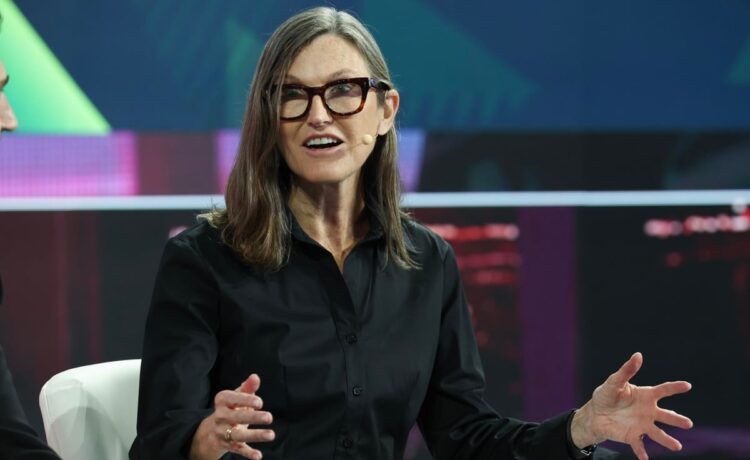
Ark Invest, Cathie Wood’s investment firm, has traded in and out of Tesla (TSLA -5.92%) stock for nearly a decade. It turns out, however, that the firm might have been better off never selling down its position.
In 2016, for example, Ark Invest acquired its first stake in Tesla at roughly $13 per share. In 2017, the firm purchased the stock every quarter at prices between $17 and $22 per share. In 2018, the buying continued through the first three quarters of the year at prices ranging from $20 to $22 per share.
In the fourth quarter of 2018, however, Ark Invest unloaded 5 million Tesla shares at roughly $21.50 per share, nearly cutting its stake in half. With Tesla stock now trading at nearly $400 per share, slashing its Tesla stake so early in the company’s growth journey was clearly a mistake.
Over the years that followed, Wood would authorize many additional acquisitions and dispositions of Tesla stock. Some of the trades paid off. Others were regrettable. Still, Wood clearly understood the electric vehicle (EV) company’s growth potential earlier than most investors or analysts.
Now, Wood is buying even more Tesla stock. After the company released its last quarterly report, Ark Invest plowed $50 million into Tesla stock, adding 160,000 shares to its holdings.
Wood remains exceptionally bullish on Tesla even at a $1.2 trillion market cap. Investors should be asking themselves why.

Today’s Change
(-5.92%) $-22.29
Current Price
$354.08
Key Data Points
Market Cap
Day’s Range
$351.32 – $364.69
52wk Range
$297.38 – $498.83
Volume
65M
Avg Vol
42.2M
Gross Margin
18.85%
Here’s why Cathie Wood remains a major Tesla bull
Tesla’s valuation today clearly does not hinge on the company’s ability to compete as an auto manufacturer. Tesla’s EV sales declined in both 2024 and 2025. Sales have stabilized thus far in 2026, but growth rates are still likely to be far lower than what the company achieved in years prior.
Despite struggling EV sales, Tesla stock still trades at 12 times sales. That’s a big premium to other EV stocks such as Rivian (RIVN -1.07%) and Lucid Group (LCID +1.74%), as well as traditional automakers including Ford (F +1.46%) and General Motors (GM +0.83%). That premium is largely tied to opportunities that, while related to EV manufacturing, have completely different economics. The biggest of those opportunities is the robotaxi market, which Cathie Wood predicts will grow into an industry worth as much as $10 trillion worldwide over the long term.
“We think $8 trillion to $10 trillion for the entire autonomous taxi opportunity throughout the world, from almost nothing,” is possible, Wood told investors last March. “That’s how quickly AI is going to cause these things to happen.”

Image source: Tesla
By 2030, Wood predicts Tesla will have a share price of $2,600, with its robotaxi business accounting for 90% of that value. In short, Wood’s investment thesis is heavily reliant not only on global robotaxi adoption, but also on Tesla’s ability to take a large share of that emerging pie.
It’s hard to argue that Tesla won’t compete aggressively in the robotaxi market. The company’s vertical integration is second to none. And on Sept. 3, the company announced a major Cybercab event that revealed that it would allow outside operators to purchase fleets of Cybercabs and operate them as robotaxi networks, with Tesla taking a cut of every ride. Tesla’s ability to control manufacturing costs should allow it to scale faster than the competition.
Whether the robotaxi market will grow as Wood expects it to is a completely different question. Many of the factors that will impact its trajectory are outside Tesla’s control, given that the expanding use of such self-driving vehicles will require many layers of regulatory approval and a significant degree of consumer acceptance. But the recent debut of the long-delayed Cybercab even proves that Wood’s long-term Tesla thesis remains intact, even if plenty of execution risk remains.