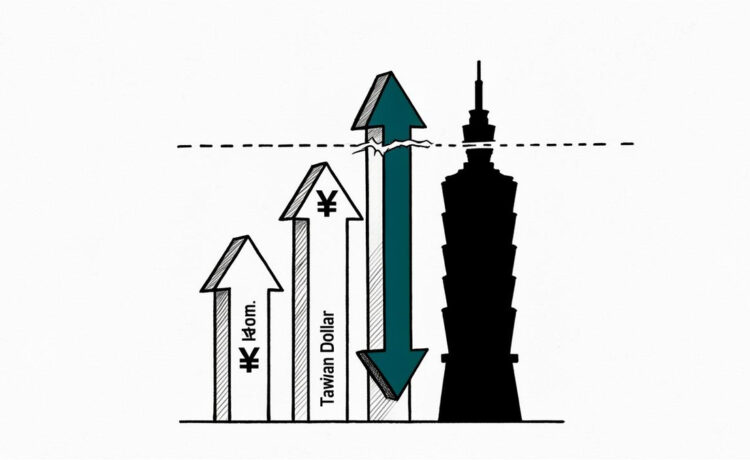
Asian currencies staged a rare collective appreciation on the 7th, with the Taiwan dollar touching an intraday high of 31.505 against the U.S. dollar before closing at 31.552, up 7.8 cents. The currency rose for a second consecutive session and posted its strongest close in more than three months. Financial expert You Tinghao noted that the surge in Asian currencies was driven by simultaneous official intervention from Japan and South Korea, with the Japanese yen and South Korean won leading the charge. Short-covering in the market amplified the move, pulling the Taiwan dollar, Thai baht, Singapore dollar, and other Asian currencies higher in tandem.
Speaking on his podcast on the 8th, You Tinghao explained that the yen had previously weakened past 163 per U.S. dollar, approaching a 40-year low. Japan’s Ministry of Finance responded by buying yen and selling euros to intervene, while the Bank of Korea also stepped in to support the won. Because the market had built up substantial short positions in Asian currencies, the official intervention triggered a wave of short-covering that further magnified the appreciation.
He noted that markets expect the Bank of Japan to raise rates again to 1.25%, narrowing the U.S.-Japan interest rate differential. Combined with the Federal Reserve’s lower probability of further hikes relative to Japan, this is creating a repatriation effect for Japanese capital. The yen has long served as a key pricing and funding currency for Asian FX markets; once it strengthens, the market follows by buying undervalued Asian currencies such as the won and Taiwan dollar, creating a chain reaction of appreciation.
Hedging Demand Rises as Dollar Selling Pressure Emerges
You Tinghao highlighted a key data point: pension funds and insurance institutions across six major markets—Japan, Canada, Taiwan, Australia, Denmark, and Finland—held an average foreign-currency asset hedging ratio of just 41% in the second quarter, the lowest in nearly a decade. These six markets collectively hold approximately $4.6 trillion in foreign-currency assets (approximately NT$144.8 trillion).
Investors previously avoided hedging because the dollar tended to appreciate during periods of volatility and hedging costs were high. But with the dollar down 2.5% this quarter and three-month yen hedging costs falling from 6% to 2.7%, some capital is now shifting toward higher hedging ratios, creating moderate selling pressure on the dollar.
South Korean Won Hits Two-Year High; Officials Watch Volatility Closely
The won has benefited from a rally in South Korean equities and sustained foreign capital inflows, briefly reaching its strongest level in nearly two years. However, You Tinghao cautioned that South Korean authorities are highly sensitive to the pace of appreciation, largely because leveraged ETFs inflicted heavy losses on investor confidence in May and June of this year. What officials truly care about is not the direction of appreciation or depreciation, but whether sharp short-term swings occur that could impact household livelihoods.
According to central bank data, as of 4 p.m. on the 7th, the U.S. dollar index was down 0.03%. Among major Asian currencies, the won rose 0.63%, the yen gained 0.48%, the Taiwan dollar advanced 0.25%, the Singapore dollar edged up 0.06%, and the Chinese yuan was flat.
Foreign exchange dealers said the Taiwan dollar has recently benefited from capital inflows driven by the equity market rally, returning to an appreciation trend. Foreign investors bought a net NT$88.308 billion (approximately $2.8 billion) worth of Taiwanese stocks on the day—the fourth-largest single-day net buying on record—clearly boosting capital inflow momentum. The Taiwan dollar is expected to maintain a mild appreciation bias in the near term, with a chance to test the 31.5 level again.
Japan’s Intervention Scale Sets New Record
Data from Japan’s Ministry of Finance showed that foreign exchange reserves stood at $1.207 trillion at the end of August, down sharply from $1.287 trillion at the end of July. The 6.18% month-over-month decline in August exceeded the previous record of 5.58% set in May, marking the largest single-month drop since records began in 2000.
The ministry did not publicly explain the decline. Media reports citing anonymous ministry officials indicated that the reserve drawdown stemmed from two factors: foreign exchange intervention to support the yen, and valuation losses on foreign government bond holdings as global bond yields rose. Sovereign bond yields across multiple countries have climbed to multi-year highs, with German, U.K., and U.S. Treasury yields rising in tandem.
Japan has conducted multiple rounds of yen-supporting intervention in recent months: ¥11.7 trillion (approximately $76.3 billion) in yen purchases between April and May. When the yen fell to around 164 per dollar in late July—a 40-year low—it triggered an even larger intervention round, with the United States simultaneously selling euros to support the yen in a coordinated effort. Ministry of Finance data shows cumulative intervention this year has reached ¥27.1 trillion (approximately $176.7 billion), shattering the previous annual record of ¥20.4 trillion (approximately $133.0 billion) set in 2003.
Carry Trade Scale Reaches 30-Year High
With the yen strengthening rapidly, markets are again concerned that so-called carry trades could face violent unwinding, potentially replaying the market turmoil that followed the Bank of Japan’s rate hike in the summer of 2024. Outstanding cross-border yen borrowing has grown from ¥216 trillion (approximately $1.4 trillion) in December 2021 to ¥360 trillion (approximately $2.3 trillion) as of March this year. Analysts describe this cycle as the largest carry-trade buildup in the past three decades, meaning the Bank of Japan will likely proceed with caution to avoid financial instability risks.
Stefan Angrick, a researcher at Moody’s Analytics, said: “The market now clearly understands that the Bank of Japan will continue raising rates, and the yen has once again become a market focal point.” However, he also believes that market chatter about a one-time 50-basis-point hike represents excessive expectations. He noted that the Bank of Japan does not want to tighten too quickly or too aggressively and ultimately drag the economy into recession.
Taiwan’s Central Bank Meeting in Focus Next Week
You Tinghao noted that as multiple emerging-market central banks have now outpaced the Federal Reserve in their rate-hike cycles, this suggests some emerging economies are showing stronger growth momentum than the United States. He expects that the inflation and economic growth data facing Taiwan’s Central Bank at next week’s board meeting theoretically meet the threshold for a rate hike; if no hike materializes, it may involve other policy considerations.
He emphasized that this wave of Asian currency appreciation is closer to a short-term capital repatriation rather than a full-year trend reversal, and that subsequent developments will depend on central bank actions across the region and the dollar’s trajectory. The yen’s near-term direction will hinge largely on U.S. inflation data due this week and how markets interpret new signals from both central banks.
Taiwan’s stock market surged 775.14 points on the 7th to close at 47,326.27, with all three major institutional investor categories posting net buying totaling NT$113.865 billion (approximately $3.6 billion). Foreign investors extended their net buying from the previous week, with the day’s net purchases expanding to NT$88.308 billion (approximately $2.8 billion)—the fourth-largest single-day net buying on record. Asian financial markets interpreted the data as evidence that U.S. economic fundamentals remain resilient, supporting continued AI demand and driving broad gains in Asian tech stocks. In addition to Taiwan’s rally, Japanese and South Korean equity markets also advanced, while most major Asian currencies appreciated.