➡️ Did someone forward you this email? If you would like to receive this information directly, every morning before the markets open in New York, sign up here.
ONE BIG THING
New Apple CEO John Ternus will launch Apple’s first foldable phone today
Apple today will host one of its most exciting events in recent memory when it is expected to unveil its first foldable phone at the Steve Jobs theater on Apple’s campus.
It’s also Apple’s first big event led by new CEO John Ternus. And with questions growing over Apple’s business momentum, its AI strategy, and challenges such as the industry’s memory chip shortage, it’s safe to say that this will be one of Apple’s most closely watched product launches in years.
“Everyone, whether you’re the kid at home saving their money for a new iPhone, or an analyst on Wall Street, will pay close attention to everything that Ternus says and does,” Michael Gartenberg, an analyst and former Apple marketing employee, told Fortune.
And while the expected $2,000-plus price of Apple’s foldable is likely to limit the potential buyers, the price will be comparable to competing products such as Samsung’s Galaxy Z Fold8 phone, which starts at $1,899.99, and the upgraded Galaxy Z Fold8 Ultra, which begins at $2,099.99.
Betting against Apple is a fool’s errand—here are the numbers that prove it
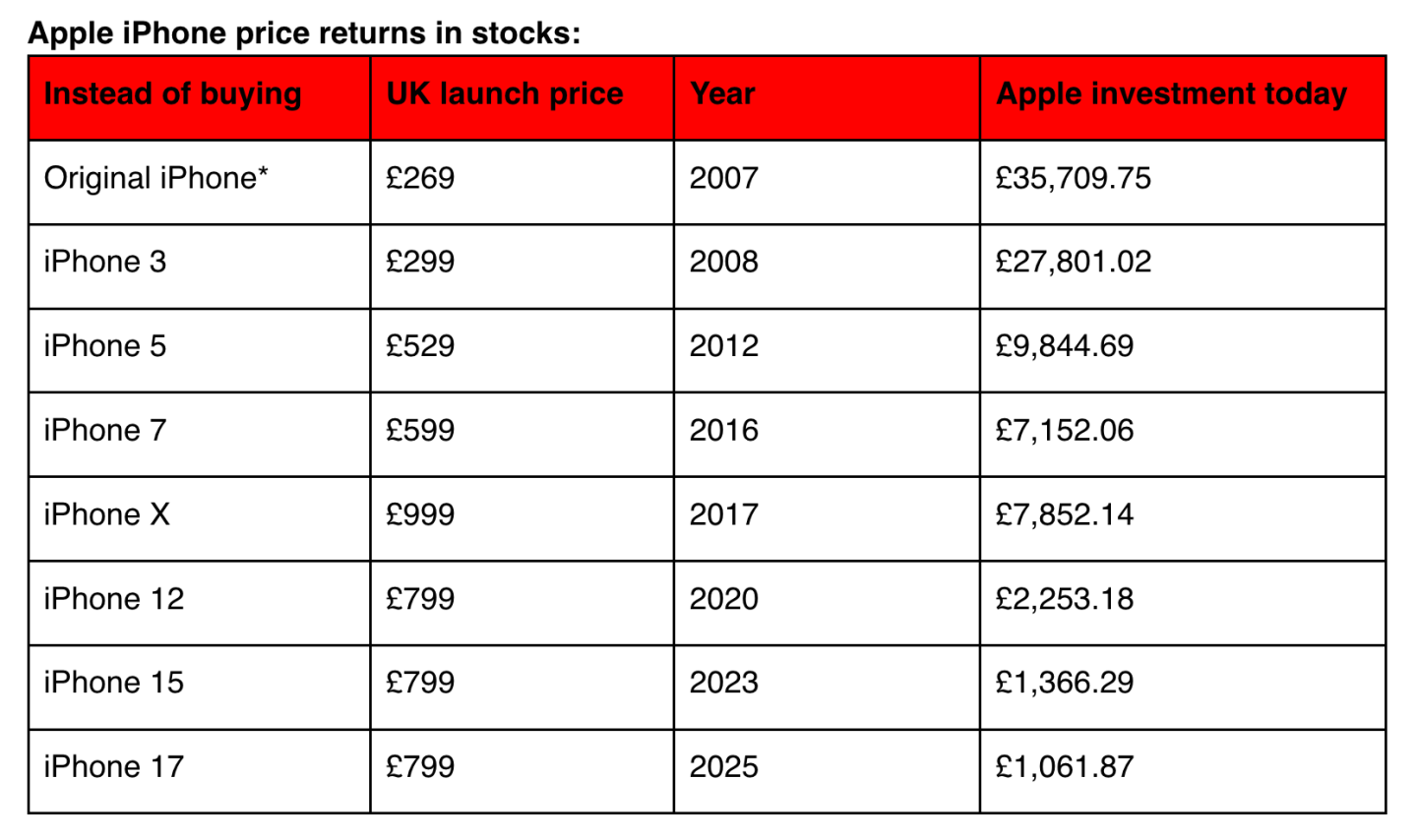
Apple stock tends to rise before a launch event and then decline immediately afterwards as traders lock in gains from the news, according to Chris Beauchamp, chief market analyst at IG. But over the long run, anyone who bought Apple stock at the time of any iPhone launch and held it would have done very well indeed. This chart from Beauchamp shows how rich you would be today if you had invested the price of an iPhone in shares of the company instead:
MORE FROM FORTUNE
Who Really Controls the Future of AI? | Fortune Daily
There are fewer than 4,000 billionaires worldwide, and they now hold a record $15.1 trillion. That’s nearly half of the U.S. economy – Catherina Gioino
AGI is here, Nvidia CEO Jensen Huang has declared. Here’s why the market doesn’t care – Eva Roytburg
Macau wants to be a ‘business city,’ not just a gaming hub—and it’s spending $16 billion to help it get there – Nicholas Gordon
Peru’s monetary system would not work in Venezuela – Steve H. Hanke and Emilio Ocampo
The pumpkin spice era is changing—if not over, as McDonald’s replaces the flavor for the first time in a decade – Marco Quiroz-Gutierrez
THE MARKETS
Oil rises above $100 per barrel as Iran ratchets up the pain
Aaaaand we’re back. Back above $100 for a barrel of Brent crude oil. The price hasn’t been this high since a brief period in July, and before that, for an extended period in April and May when the market was trying to figure out just how bad the war with Iran would be for fossil fuel supplies.
It’s increasingly clear that the siege of the Strait of Hormuz won’t end anytime soon. Iran today claimed it struck two U.S. vessels and eight oil tankers, plus 10 other “violating ships” in the Strait, Al Jazeera reported. It also captured an unmanned submarine drone made by Anduril, according to Reuters.
Those attacks were reprisals for the sinking of five tankers by U.S. forces in the Gulf region.
Bottom line: Iran is increasingly confident and intends to escalate action in the Gulf—hence the rise in the price of oil. Mohammed Bagher Ghalibaf, the speaker of Iran’s Parliament, told fellow lawmakers that “from now on, any aggression against Iran’s interests and security will be met with a response that is faster, heavier, and more painful,” according to the NYT.
- With that context, it’s no surprise that stocks are largely down in Europe and Asia this morning and U.S. futures are flat after a down session yesterday.
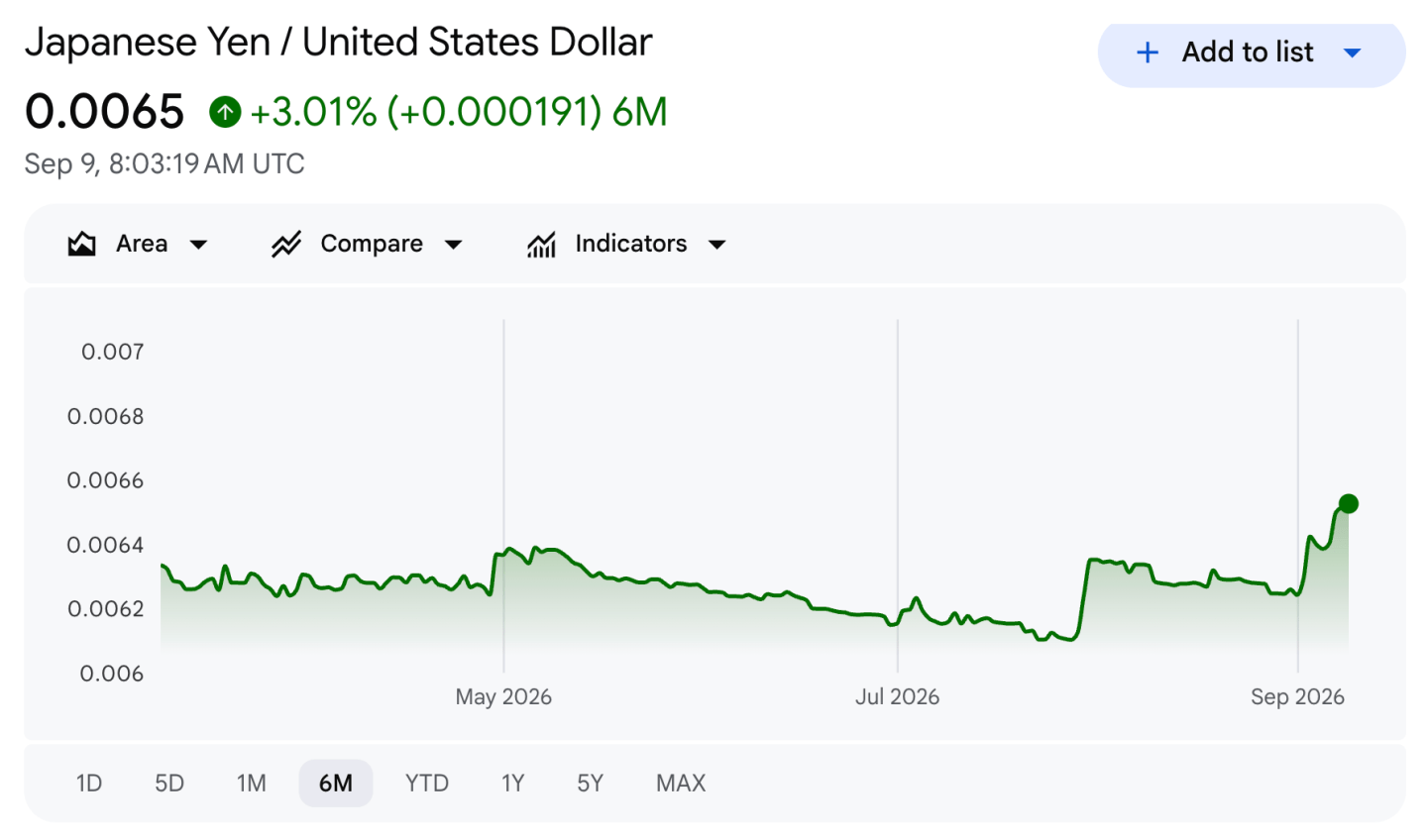
Bessent on the yen trade: ‘I am the house now’
U.S. Treasury Secretary Scott Bessent dared the currency and bond markets to bet against U.S. Treasuries yesterday in a speech in which he declared: “I am the house now.” His remarks came after the U.S. made an unscheduled sale of euros to buy Japanese yen, a move widely interpreted as helping the Japanese government avoid selling its U.S. bonds to prop up its moribund currency. Following that, Bessent announced a doubling of its periodic bond buybacks in an attempt to raise prices and reduce yields on longer-dated bonds. In remarks at Southern Methodist University in Texas on Tuesday, he doubled down on the Treasury’s activism:
“When we intervene with the Japanese yen, I have pretty good insight into what the Bank of Japan is going to do, what Japanese policymakers are going to do,” he said, according to the FT. “I have asymmetric information. I am the house now,” Bessent said. “You can bet against me if you want.”
- S&P 500 futures were up 0.02% this morning. The index sank 0.58% yesterday.
- In Europe, the Stoxx 600 was down 0.79% in early trading and the U.K.’s FTSE 100 was down 0.38% before lunch.
- Asia: South Korea’s KOSPI was up 1.4%. Japan’s Nikkei 225 was down 0.19%. India’s Nifty 50 was down 0.46%. China’s CSI 300 was down 0.3%.
- Brent crude was $100 per barrel this morning.
- Bitcoin was at $79,697.
THE FUTURE
GM CEO Mary Barra: ‘EVs are the endgame’
Consumer adoption has slowed, the rollout of the charging infrastructure may have taken longer than expected, and the Trump administration reversed policies designed to accelerate the transition, but GM CEO Mary Barra is unfazed. “I don’t think it’s shifted our mission,” she told Fortune’s Alyson Shontell. “We still think EVs are the end game.”
YIKES
More evidence that AI is reducing the number of jobs available
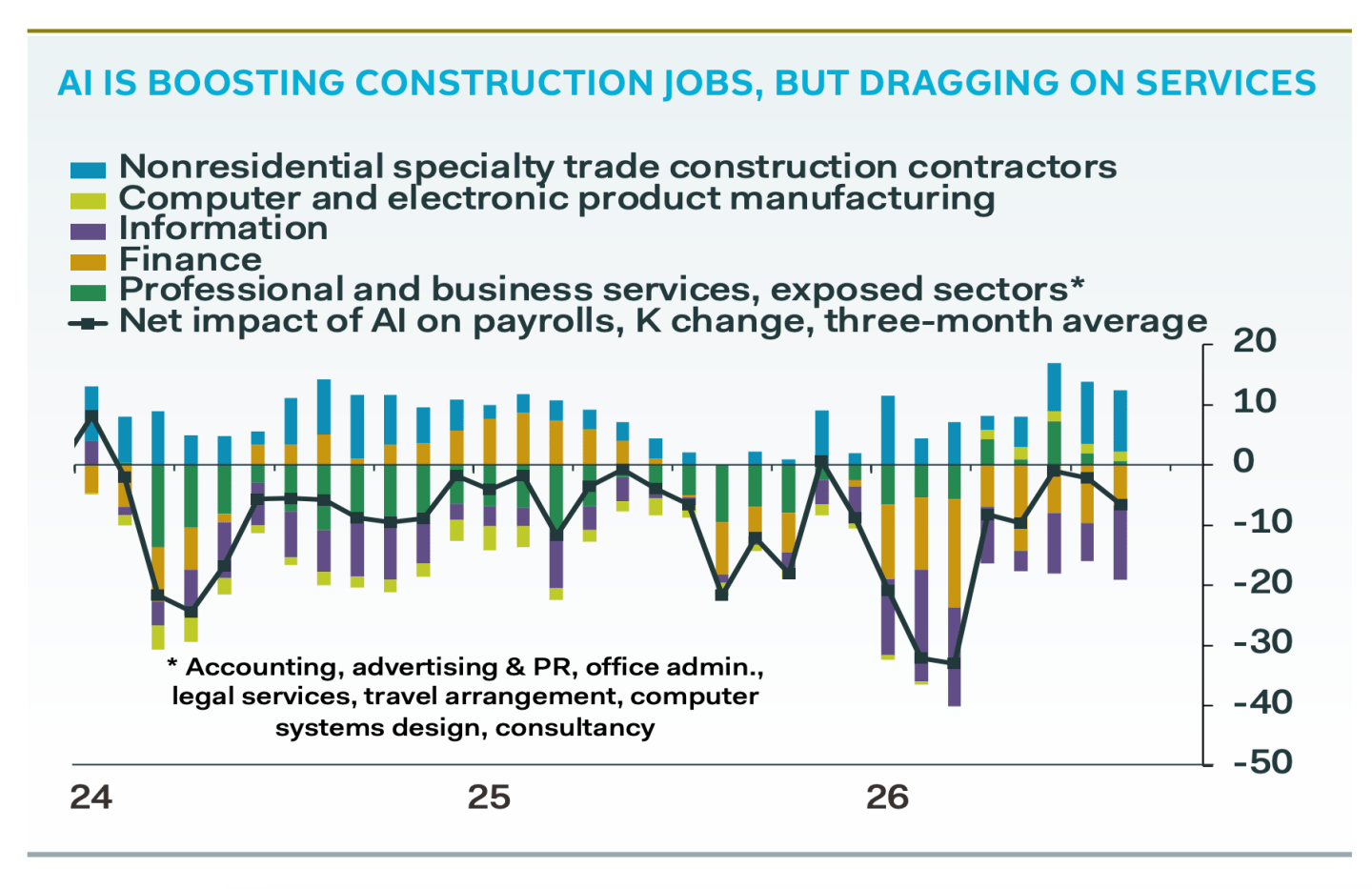
The very good U.S. jobs number for August—162,000 jobs added—is hiding an uncomfortable truth, according to Samuel Tombs of Pantheon Macroeconomics: “AI looks like a minor net drag on payrolls overall,” he says. This chart shows jobs affected by AI broken out by career type. While construction (data centers) and tech product-making jobs are on the rise, all other roles related to tech—information, finance, professional and business services—are in decline. “AI likely is contributing to services firms’ diminished appetite for hiring new staff,” he said in a note.
MAKING DOUGH
Bank of America calls out the oddly competitive $40 billion sandwich business
Americans eat $40 billion worth of sandwiches every year, but it’s a wide-open market, and that’s why Sara Senatore and her team at Bank of America have a “buy” rating on Jersey Mike’s, the sandwich chain that went public at the end of July. Perhaps surprisingly, the sandwich category is not dominated by any single brand or chain, and that means Jersey Mike’s could easily capture share as it expands, Senatore argues.
Subway is the biggest sandwich chain, of course, but it captures only 22% of sandwich sales. Sandwiches have the lowest level of brand dominance of all the different fast-food categories. The most dominant chain in its category is Panda Express, which owns 65% of Asian food sales among limited-service restaurants.
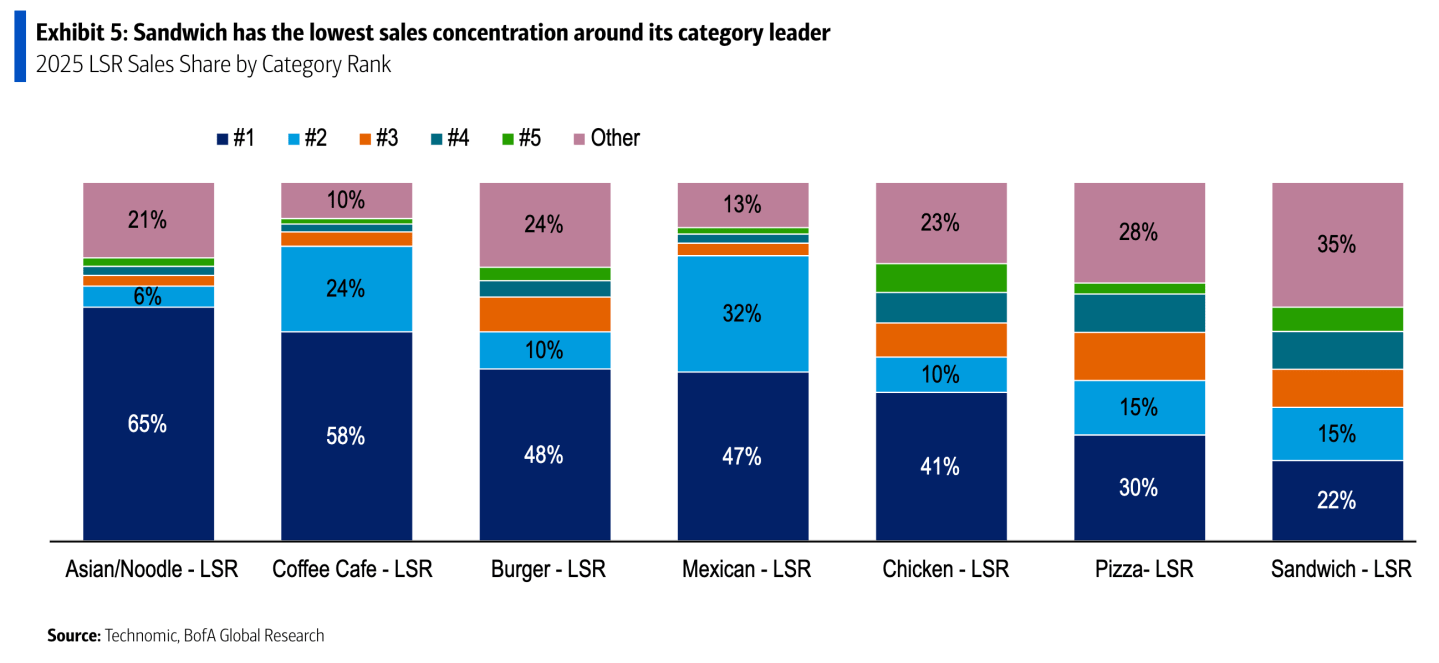
CHART OF THE DAY
The internet’s Achilles’ heel: undersea ‘chokepoints’
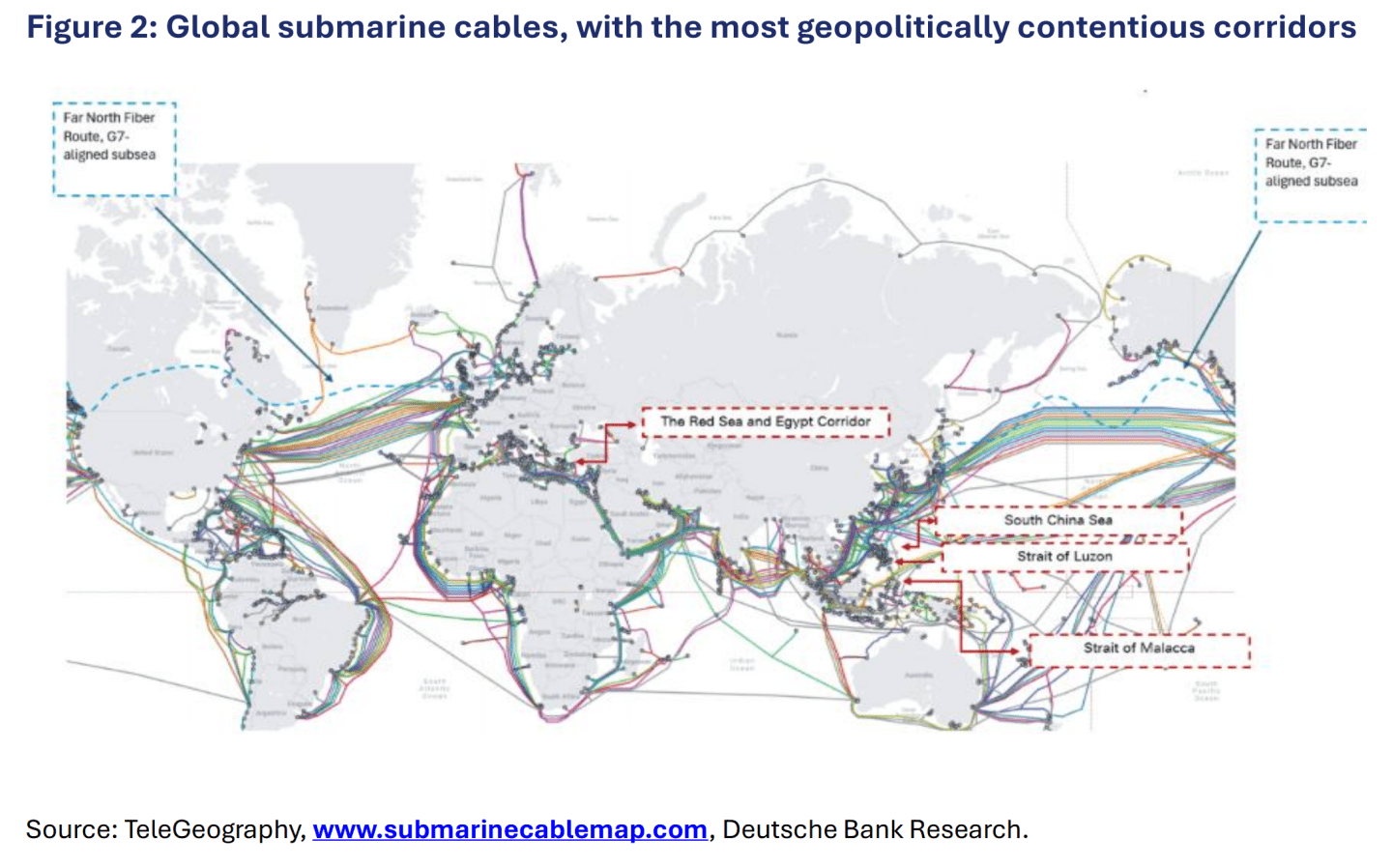
The Iran war has heightened sensitivity to global “chokepoints”—geographic areas that function as unavoidable bottlenecks on the economy. This map shows undersea internet cables, of the type monitored by Russia’s submarine fleet. Each cable can carry 375 million simultaneous telephone conversations, and “$10 trillion worth of financial transactions travel through these subsea cables every day,” according to Deutsche Bank’s Marion Laboure and Camilla Siazon.
Worryingly, “a typical cable disruption often triggers an immediate 2ppt decline in GDP [per] capita growth for an economy,” they said in a note.
NUMBER OF THE DAY: LinkedIn time travelers
19.7%
A new working paper has found that one in five American LinkedIn users goes back and edits either their job title or description for roles after they’ve already left them.
The authors, Nicholas Bloom, Gideon Moore, Lisa K. Simon and Caelan Wilkie-Rogers define these individuals as “time travelers” because they retrospectively edit their career paths. The report suggests that the changes LinkedIn users make often add or highlight skills which are increasingly demanded in the labor market. In 2026, that might be artificial intelligence proficiency, for example.
Using data from Revelio Labs, the report finds that ‘time travel’ has been most common since 2020 among those in the technology and information sector (where nearly one in three have edited their career history), followed by arts, entertainment and recreation.
THE FRONT PAGES TODAY
Elon Musk documentary hits Venice Film Festival with cold dose of reality – FT
U.S. reveals import ban on slew of Canadian goods as trade war escalates – CNBC
Historic NYT v. OpenAI copyright battle heats up – Axios
Trump Gifted Natalie Harp, Two Other Aides $45,000 Each Last Christmas – WSJ
Google to Invest €13 Billion in AI Infrastructure in Finland – Bloomberg
ONE MORE THING
Drought is forcing bears into cars
Patrick Sullivan was sure it was a “crazy neighbor” honking a car horn nonstop while Sullivan was up feeding his infant son at 3 a.m. one night this summer. It was a neighbor all right, but not a human one. A black bear had opened the door of a Toyota SUV and gotten trapped inside the vehicle in Gold Hill, Colo., northwest of Denver.
In one of hundreds of examples of bears getting into more trouble than usual in the parched Rocky Mountains this summer, the animal kept bumping the horn as it ripped apart the Toyota’s interior, desperately trying to escape. “It’s totaled. It’s unfit to drive,” Sullivan told the AP.
Across the Rockies, a widespread drought has reduced supplies of nuts, berries and plants that bears eat. That’s prompting the animals to roam far and wide for food.
Sullivan’s brother-in-law eventually freed the bear trapped in the Toyota. But one bear stuck in a car in Colorado Springs died from the heat. Wildlife officials have killed dozens of others, as record numbers of hungry bears have lost their natural hesitancy to raid homes, cars and campgrounds.