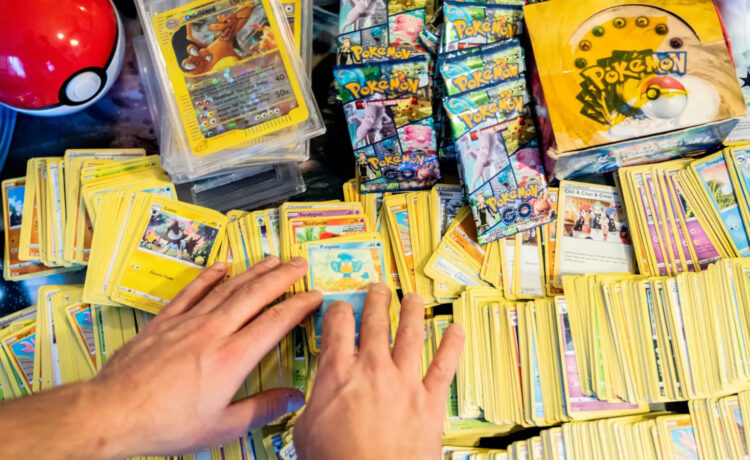
Most investors keep their thesis in a spreadsheet. Peter Levin keeps his in plastic slabs. The Griffin Gaming Partners founder — who previously co-founded Nerdist Industries and manages around $1.5 billion in gaming-focused capital — owns more than 500,000 video games-adjacent trading cards and believes the hobby has crossed into something closer to a genuine asset class. His proof of concept: a roughly $50 billion annual market, a collectibles ecosystem north of $300 billion, and a single Pikachu card that sold for $16.5 million. That last number is less absurd once you understand the infrastructure behind it.
From Ice Cream Trucks to Auction Houses
How a childhood hobby quietly acquired the bones of a financial market.
The numbers aren’t subtle. In February 2026, Logan Paul sold a Pikachu Illustrator card at Goldin Auctions for $16.5 million — up from the roughly $5.3 million he paid in 2021. Magic: The Gathering’s one-of-one “One Ring” card from its Lord of the Rings set fetched around $2 million in 2023. The Cyberpunk TCG raised $28 million on Kickstarter, landing as the platform’s fourth most-funded campaign ever.
Grading firms PSA, CGC, and TAG now assign standardized 1–10 scores — TAG using AI and machine learning to reduce human bias — turning sentimental cardboard into tradeable, mark-to-market assets sealed in UV-resistant plastic slabs. That infrastructure is what separates the current era from pure nostalgia. Once grading created price transparency, cards stopped behaving like memorabilia and started behaving like standardized assets with discoverable market values.
“I’m absolutely convinced that if the world suffered an apocalypse tomorrow, the following day the global currency would be Pokémon cards.” — Peter Levin, Griffin Gaming Partners
IP expansion accelerated everything. Pokémon built the template; the rest of the market followed. One Piece TCG is moving, per Levin, on “a faster growth trajectory than any card game in history, including Pokémon” — his claim, not an independently verified metric, though it gained anecdotal weight when a Monkey D. Luffy promotional card at a Dodgers game during Anime Expo reportedly drew lines out of Dodger Stadium that had little to do with baseball. Magic: The Gathering has cross-pollinated with Final Fantasy, God of War, Fortnite, and Lord of the Rings. Disney Lorcana rare cards already trade in the tens of thousands of dollars.
The Bull Case and the Bubble Risk
Nostalgia plus disposable income is a powerful demand engine — until supply discipline breaks down.
Adults now represent nearly 30% of global toy sales, with spending up roughly 18% in 2025. Millennials and Gen Z who grew up ripping packs now have salaries and a taste for tangible assets that carry childhood weight. That demand engine is real, and independent market analysts tracking the broader collectibles space broadly support the scale Levin describes.
The cautionary tale, though, is baked into the hobby’s own history. The 1990s sports card market collapsed because publishers overprinted and oversaturated — a dynamic documented in Pete Williams’ Card Sharks. Levin’s counter is that the industry “learned from its mistakes.” Supply discipline is easier to promise than enforce, and the tension between accessibility and scarcity remains unresolved.
“The odds of you pulling a rare and valuable card are no less or greater than my odds.” — Peter Levin
Levin claims Pokémon cards have beaten the S&P 500 by 3,000% — verified as his statement, not a finding from a replicable public index. Survivorship bias haunts every collectibles return story; only the winning sets get cited. For everyday collectors and retail investors, that distinction matters: the market that looks like a blue-chip from the outside can behave like a speculative asset on the inside. Whether trading cards have genuinely matured into a durable alternative asset class or are running on structured nostalgia is a question the next correction will answer more honestly than any auction record. Still, 500,000 cards and roughly $1.5 billion under management suggest Levin isn’t just making conversation. If you’re entering the hobby as an investment, it’s worth understanding what you might be paying too much for without realizing it.