Updated Dec. 2, 2025, 6:24 p.m. ET
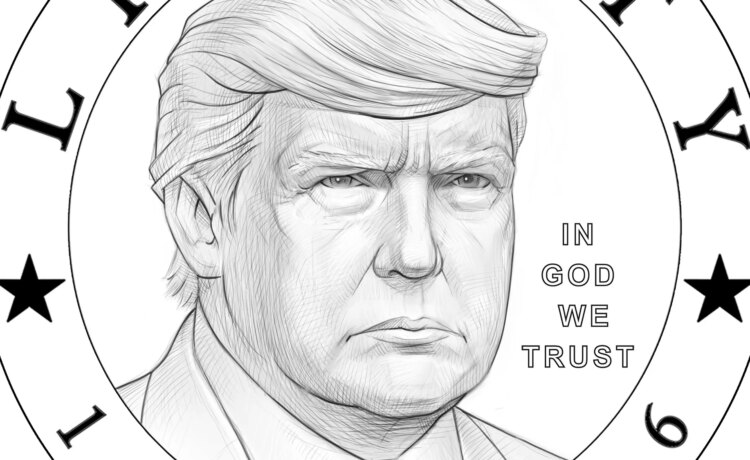
Nevada Sen. Catherine Cortez Masto is among a group of senators urging Treasury Secretary Scott Bessent to reject designs for a $1 coin celebrating America’s 250th birthday and featuring the face of President Donald Trump.
Apart from the three designs featuring President Trump, there are no other commemorative coins planned for the United States’ 250th anniversary.
The senators, all Democrats, cite the U.S. Mint’s centuries-long practice of not putting images of living persons on American coinage.
Joining Cortez Masto in a letter to Bessent were Lisa Blunt Rochester (D-Delaware), Ruben Gallego (D-Arizona), Mazie Hirono (D-Hawaii), Andy Kim (D-New Jersey), Jack Reed (D-Rhode Island), Adam Schiff (D-California) and Ron Wyden (D-Oregon).
“American lawmakers throughout history have reaffirmed the time-honored tradition of not circulating U.S. currency with images of currently elected officials,” the senators wrote. “For centuries, minting sitting presidents on U.S. currency has been avoided to prevent the appearance that the U.S. is a monarchy or subject to a cult of personality.”
A federal law passed in 1866 prevents the use of living people on paper U.S. currency, and a 1955 revision to 31 U.S. Code 5114 allows for “only the portrait of a deceased individual” on all U.S. currency and securities.

Early designs featured Trump on front, back of coin

The latest set of design proposals include three options for the front of the coin with images of Trump.
For the reverse side, variations include the Great Seal of the United States and eagles in various poses.
That’s a change from the original design released in October, which included Trump in profile on the front, and another head-and-torso image of Trump with his fist raised, a nod to his pose after an assassination attempt on July 13, 2024.
During Trump’s first administration, Congress passed the Circulating Collectible Coin Redesign Act of 2020 that authorized the Department of the Treasury to issue commemorative coins beginning January 1, 2026, “with up to five different designs emblematic of the U.S. semiquincentennial.”
Cortez Masto: ‘you must reject it’
The proposed coins would be created under the Circulating Collectible Coin Redesign Act of 2020 to recognize America’s 250th anniversary, or semiquincentennial.
In addition to 31 U.S. Code 5114, the senators’ letter cites requirements in the Circulating Collectible Coin Redesign Act itself as justification for the coin’s rejection.
“The law clearly requires that the designs selected by you following your consultation with the U.S. Commission of Fine Arts and the CCAC be ’emblematic of the United States semiquincentennial, including at least one quarter dollar design emblematic of a woman’s or women’s contribution to the birth of the Nation or the Declaration of Independence or any other monumental moments in American History,'” the letter reads.
“It also requires that your design selections be made ‘in consultation with the United States Semiquincentennial Commission and with recommendations from the general public.’ As the coin design featuring President Trump does not satisfy those requirements, you must reject it.”
Which living presidents have been featured on a U.S. coin?
At least two presidents have been featured on commemorative currency, both before the 1955 law preventing living persons on currency.
President Calvin Coolidge was the sitting president when he appeared on a coin in 1926. His face in profile appeared alongside George Washington’s on the front of a coin commemorating the 150th anniversary of the Declaration of Independence.
Coolidge served as president from 1923 to 1929.
The coins were sold for $1 each, but had a face value of 50 cents; proceeds helped finance the nation’s Sesquicentennial Exposition in Philadelphia. One million of the half-dollar coins were minted, according to the American Numismatic Association, but there was little interest from collectors. The vast majority — 859,408 — were returned to the Mint and melted.
President Franklin D. Roosevelt also appeared on a U.S. coin, but with a bit of an asterisk. In 1936, when the Philippines were still under control of the United States, FDR appeared on a one-peso commemorative coin in profile alongside Manuel L. Quezon, who served as second president of the Philippines.
Roosevelt was in office from 1933 until his death in April 1945. The Philippines gained full independence from the United States in 1946.
What other people have been featured on American currency?
The most common coins in U.S. circulation feature U.S. presidents on the front, all of whom were honored after their deaths:
- Abraham Lincoln, penny, since 1909
- Thomas Jefferson, nickel, since 1938
- Franklin D. Roosevelt, dime, since 1946
- George Washington, quarter, since 1932
Additionally, all deceased U.S. presidents (with the exception of recently deceased Jimmy Carter) are on $1 coins.
Other honorees on coins in circulation include:
- Maya Angelou, quarter (reverse side); poet and civil rights activist (in circulation since 2022)
- Susan B. Anthony, dollar; suffragist and women’s rights activist (since 1979)
- Jean Baptiste Charbonneau, dollar; explorer and son of Sacagawea (since 2000)
- William Clark, quarter (reverse side); explorer of the Louisiana Purchase (since 2003)
- Bessie Coleman, quarter (reverse side); African American aviation pioneer (since 2023)
- Celia Cruz, quarter (reverse side); singer and actress (since 2024)
- Duke Ellington, quarter (reverse side); jazz composer and musician (since 2009)
- Benjamin Franklin, 50-cent piece; Founding Father (in circulation from 1948 to 1963)
- Ge. Edward Hand, quarter (reverse side); Continental Army officer (since 1999)
- Jovita Idar, quarter (reverse side); journalist, political activist and civil rights worker (since 2023)
- Kamehameha I, quarter (reverse side); King of Hawaii (since 2008)
- Edith Kanaka’ole, quarter (reverse side); dancer, teacher and master hula instructor (since 2023)
- Helen Keller, quarter (reverse side); deaf-blind activist and author (since 2003)
- Meriwether Lewis, quarter (reverse side); explorer of the Louisiana Purchase (since 2003)
- Patsy Mink, quarter (reverse side); politician and women’s rights activist (since 2024)
- John Muir, quarter (reverse side); preservationist (since 2005)
- Pauli Murray, quarter (reverse side); civil rights activist (since 2024)
- Nina Otero-Warren, quarter (reverse side); suffragist and politician (since 2022)
- Caesar Rodney, quarter (reverse side); signer of Declaration of Independence (since 1999)
- Eleanor Roosevelt, quarter (reverse side); First Lady, human rights activist (since 2023)
- Sacagawea, dollar; explorer, guide during exploration of Louisiana Purchase (since 2000)
- Sally Ride, quarter (reverse side); astronaut (since 2022)
- Maria Tallchief, quarter (reverse side); Native American ballerina (since 2023)
- Prince Whipple, quarter (reverse side); former enslaved person and Continental Army soldier (since 1999)
- Wilma Mankiller, quarter (reverse side); Cherokee activist and leader (since 2022)
- Orville and Wilbur Wright, quarter (reverse side); aviation pioneers
- Mary Edwards Walker, quarter (reverse side); first woman U.S. Army surgeon, Medal of Honor recipient (since 2024)
- Anna May Wong, quarter (reverse side); first Chinese American movie star (since 2002)
- York, quarter (reverse side); enslaved person and explorer of the Louisiana Purchase (since 2003)
- Zitkala-Ša, quarter (reverse side); Dakota writer, musician and political activist (since 2024)
With USA TODAY reporting.