The vulnerability of women in countries post-disaster is heightened if they do not have the necessary resources to survive.
A senior representative of United Nations Women (UN Women) has cautioned that the devastation left behind by Hurricane Melissa — including the widespread loss of women’s livelihoods — can create an environment of sexual exploitation and the exchange of sex for money and necessities.
Isiuwa Iyahen, deputy representative and head of office ad interim for UN Women Multi-Country Office (MCO) for the Caribbean, explained that the sudden collapse of income for women heightens their vulnerability, especially in communities where recovery is slow. With limited access to food, water, transportation, and shelter, she said, power imbalances deepen, making women and girls more susceptible to coercion or abuse.
“We see this globally, and this is one of the reasons why we are also in collaboration with UNICEF [United Nations Children’s Fund] and are really intent on getting money into the hands of women [with] cash transfers, because we are in a situation where people are desperate.
“Everyone is desperate. Men are desperate, women are desperate, everybody is desperate, but because of their disproportionate care needs, and also because they are more vulnerable to sexual violence, we have seen situations where women will then make difficult choices if they don’t have access to money or to shelter and a livelihood,” Iyahen told the Jamaica Observer in an interview last week.
“[Women] need money to be able to take care of themselves, their children, their family members, and if they’re taking care of elderly parents. If they’re in a situation where unscrupulous persons may decide to take advantage of that and trade or provide them with money in exchange for, unfortunately, sex, these are the kinds of situations that unfortunately can occur,” she explained.
Iyahen noted that, while there have not been any reports of such incidents in Jamaica, the destruction in western parishes creates an environment where these instances can occur and go unreported.
“As a United Nations system, and as UN Women, we have to support the Government of Jamaica and work in collaboration with other partners to prevent transactional sex and other forms of sexual exploitation and abuse from occurring,” she stressed.
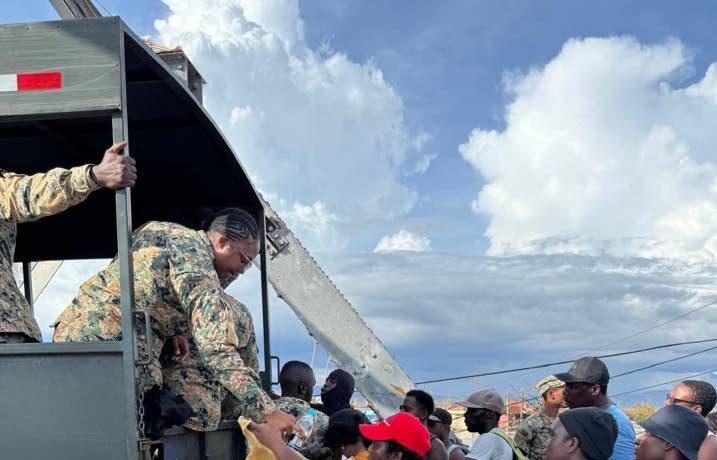
Iyahen said UN Women is training front-line service providers, such as the Jamaica Defence Force (JDF), on how to spot signs of these activities and respond. She shared that the training sessions sensitise front-line service providers about sexual exploitation, provide information on key principles to uphold, and how to ensure issues such as power imbalances do not occur.
She said while initial reports of rape in shelters in Jamaica have been investigated by the Jamaica Constabulary Force and found to be false, that’s not to say because of the nature of these situations that it is not occurring.
“Research data evidence shows that most cases of gender-based violence tend to go unreported, and so this is why it is very important to send out messages as well to women and children in communities. Of course, men and boys do get exploited and they are victims of sexual abuse as well, but we know overwhelmingly, globally, that the majority of survivors of and victims of sexual exploitation and abuse and other forms of gender-based violence tend to be, unfortunately, women, girls, and children,” she told the Sunday Observer.
Iyahen said reports of gender-based violence have not yet reached UN Women, but they are working with the United Nations Population Fund (UNFPA) and the Bureau of Gender Affairs to strengthen organisations that support people experiencing gender-based violence.
Meanwhile, having received reports of women returning to abusive partners, fleeing communities, and citing the possibility of exchanging sex for favours to survive, Eve for Life Executive Director Joy Crawford said Jamaica could see an increase in births, intimate partner violence, and other social issues, if adequate resources are not supplied.
“A lot of our young women, based on their before Melissa life experience — they may have left school, they’re single moms, they may have two children, and they’re not fully solid…Prior to Melissa their life circumstances were already very limited in access, so now it’s heightened.
“…If someone has to sleep out under the elements, if you don’t know where your next meal is going to come from, you don’t know when you leave the shelter where you’re going to go, that comes with its own [challenges] so they are more likely to take anything that’s offered to them and that in itself is dangerous,” she told the Sunday Observer.
Crawford said, throughout its 17 years, Eve for Life has focused on the well-being of young women and girls in Jamaica, particularly those who are highly vulnerable or have experienced HIV, unplanned pregnancy, or gender-based violence. However, the recent displacement has left many of these women effectively nomadic and harder to reach, creating additional challenges — especially with limited access to telecommunication services.
According to Crawford, within her organisation alone, they have identified 45 to 50 families across western parishes that need support, including 120 children ranging from zero to 18 years old. She called on social agencies to be mediators and urged the Government to partner with local non-government organisations to reach vulnerable groups.
“I’m saying to the government agents — I’ve written to a few, I’ve not gotten any response — allow us to mediate for them. Give me the food so I can take it to them, give me mattresses so I can take it to them, because they are not going to be able to access it through the [care package delivery system]. Yes, create your system, you have your partners, you know who they are and there’s accountability, but you don’t want to leave anybody behind,” stressed Crawford.
She stated that she is concerned that if systems do not target vulnerable groups, they will get left behind.
“How do we ensure that the pregnant mother gets what she needs? That that woman with two or three children gets what she needs? That elderly woman who is not very mobile gets what she needs? How do we ensure that the women who have been beaten before Melissa are not still in the situation with men who are frustrated because they’ve lost their jobs, they’ve lost their homes, and that they’re managing their own emotional stuff, their own depression, their own aggression?
“How do we make sure that women, girls, and children who, before Melissa, were already in vulnerable situations survive this? Internationally, they tell you once there’s a crisis — if there’s war, if there’s famine, if there’s a natural disaster — ‘Look out for your women, look out for your children,’ simply because their risk for violence, the risk for abuse becomes heightened for this population,” Crawford insisted.
Speaking on the impact of disasters on sexual behaviour, sexologist Dr Sydney McGill told the Sunday Observer that research shows disasters often push people toward sexual activity as a form of emotional relief, making it critical to ensure access to contraceptives and the provision of targeted support for vulnerable groups who may face pressure or coercion into trading sex for favours as they struggle to cope and survive.
“Sex is not just only to reduce anxiety, but also at least you get lost in it for the few minutes that you’re involved, so it’s a distractor from the real hard issues that you might be dealing with, such as the loss of important belongings and property,” said McGill.
He also expressed concern that this heightened desire can lead to the exploitation of women through the exchange of sexual favours for survival, as well as serve as relief for women seeking to escape their reality.
“If I don’t have a roof over my head, if I don’t have food, if I’ve been laid off from work because of the devastation, I have very little. In fact, if I’ve been going from hand to mouth for a long time now, there’s nothing to go from hand to mouth, so I’m going to have to depend on persons who have a bit more than me.
“A lot of times, if it’s a young woman, she’ll find an older man who has assets and who can help her, but he wants some kind of payment in return. A lot of this is unwritten, it’s unsaid, but it’s implied, and so if I help you, then you’re going to have to help me.
“…It’s just what he considers to be fair trade, so, that is a concern I have, especially with young women who feel very vulnerable, who are unattached. By unattached, I mean don’t have a good family connection and relationships with family, and maybe have left home for a long time before they really were ready to leave home, but they just had to leave home to survive, and they’re on their own, trying to do their own little thing,” he told the Sunday Observer.
McGill further noted that while the exchange is often frowned upon, the “environment that we’re now in after the hurricane, these things, it’s currency. Sex becomes a currency”.
He added, too, that the devastation from the hurricane can open old, unhealed wounds that cause individuals to become sexually abusive.
The sexologist noted that with access to contraceptives limited in some areas, there is a need to include the items so that women and men can protect themselves against sexually transmitted diseases and pregnancies in consensual and non-consensual interactions. He further advocated for churches and families to step up and provide a haven for the most vulnerable.
The UNFPA, UNICEF, the Caribbean Technical Assistance and Education Centre for Health (C-TECH), DTR Foundation, University Hospital of the West Indies (UHWI), and the National Health Fund (NHF) are some agencies that have answered the call, distributing dignity kits in the hardest-hit areas and creating awareness about sexual reproduction in post-disaster environments, which they agreed often result in an upsurge in sexual and reproductive health challenges, and in particular gender-based violence.
The Eve for Life executive director said her team has also joined the mission, providing contraceptives on relief missions.
“One of the things that we must get past in our society is that we have to be able to see a glaring tragedy before we accept what the signs are. These things are scientific. It has been documented. We have seen the trends after the COVID[-19 pandemic], we have seen it after [Hurricane] Beryl locally, so to me, or us, to wait and say, ‘Oh, there’s not an increase in reports,’ or ‘The police have no evidence,’ we have to get past that. We [Eve for Life] already see where things are coming in,” said Crawford.
Domestic violence cases in Jamaica remain alarmingly high in the post-COVID era, with reporting rates increasing significantly since the pandemic. Before 2020, the Jamaica Constabulary Force recorded an average of 4,000 cases annually; this number nearly doubled in 2021 to roughly 8,000 reports, and remained high at 8,714 in 2022, and 8,500 in 2023.
Crawford stated that while she understands that the police cannot say there is an increase without reports, history has shown that disasters breed social issues, so it must at least be acknowledged that the incidents are possible.
“One of the things about reporting, long before Melissa, a lot of women do not report sexual violence because for all of these records they are going to be [asked], ‘Where’s the evidence?’ so when we have [a hurricane], when we know that this is a possibility and a strong possibility, we need to take steps to mitigate it. We don’t need to wait until it happens. Let’s get information out,” stressed Crawford.
“Let’s make sure that in the shelters, for example, we’re providing security. What is the lighting like? And being able to recognise how we place our bunks, who are the shelter [managers?] We just need to do things in communities. Right now, there are still a number of communities in western Jamaica that have no electricity, so some people have had to go back to work.
“When they leave work, by the time they get to their community, it’s dark. What kind of empathy, what kind of plan do we have? I do think that there are many things that we can do differently. If we acknowledge that women, girls, and children are at greater risk in the aftermath of something like Melissa, we must pay attention to what their needs are and what their nuances are,” she insisted.
Crawford urged the integration of local non-governmental organisations, civil society groups, and churches that already have a strong presence in communities and trusted relationships with residents, noting that people are more likely to confide in them.
“Let us help you take care of them, which means you have to identify us, you have to give us the resources, you have to give us the care packages, give us the tarpaulins, give us the cots so that we can go, or if you want to go, let us take you.
“You cannot walk into a community without people that feel safe with and believe that you are going to be able to serve them. It doesn’t work that way…These people are abused and have experienced trauma…so we need to respond. We need to have a response that is…trauma-informed and…a sense of psychological awareness in our response. It has to be sensitive, it has to be sensitive,” she stressed.

Domestic violence cases in Jamaica remain alarmingly high in the post-COVID era, with reporting rates increasing significantly since the pandemic.

MCGILL…if I’ve been going from hand to mouth for a long time now, there’s nothing to go from hand to mouth, so I’m going to have to depend on persons who have a bit more than me

IYAHEN…men are desperate, women are desperate, everybody is desperate