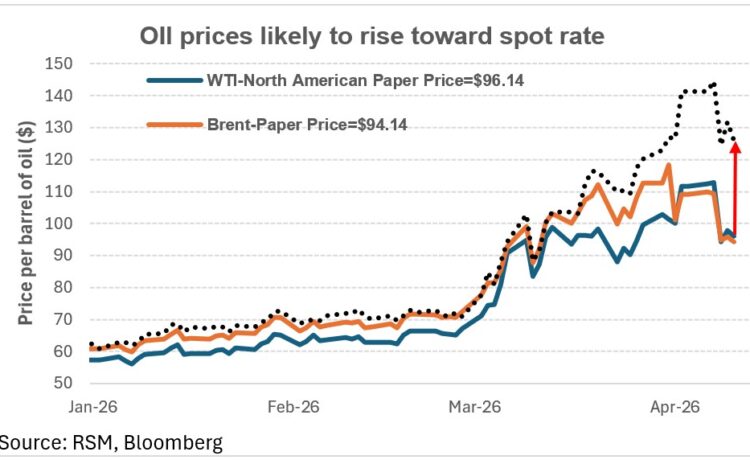
The failure of talks with Iran over the weekend will usher in a jump in oil prices when Asian markets open later on Sunday and will almost surely follow on as London and New York open on Monday.
The announcement of a naval blockade of shipping out of the Persian Gulf will only worsen the shortages of oil, natural gas, distillates, other liquids and refined products.
Get Joe Brusuelas’s Market Minute economic commentary every morning. Subscribe now.
One can imagine that consumer sentiment will deteriorate from its already low point, requiring efforts to mitigate the energy shock on the part of the state and national political authorities.
Before the breakdown of talks, roughly 10% of the world’s oil supply faced a constraint. That squeeze will tighten as markets increasingly rely on shipments out of the Red Sea.
Asian economies are most at risk. Europe within a week or two will also begin facing shortfalls of jet fuel and diesel.
The focus in the near term should be on:
- Energy prices: Oil, diesel, jet fuel and gasoline will all increase.
- The U.S. dollar: Safe haven moves will push up dollar’s value.
- Bond yields: Rising as investors price in the probability of stagflation.
- Inflation expectations: Rising as consumers brace for higher prices.
- Mitigation efforts: Governing authorities accelerate relief measures.
Dated Brent crude closed at $125.88 on Friday in London and will provide a target for the trading community, which will push up the paper price immediately.
The bid-ask spreads on Monday will most likely approach the recent high of $144.46.

Global stagflation will be the focus across the $30.6 trillion U.S. Treasury market within the context of a $107 trillion market for international government debt. That will send yields higher in the U.S., UK, Europe and Japan.
A safe haven move into the U.S. dollar and other dollar-denominated assets will most likely restart.

The key transmission mechanism between events in the Persian Gulf and global consumers will be gasoline and diesel prices.
Over the weekend, the price of gasoline in the U.S. dropped from $4.17 to $4.12 amid hope of a ceasefire. Those prices will increase again this week.

In the United States, Europe and Asia, expect governments to provide relief to beleaguered consumers on rising energy prices.
In the U.S., I expect state governments to begin providing gas tax holidays like those taken in Georgia and Indiana over the past month.

In Asia and Europe, as rationing of energy takes hold, stagflation will be part of a larger narrative of adjustment that will accelerate should the shipping of energy products out of the Persian Gulf come to an effective halt.