Unlock the Editor’s Digest for free
Roula Khalaf, Editor of the FT, selects her favourite stories in this weekly newsletter.
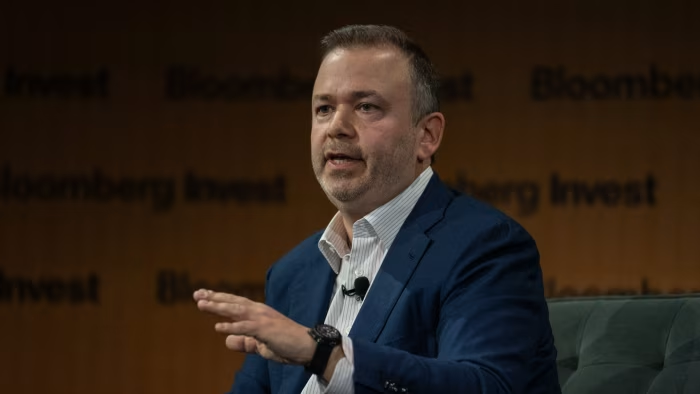
Nobody likes being rudely awoken. Ask any of the UK investment trusts whose cages were vigorously rattled by US activist Boaz Weinstein in his campaign to liven up a venerable but sleepy £272bn industry. Saba, the fund Weinstein runs, hasn’t got what it initially came for, but it has prompted change, and profitably so.
Closed-end trusts are listed on stock exchanges, and to a degree resemble exchange traded funds. A big difference is that the trusts do not have a mechanism that ensures share prices track the value of the underlying assets; as a result they often trade at a discount. For active fund managers, having a locked-in pool of capital is advantageous. It’s less appealing to investors who might seek a quick exit.
Weinstein’s claim a year ago was that the solution for underperformance, captured by funds’ discount to their net asset value, was to remove each target’s board, appoint Saba choices and restructure the trust to buy up similarly undervalued peers. City outrage followed.
But it’s hard to see the old guard’s indignation as justified, given the weak performance of investment trusts in recent years. Excluding giant 3i and venture capital vehicles, trusts’ weighted average discount to their net assets was 15 per cent by the time Saba first went public, roughly quadruple what it was four years earlier.

None of Saba’s targeted trusts have replaced their management or taken on its representatives, so in that sense Weinstein has fallen short of his goals. But since Saba showed up, several of his UK targets have held tenders to allow at least a partial exit at net asset value, one has converted to an open-ended structure that will track its asset prices, while Henderson Opportunities and Keystone Positive Change have liquidated themselves.
Managers across the UK investment trust universe are taking notice, say sector experts. Another fund in which Saba holds a stake but had not publicly attacked — the £1.6bn Smithson — has voluntarily decided to become open-ended. Tactics can vary, of course: publicly taking on Smithson’s overseer, the blunt-talking City veteran Terry Smith, would have been high risk, even for the brash Weinstein.
The sector might have shaken up even without Weinstein’s intervention. Deal activity — mergers and liquidations — first began to pick up in 2023 with activity in 2025 matching 2024 levels. That suggests investor pressure was already building.
Whatever Weinstein has achieved so far for shareholders, his ultimate goals may still be different. Saba this week blocked the proposed merger of two of its original targets, despite the deal offering a partial exit at a narrow discount to net asset value. The deal, too, would have left the existing Baillie Gifford management team at the helm. That suggests that control of at least one fund remains a big target for Weinstein.