
📌 Top story — scroll down for more updates
ARM Rides Intel’s CPU Wave
2:31 pm — ARM +14.46%
Arm Holdings (ARM +14.39%) surged ~15% Friday after Intel (INTC +21.23%) crushed earnings expectations, driven by explosive data center CPU demand. The catalyst: agentic AI — autonomous systems that plan and act without human input — appears to favor CPUs over GPUs at scale. Intel’s CFO noted that GPU-to-CPU ratios can actually flip in agentic workloads.
- The ripple effect: Advanced Micro Devices (AMD +13.40%) jumped 13%+ alongside ARM, as investors bet that the agentic AI buildout lifts all CPU designers.
- ARM’s edge: Beyond licensing its architecture to Nvidia (NVDA +4.16%) and cloud hyperscalers, ARM debuted its own custom data center chip last month — potentially opening a new direct revenue stream.

Alphabet’s $40 Billion AI Power Play
1:10 pm — GOOG +1.3%
Alphabet (GOOG +1.24%) is doubling down on the generative AI arms race with a massive commitment to invest up to $40 billion in Anthropic. The deal includes an immediate $10 billion cash injection at a $350 billion valuation, following a similar $25 billion move by Amazon (AMZN +3.25%). Anthropic has become a dominant enterprise force, with its annual run-rate revenue ballooning from $9 billion to over $30 billion in just four months. As the creator of the Claude models hunts for massive computing capacity, this partnership secures Alphabet’s position as a primary infrastructure provider while deepening the integration between Anthropic’s specialized coding models and Google’s global data centers.
- Explosive Fiscal Velocity: Anthropic’s revenue surged over 230% since late 2025, driven by enterprise adoption of its Claude models for complex software development and reasoning tasks.
- Infrastructure Synergy: The startup is diversifying its compute needs through high-capacity deals with Broadcom (AVGO +0.38%) and CoreWeave to support its goal of hitting 1 gigawatt of power by year-end.
Intel’s Back: Data Center Soars, Stock Surges
1:20 pm — INTC +19.8%

By Tim Green
Team Hidden Gems
★ INTC is recommended in Stock Advisor (Team HG)
CPUs are hot again thanks to agentic AI. Intel (INTC +21.23%) has largely sat out the AI boom so far, but no more. Data center revenue soared 22% in the first quarter, and Intel’s guidance blasted past expectations. The CPU industry is supply constrained, so not only is Intel going to ship more server CPUs this year, but pricing should be extremely strong. This is a big reason why the stock surged around 20% on Friday.
The other reason is the foundry. There’s not much external revenue yet, but the pieces are falling into place. Yields are improving for the Intel 18A process, and CEO Lip-Bu Tan said he expects commitments from customers for the upcoming Intel 14A process this year. Intel 14A will also be used by Terafab, Elon Musk’s semiconductor initiative. The good news keeps piling up for Intel.
TSMC Shares Jump 5% on Rule Change
12:15 pm — TSM +6.7%
Taiwan Semiconductor Manufacturing Co. (TSM +6.04%) shares surged 5% to a record high Friday following a landmark decision by Taiwan’s Financial Supervisory Commission to loosen single-stock investment caps. Domestic funds can now allocate up to 25% of their assets to TSMC, up from the long-standing 10% limit. As the only company holding over a 40% weighting on the Taiwan Stock Exchange, TSMC is the sole beneficiary of this change, which aims to narrow the price gap between local shares and U.S.-listed ADRs. This policy tailwind coincides with explosive 58% profit growth in the first quarter, fueled by relentless demand from AI leader Nvidia (NVDA +4.16%) and Apple (AAPL 1.22%) for cutting-edge processors.
- Asia’s Valuation King: TSMC’s record profit — reaching 572.48 billion New Taiwanese dollars — marks its fourth consecutive quarter of peak earnings as AI infrastructure spending shows no sign of cooling.
- Passive Inflow Catalyst: With Taiwan’s benchmark index now the seventh-largest globally, the expanded 25% cap allows local actively managed ETFs to chase the semiconductor boom without the previous regulatory “handcuffs.”
Is Nvidia Losing Its Grip on China?
11:20 am — NIO -1.0%
NIO (NIO 0.48%) is pivoting toward in-house semiconductor development to erode its dependence on Nvidia (NVDA +4.16%) and bolster long-term profitability. CEO William Li stated Friday that custom silicon better aligns with the company’s proprietary algorithms for advanced driver-assistance systems compared to off-the-shelf hardware. While research costs are substantial, Li argues that avoiding Nvidia’s “high gross margins” will eventually lift the automaker’s bottom line. The strategy centers on the newly independent Shenji chip unit and a native operating system, which NIO believes are vital to redefining the global luxury electric vehicle market and securing a competitive edge against both domestic rivals and Western incumbents.
- Open-Market Ambitions: By spinning off the Shenji unit, NIO intends to supply its high-performance automotive chips to external manufacturers, potentially creating a secondary revenue stream.
- Algorithm Synergy: Specialized nanometer-scale chips allow for a tighter integration with NIO’s sensor layouts, reducing the latency and power consumption typical of general-purpose AI processors.
The Fear Gauge Is Breaking Its Own Rules
12:35 pm
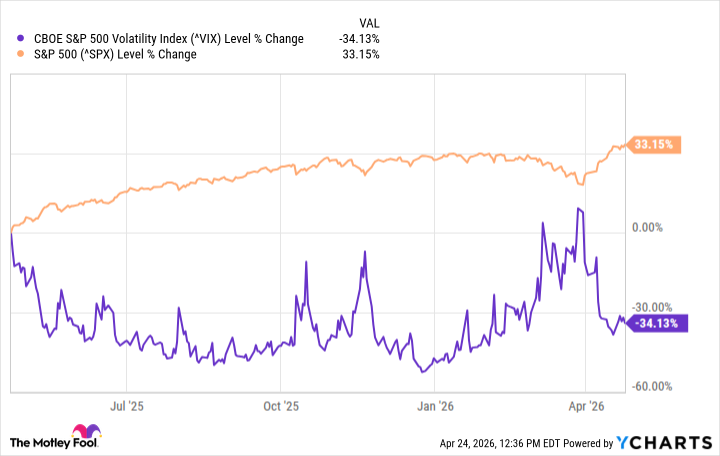
Wall Street’s “fear gauge,” the Cboe Volatility Index (INDEX: VIX), is defying traditional logic by rising alongside the S&P 500. While the two usually move inversely, the VIX remains stubbornly near 20 even as stocks hit record highs. This anomaly suggests investors are aggressively hedging against geopolitical instability and crude oil spikes. Conversely, massive demand for upside call options in leaders like the VanEck Semiconductor ETF (SMH +5.01%) is keeping option premiums — and thus the VIX — inflated. Historically, when volatility and prices climb together for an extended period, it often precedes a near-term market correction as realized volatility “catches up” to the index.
- High-Stakes Chip Bets: Bullish sentiment is so high that one trader recently spent $2.4 million on Marvell Technology (MRVL 1.04%) calls, betting the stock will climb another 10% despite already doubling since last month.
- Skewed Protection: Total call premium in the semiconductor sector now outweighs put premium by 25%, indicating that “fear” in the VIX might actually be a byproduct of FOMO-driven buying rather than pure panic.
Is Nvidia Losing Its Grip on China?
11:20 am — NIO -1.0%
NIO (NIO 0.48%) is pivoting toward in-house semiconductor development to erode its dependence on Nvidia (NVDA +4.16%) and bolster long-term profitability. CEO William Li stated Friday that custom silicon better aligns with the company’s proprietary algorithms for advanced driver-assistance systems compared to off-the-shelf hardware. While research costs are substantial, Li argues that avoiding Nvidia’s “high gross margins” will eventually lift the automaker’s bottom line. The strategy centers on the newly independent Shenji chip unit and a native operating system, which NIO believes are vital to redefining the global luxury electric vehicle market and securing a competitive edge against both domestic rivals and Western incumbents.
- Open-Market Ambitions: By spinning off the Shenji unit, NIO intends to supply its high-performance automotive chips to external manufacturers, potentially creating a secondary revenue stream.
- Algorithm Synergy: Specialized nanometer-scale chips allow for a tighter integration with NIO’s sensor layouts, reducing the latency and power consumption typical of general-purpose AI processors.
AMD Hits Record High on AI Pivot
10:15 am — AMD +13.9%
Advanced Micro Devices (AMD +13.40%) shares surged 10% to all-time highs Friday following a bullish upgrade from D.A. Davidson. The shift from Neutral to Buy comes as rival Intel (INTC +21.23%) reported explosive results, signaling a “CPU renaissance” where general-purpose processors are becoming the bedrock for AI agents. Analysts suggest that as “agentic” workloads move beyond specialized GPUs, AMD’s CPU franchise is poised for a massive expansion. With the market pivoting toward more versatile compute needs, AMD is capturing record-breaking momentum, proving that the AI era isn’t solely reserved for graphics chips.
- Bot-Driven Demand: The rise of autonomous AI agents is shifting technical requirements, favoring the high-throughput reasoning capabilities found in the latest Zen architecture.
- Symbiotic Rally: Intel’s optimistic forecast acted as a sector-wide catalyst, convincing institutional investors that the broader semiconductor cycle is entering a new, durable growth phase.

Today’s Change
(13.40%) $40.91
Current Price
$346.24
Key Data Points
Market Cap
$498B
Day’s Range
$334.51 – $352.99
52wk Range
$91.87 – $352.99
Volume
3.4M
Avg Vol
37M
Gross Margin
45.99%
Meta Strikes Massive Chip Deal With AWS
10:05 am — META +0.8%
Meta (META +2.42%) is deepening its infrastructure splurge, inkng a three-year deal to deploy hundreds of thousands of Amazon (AMZN +3.25%) Web Services Graviton chips. This agreement follows $48 billion in recent commitments to Nebius (NBIS 3.48%) and CoreWeave for Nvidia (NVDA +4.16%) hardware. By adopting these Arm-based (ARM +14.39%) processors, Meta aims to optimize “agentic AI” and post-training refinements with 60% better energy efficiency than traditional setups. While CEO Mark Zuckerberg counterbalances this spend with a fresh 10% workforce reduction, the pivot to custom silicon highlights a desperate race to secure compute capacity as competitors like Alphabet (GOOG +1.24%) and Microsoft (MSFT +1.58%) scale their own internal hardware.
- The CPU Renaissance: Intel (INTC +21.23%) leadership recently noted that central processors are re-emerging as the “indispensable foundation” for AI, as seen by Meta selecting Graviton over specialized accelerators for intensive agent workloads.
- Economic Trade-off: Meta’s massive infrastructure investment coincides with 8,000 fresh layoffs, signaling a permanent shift in capital allocation from human headcount to high-performance silicon.

Today’s Change
(2.42%) $15.95
Current Price
$675.10
Key Data Points
Market Cap
$1.7T
Day’s Range
$653.90 – $680.64
52wk Range
$520.26 – $796.25
Volume
889K
Avg Vol
16M
Gross Margin
82.00%
Dividend Yield
0.32%
Top of the Morning
9:45 am — LUV +2.2%

By Alicia Alfiere
Team Rule Breakers
Southwest (LUV +3.81%) built its brand on being a low-cost carrier, also known as an LCC in the airlines biz. But now, the company is undergoing a massive transformation to make it … well, like most other airlines.
In January, the airline began a new practice of offering assigned seating and extra legroom. That’s not a small change — it caused the airline to retrofit aircraft to accommodate its strategy shift. The company also signed strategic partnerships with other airlines. That’s important because it allows customers to book longer, international trips with Southwest flying part of the route. And, it means customers can earn and use miles for flights on more than just Southwest. That’s kind of a big deal for business fliers and certain leisure travelers too.
6:45 am

By Morning Show host Jim Mueller, CFA
Team Rule Breakers
Have you run into the prediction markets recently?
If you’ve tried to log into your broker, it’s quite possible. I know as I log into my Interactive Broker account, I see a chance to make an “investment” on some prediction. Will the Fed raise interest rates at its next meeting? Yes or No?
I say “yes” (just for example) and put some money on the line. Maybe $0.60 for a single contract. If I’m right and the Fed does raise interest rates, I’ll make $0.40 as I get my investment back plus the cost paid from someone saying the opposite who lost (less a fee paid to the provider of that market).
The price I pay depends on how many others of the total are saying the same thing. The more people who say “yes”, the more expensive the investment becomes and the less the return is if you’re right. That’s how the odds are set. The companies offering this stand to make a lot of money. Recently, Kalshi and Polymarket together handled over $5 billion in weekly prediction market investments recently. Say they take a 2% cut. That’s $100 million in a week. There’s a lot of money involved.
Yet, this isn’t gambling. It’s a futures market. At least according to a recent ruling by a federal appeals court in New Jersey. And that has huge implications. If it holds, this kind of thing will be legal in all 50 states and the District of Columbia.
There are some troublesome aspects about this, though.
4:00 am — MEDP -0.75% in pre-market trading

By Morning Show host Jim Gillies
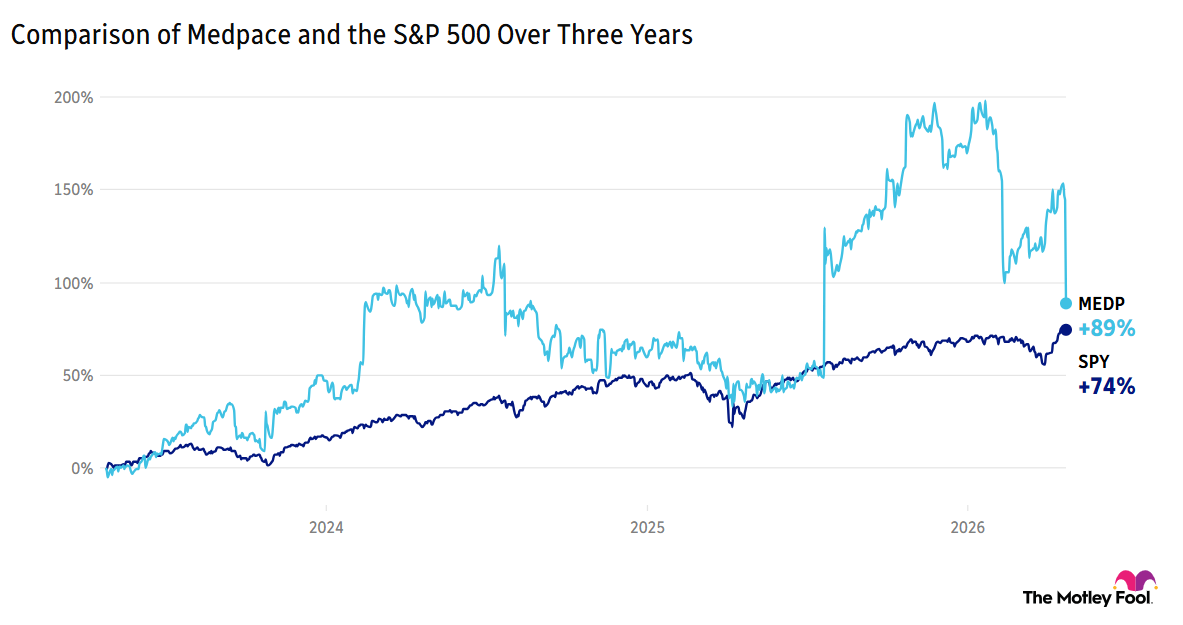
When Medpace Holdings (MEDP +4.96%) reported Q1-26 results after market close on Wednesday I knew that my topic for today was going to be discussing earnings. Let’s get to the results first before discussing some implications.
Results? Actually pretty good.
- Revenue was up 26.5% year-over-year, EBITDA up 25.9%, and Net income up 8.1%. That last one might seem disappointing, but last year saw an ultra-low effective tax rate (3%) while this year returned to a more normal level (upper teens).
- Despite those tax rate “variabilities”, earnings per share (EPS) were up 16.4% year-over-year, mainly because of the aggressive share buybacks Medpace did between Q4-24 and Q2-25 that shrank share count by 7.2% year-over-year.
- Also working against EPS growth pacing revenue growth is that revenue attributable to “reimbursed pass-through expenses” was elevated versus last year as expected. This quarter 44.2% of revenue was “reimbursed costs” versus 36.2% last year.
- Free cash flow of $145 million was up 25% versus last year, the cash pile on the debt-free balance sheet reaching nearly $653 million.
- New business awards were up nearly 24% year-over-year to $618.4 million.
- Management reaffirmed full-year guidance.
So – that all looks pretty great, why then did the stock price get obliterated by as much as 27% yesterday?
I believe the answer can be found on two fronts. First, and of the most importance is the “book-to-bill” ratio – new business awards divided by reported revenue. All else equal a book-to-bill above 1.0 foreshadows future growth and is greeted with much rejoicing by the market. A book-to-bill below 1.0 heralds future (near-term) revenue decline.
Opening Bell
9:35 am — INTC +25.0%
The S&P 500 edged higher Friday as optimism regarding imminent U.S.-Iran negotiations in Pakistan countered a week of broad market declines. While geopolitical tension persists in the Strait of Hormuz, investors are refocusing on a stellar semiconductor sector. Intel (INTC +21.23%) shares surged 24% after a dominant first-quarter beat and optimistic guidance, fueling a record-breaking 17-day winning streak for the iShares Semiconductor ETF (SOXX +4.59%). Despite the tech boost, the Dow remains on track for a losing week as traders weigh “super normal” chip growth against the risks of a naval standoff.
- Crude Volatility Cooling: Oil prices retreated as West Texas Intermediate dipped toward $95 per barrel, signaling that energy markets are pricing in a potential diplomatic breakthrough in Islamabad.
- Narrowing Market Leadership: NewEdge Wealth analysts warn that the rally is becoming dangerously reliant on cyclical semiconductors, which are projected to deliver 100% earnings growth this year.
Which Eggs Should Go in Which Baskets
8:00 am

By Robert Brokamp, CFP®
Team Hidden Gems
In his 1605 novel Don Quixote, Cervantes wrote, “It is the part of a wise man to keep himself today for tomorrow, and not to venture all his eggs in one basket.”
More than four centuries later, the phrase is still used to represent the value of diversification: Don’t put all your money in one investment or type of investment.
A modern spin on the phrase could go this way: Buy all kinds of eggs (investments) and have a few different types of baskets (accounts).
We at the Fool have recommended that investors own at least 25 stocks, and co-founder and CEO Tom Gardner recently increased that number to 50. Personally, I believe a diversified portfolio of low-cost index funds is also a good diversifying complement to a portfolio of individual stocks.
Deciding which investments to own is crucial. But another important consideration is in which types of accounts to own them.
This Morning’s Breakfast News
7:30 am — INTC +26.67% in pre-market trading
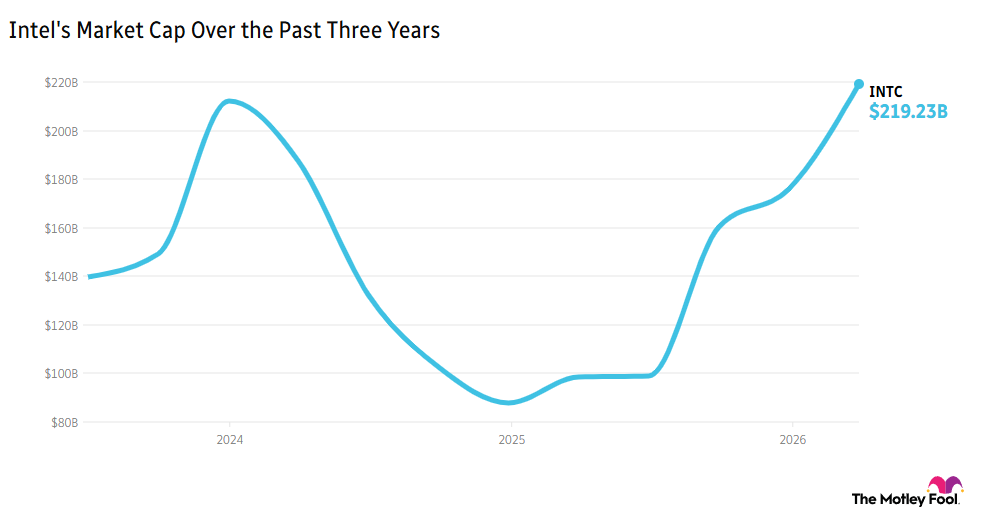
Intel (INTC +21.23%) soared 25% ahead of the market open after CEO Lip-Bu Tan praised the Team Hidden Gems recommendation’s ongoing pivot to AI, saying “this is a fundamentally different company today,” with results beating expectations and the financial outlook upgraded.
- “Focused on maximizing our factory network to improve available supply and meet our customers’ needs”: CFO David Zinsner explained high demand in areas such as data center processors means Intel is striving to quickly increase capacity to avoid disappointment.
- “The backbone of AI computing in production remains a CPU anchored architecture”: CEO Tan flagged “great news for Intel” for the future as more companies are deploying Intel’s CPUs as AI systems become more complex. This is one factor contributing to increasing next quarter’s revenue guidance from $13 billion to between $13.8 billion and $14.8 billion.
Rocket Lab Unveils Deep-Space Star Tracker
6:00 am — RKLB +1.30% in pre-market trading
Rocket Lab (RKLB 4.49%) is doubling down on its vertical integration strategy, unveiling a next-generation High-Performance Star Tracker (ST-HP) designed for extreme deep-space environments. The new sensor achieves pointing accuracy better than 1 arcsecond and features radiation hardening capable of withstanding 50 kRad, making it ideal for the long-duration missions increasingly demanded by defense and commercial constellations. The launch follows a “rapid-fire” week for the company, which saw its stock climb over 30% in April to roughly $85.70 after completing back-to-back missions for JAXA and closing its $155 million acquisition of laser-comms firm Mynaric.
- The Margin Multiplier: By manufacturing the ST-HP in-house alongside its reaction wheels and flight software, Rocket Lab aims to capture more “satellite real estate” and improve margins compared to pure-play launch rivals.
- Operational Velocity: The announcement coincided with the company’s eighth successful launch of 2026, keeping it on track for 20% year-over-year growth as it prepares for the debut of its larger Neutron rocket.

Today’s Change
(-4.49%) $-3.80
Current Price
$80.80
Key Data Points
Market Cap
$49B
Day’s Range
$80.55 – $86.34
52wk Range
$20.23 – $99.58
Volume
426K
Avg Vol
21M
Gross Margin
31.66%
ICYMI: Thursday’s Scoreboard
5:15 am — BLD unchanged in pre-market trading
TopBuild (BLD 2.10%) was the subject of the latest Scoreboard video.
Before the Opening Bell
5:00 am
Stock futures showed mixed momentum Friday after President Trump announced a three-week extension of the Israel-Lebanon ceasefire, providing a rare pocket of stability as the U.S.-Iran standoff continues. While the regional peace progress offered hope for stalled negotiations, the tech sector remained the primary engine for gains. Intel (INTC +21.23%) shares climbed after the chipmaker delivered its sixth consecutive earnings beat, with CEO Lip-Bu Tan highlighting a massive surge in demand for AI-centric CPUs. The upbeat mood followed a historic rally in Texas Instruments (TXN 1.59%), which saw its biggest jump in 25 years after crushing estimates, signaling that the “AI trade” is finally lifting legacy semiconductor names.
- Foundry and AI Focus: Intel’s Q1 revenue reached $13.6 billion, outperforming its own guidance by $1.4 billion as it scales “agentic AI” infrastructure to meet unprecedented silicon demand.
- Blue-Chip Friday: Investors are now parsing pre-market results from Procter & Gamble (PG +2.63%), which expects a volume recovery in beauty and home care, alongside healthcare giant HCA Healthcare (HCA 8.29%) and Norfolk Southern (NSC 0.07%).
Cannabis Stocks Slide Post-DOJ Order
4:30 am — TLRY -0.88%, CGC +0.82% in pre-market trading
The U.S. Department of Justice has officially reclassified cannabis to a less dangerous drug, a major shift in the country’s policy and a move that saw sharp volatility in related stocks including Tilray Brands (TLRY 1.29%) and Canopy Growth (CGC 1.23%).
- The move doesn’t legalise cannabis at a federal level: Cannabis will now be obtainable with a prescription, providing a boost for the $47 billion industry as access to funding and other benefits become obtainable, with more legal progress likely further down the line.
- Sector reaction is telling: After initially spiking on the news, marijuana stocks closed Thursday lower, with Tilray and Canopy Growth down over 11%, with a mix of “buy-the-rumor, sell-the-news” action, along with a realization of a lengthy regulatory road still ahead.

Today’s Change
(-1.29%) $-0.09
Current Price
$6.85
Key Data Points
Market Cap
$809M
Day’s Range
$6.65 – $6.92
52wk Range
$3.51 – $23.20
Volume
7M
Avg Vol
4M
Gross Margin
23.71%