On holiday in Devon this summer, Charles Hall felt a familiar sinking feeling.
The most senior analyst at City stockbroker Peel Hunt had just read that AstraZeneca held talks with US pharmaceutical giant Bristol Myers Squibb about a potential merger.
It reignited concerns that Britain’s second-most valuable company could exit the London market altogether.
Such an event would escalate a decades-long decline for the City, which has suffered from an exodus of listed companies pursuing better returns elsewhere.
“It definitely is concerning,” says Hall.
“The equity market is a central part of our economy. It’s available for companies to raise capital, for people to generate wealth and for pension funds to perform better.
“It should be seen as a national asset that is central to the health of our economy.”
After shares in AstraZeneca fell by 9pc, a source close to the company sought to deny that merger talks had taken place.
But the speculation was enough to raise alarm bells that Britain’s stock market is stuck in a relentless cycle of decline.
The number of listed companies on the main market of the London Stock Exchange has plunged from nearly 1,700 in 2006 to just 909 in July.
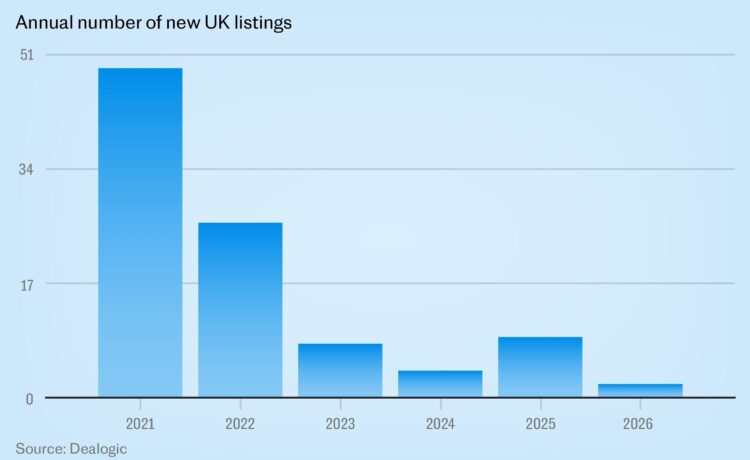
During that same 20-year period, the number of companies joining the market has also fallen.
The number of new listings, called initial public offerings or IPOs, is down from nearly 60 in 2007 to barely a handful in each of the last four years.
“IPOs are down considerably on previous years,” says Julian Morse, the joint chief executive of investment bank Cavendish.
“It’s down to the capital available.”
Companies typically list their shares on public markets when they want to raise money from investors, but data show the amount raised in London has fallen considerably in recent decades.
UK listings raised nearly £22bn in 2006, but this sank to just £1.6bn last year.
Rather than raise money in Britain, blue-chip companies are being drawn to the allure of deeper pools of capital overseas.
Glencore, the FTSE 100 mining giant, triggered a fresh concern on Wednesday when it announced plans for a secondary listing in Australia.
Bosses hailed it as a move to gain access to “one of the world’s largest and fastest-growing pools of long-term investment capital”.
Pension funds shun domestic markets
The downturn in UK-listed companies has been fuelled by pension funds turning away from domestic markets in favour of investments elsewhere.
The Department for Work and Pensions estimated that around 32pc of defined benefit pension assets were invested in UK equities in 2006. This has now crashed to below 2pc.
Peel Hunt said domestic stock markets made up only 2.8pc of UK pension fund investments in 2025, compared to 63.5pc for the US, and more than 40pc in Japan and Italy.
Hall says it is “ludicrous” that pension funds receive £50bn a year of taxpayers’ money through tax and National Insurance relief, without the expectation that “a decent portion” of their funds is invested in the UK.
“Whether it’s voluntary or whether it’s mandatory, the reality is pension funds should be investing a lot more in the UK,” he says.
Jeremy Hunt and Rachel Reeves, former chancellors, both toyed with the idea of forcing pension funds to allocate a set amount of their investments to British companies.
Morse, of Cavendish, urged John Healey, their successor as Chancellor, to push ahead with the plans.
“I’m all for mandating a certain percentage into UK companies, seeing as they’re getting a 40pc tax break,” he says.
Yet this would only go some way to undoing the damage done by high taxes under Labour.
It recently emerged that UK investors pulled £1.6bn from stock market funds last month amid fears that Andy Burnham’s Government will put up wealth taxes, including capital gains.
July was the fifth-worst month for equity fund withdrawals in the last 11 years, meaning investors have pulled an unprecedented £13.9bn from funds in the last 12 months alone, according to Calastone.
‘Tax rises change investor behaviour’
Edward Glyn, the head of global markets at the data provider, says: “Tax rises – and even speculation about tax rises – change investor behaviour.
“The evidence increasingly suggests that policy unpredictability is unnerving investors almost as much as the tax measures themselves.”
Yet this masks an underlying issue that UK shares are simply not as attractive as companies listed elsewhere.
Someone who put £1,000 into the UK market in 2007 would have seen that investment grow to £1,880 by June this year in real terms after inflation, an 88pc increase.
By contrast, $1,000 (£740) put into the S&P 500 would be worth $4,280 after inflation, up 328pc. Elsewhere, €1,000 (£860) put into the Amsterdam stock market would be worth €3,447, a return of 245pc.
To make matters worse, during the last 20 years, investors have consistently been willing to pay more to own a share of companies in America and Europe.
In the US, the price to earnings ratio (P/E ratio), measuring a company’s share price against its earnings per share, stands above 25 for the S&P 500.
That is compared to barely 15 for the FTSE 350 in Britain, which contains all the companies across the FTSE 100 and FTSE 250.
One of the reasons people have been willing to pay more is to gain exposure to the greater proportion of tech companies in those markets, where valuations have surged.
Around 37pc of the value of the S&P 500 comes from tech companies, compared with just 1pc of the FTSE 100.
“If you look at the US and the Netherlands, these are markets where you’ve had extraordinary companies, especially extraordinary companies in the tech sector,” says Martin Frandsen, a portfolio manager at Principal Asset Management, pointing to the likes of Amazon, Nvidia and Tesla.
“If you look in terms of the UK, you won’t have that many companies which really have that sort of exposure.”
The reason tech companies are not interested in the UK market is that there are deeper pools of capital on offer in places such as the US, Frandsen says.
Mike Bell, the head of market strategy at RBC BlueBay Asset Management, adds: “The UK has a tiny allocation to tech shares compared with the US and emerging markets because we have failed to build and then scale tech businesses in the UK in recent decades.
“It’s not that the UK lacks innovative talent – think for example of Sir Demis Hassabis at Google DeepMind or Sir Jony Ive of Apple and now Open AI – but they have tended to work with US businesses, who have been more successful at scaling businesses globally.”
Meanwhile, the one benefit of a low PE ratio compared with rivals such as the US is that UK stocks should appear more attractive to investors because they are cheaper to buy.
However, it appears that the UK has been attracting the wrong kind of buyers.
Private equity giants have recently been snapping up UK-listed companies on the cheap, with Intertek, DCC and CAB Payments among a string of companies announcing sales in the past year.
There have been 39 mergers and acquisitions involving UK-listed companies so far this year, according to AJ Bell, putting the market on track to surpass last year’s total of 52.
America’s investment behemoth Apollo also announced a £5.7bn deal for easyJet on Thursday after rival suitor Castlelake walked away.
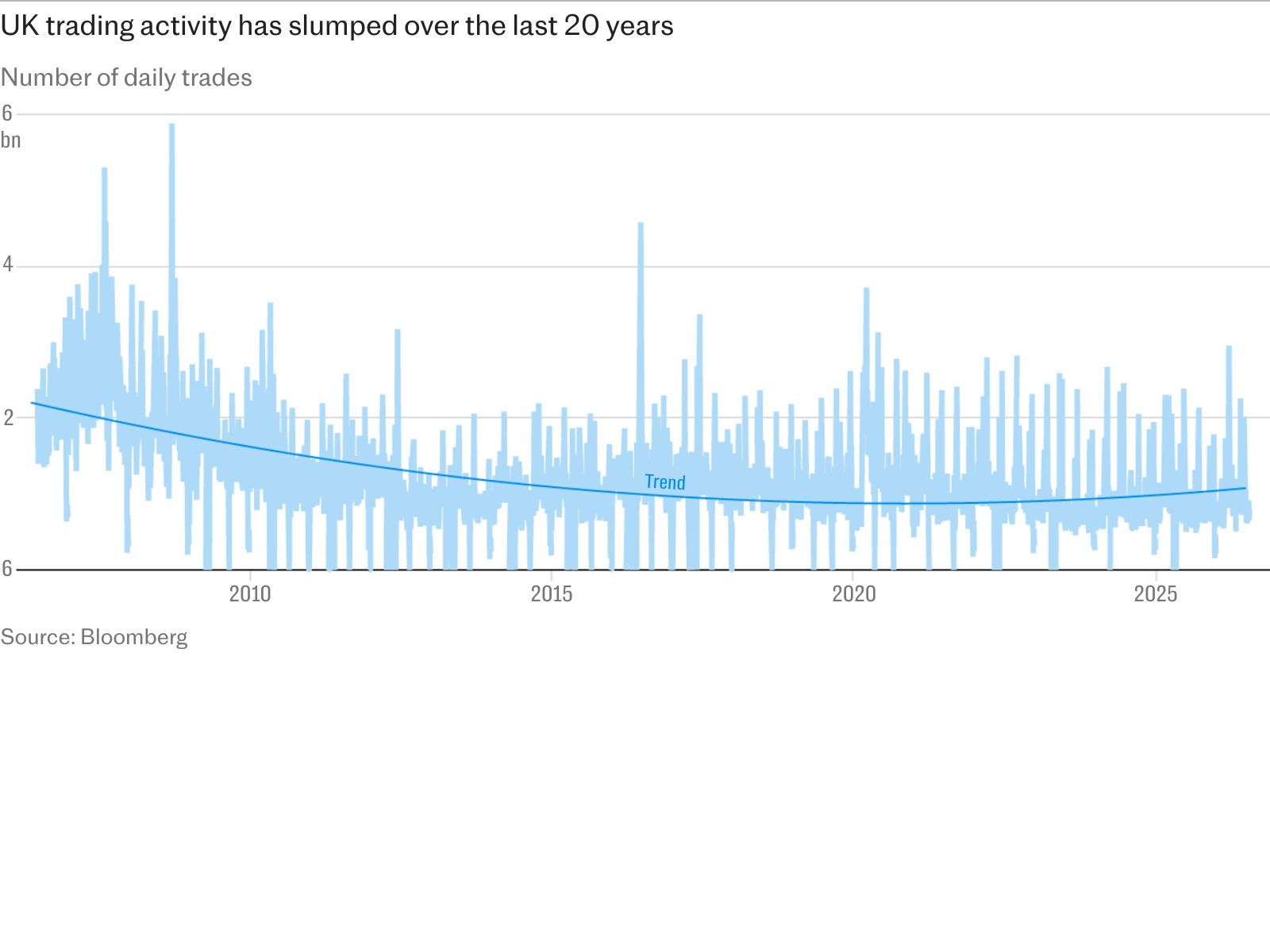
General malaise around the City has led to a sharp drop in the number of daily trades.
‘The UK is an illiquid market’
Each day there were typically more than two billion trades happening on the London stock market in 2006. This has now fallen to 700,000.
Hall, of Peel Hunt, warns the declining trading volumes can be partially blamed on the fact that retail traders have to pay stamp duty on shares.
However, that duty does not apply to hedge funds and institutional investors who use complex financial derivatives such as contracts for difference (CFDs).
The share-trading statistics do not include things such as CFDs, potentially hiding the scale of activity in the UK market.
“A lot of people, particularly overseas investors, think that the UK is an illiquid market because that’s what the stats say, but you don’t know the real picture,” says Hall.
“It’s part of the reason you often see companies who have decided to move their listing cite liquidity. And it’s one of the myths that there isn’t enough liquidity in the UK market. That’s just not the case.”
A spokesman for the London Stock Exchange also insists that the UK “has no shortage of innovative businesses or available capital”.
But they acknowledged that “the challenge is ensuring more of that investment is directed towards supporting growth at home”.
To combat fears of decline, the Financial Conduct Authority last week announced a package of reforms designed to boost activity.
This will include a new platform to record the value of all trading in UK-listed shares, as it seeks to combat the under-reporting of London market liquidity.
Some hope that such measures, combined with the fact that Britain’s stocks are so cheap, will help boost trading.
“While it has continued to get cheaper and cheaper, you have a lot of companies which are trading at quite significant discounts,” says Frandsen, whose portfolios are now increasingly in favour of the UK.
However, others are not so sure.
“For every company joining the market, several more seem to be heading for the exit,” says Garry White, an analyst at US investment bank Raymond James.
“Investors are still waiting for initial public offerings, but bidders are not hanging about.
“Unless the pipeline of new listings improves markedly, the London market risks becoming better known as a departure lounge than a destination.”