
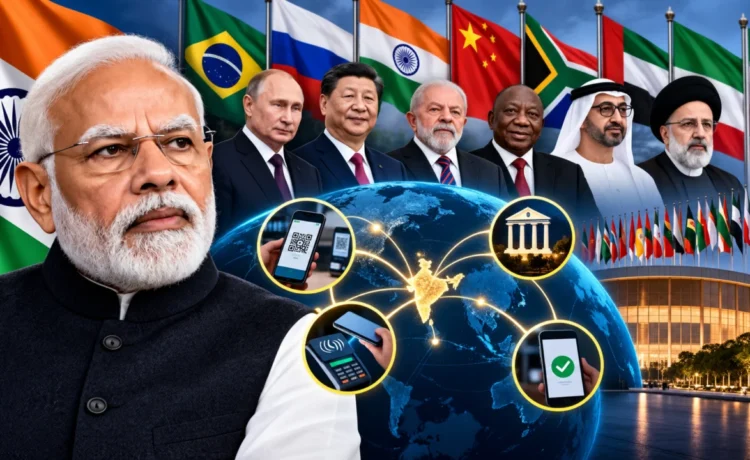
New Delhi is hosting the loudest kind of diplomatic theatre this weekend — eleven flags outside Bharat Mandapam, a group photograph of heads of state, a New Delhi Declaration still being negotiated line by line between Iranian and Emirati officials. But the part of this summit likely to matter most in five years happened away from the cameras.
On September 10, The Finance Ministers and Central Bank Governors (FMCBG) of the BRICS nations collectively voiced their concerns about the “unilateral imposition” of tariffs and non-tariff measures that distort trade. Two days later, heads of state gathered under the “Building for Resilience, Innovation, Cooperation and Sustainability” banner in New Delhi, and the phrase “BRICS currency” once again ricocheted through cable news and currency-trading Telegram channels, as it has every summit season since 2023. The Reserve Bank of Bharat Governor Sanjay Malhotra was asked a fairly ordinary question about cross-border payments few days back.
However, His answer was notably unglamorous. “Various options are on the table, but it is still at the discussion stage, including CBDCs and linkages of fast payment systems,” he said. Bharat has been explicit, separately, that it does not support a common BRICS currency. What it has spent its chairship year pushing is narrower and, by its own account, more achievable: connecting payment systems and digital currencies that already exist, rather than building a new one.
That distinction matters because Bharat arrives at this conversation with more actual infrastructure than any other BRICS member. It is the reason Bharat’s voice on payments carries particular weight inside the group, and it is worth understanding what Bharat has already built before assessing what it’s now asking its BRICS partners to consider.
BRICS Payment Task Force – What Bharat is bringing to the table
The BRICS Payment Task Force — a body most people have never heard of — to keep working on ways to make transactions between member countries faster, cheaper and more transparent. The mandate covers two distinct tracks: interoperability between payment and financial-messaging systems, and the mechanics of settling trade and investment in local currencies rather than dollars.
Neither track is new. What changed under Bharat’s chairship is that an initiative first agreed among BRICS leaders in 2025 — to incubate a shared payments arrangement inside the New Development Bank as a pilot — moved from concept to a defined workstream. The bank, rather than a new standalone institution, is the vehicle, at least for now. That detail matters more than it sounds: it means the project inherits the NDB’s existing legal personality, its five founding shareholders’ voting structure, and its decade of experience actually moving money across borders, instead of starting from a blank institutional slate.
Bharat also used its chair to push a narrower and more specific idea: linking central bank digital currencies, rather than building one shared BRICS digital currency. The pitch, which the RBI is understood to have put forward for the New Delhi summit agenda, is to connect the digital rupee, digital yuan, digital real and other members’ CBDCs through common technical and governance standards — allowing two central banks to settle a transaction directly, digital-currency to digital-currency, without a shared unit of account and without routing through a third country’s banking system. It is a plumbing proposal dressed, inevitably, in the language of monetary sovereignty.
Corridor everyone talks about, and the ones nobody does
The Unified Payments Interface, built by Bharat’s National Payments Corporation, now processes on the order of 24.5 billion transactions a month domestically, worth roughly ₹29.8 trillion. Bharat has spent the past three years exporting it: UPI is live in some form in nine countries — Bhutan, Nepal, Singapore, the UAE, France, Mauritius, Sri Lanka, Qatar, and, since June 2026, Cambodia. Most of these are retail and tourism corridors rather than large-scale trade settlement, but they give Bharat something none of its BRICS partners have: a live, working instant-payment system that other governments have chosen to plug into voluntarily, not as part of any BRICS mandate.
Bharat has paired that with a steady build-out of bilateral local-currency trade arrangements — agreements to settle trade directly in rupees and a partner’s own currency rather than dollars — with the UAE, Mauritius, the Maldives and Indonesia, with more under negotiation, Malhotra has said. The most heavily used of these is with Russia: roughly 96 percent of Bharat’s trade with Russia is now settled through rupee-ruble mechanisms, according to Ivan Nosov, who heads Sberbank’s Bharat operations. That figure is inflated by sanctions rather than pure design — Russian banks have few alternatives to routing trade outside the dollar system — but it means Bharat already runs, at real volume, the kind of local-currency settlement that BRICS as a group is still only discussing.
Bharat has also lent its own currency credibility to the New Development Bank, the group’s shared lender: the NDB is preparing its first rupee-denominated bond, expected before the end of March 2026, alongside the yuan and rand bonds it has already issued.
BRICS Currency and Barriers
- Project mBridge proved that digital cross-border payments work between multiple central banks.
- However, the Bank for International Settlements (BIS) stepped away from it, partly because BRICS leaders floated their own rival system.
- China’s digital yuan now controls 95% of mBridge’s volume.
- Meanwhile, the BIS launched Project Agóra with Western-aligned banks, effectively splitting global digital currency efforts into separate camps and leaving most BRICS members without a usable system.
Legal and Sanctions Roadblocks
- BRICS includes 11 nations with drastically different financial rules and laws.
- Some have open markets, while others tightly control currency movement or face heavy Western sanctions, like Russia and Iran.
- Every direct payment link requires a complex legal contract covering liability, crime prevention, and disputed transactions.
- Major banks in Bharat, Brazil, and the UAE avoid fully integrating with sanctioned members to prevent penalties from the US and Europe.
Local-Currency Lending at the NDB
- The New Development Bank (NDB) made the only measurable push toward local currency use by shifting its loan portfolio away from the dollar.
- The bank set a target of issuing 30% of its loans in member currencies by 2026, but it will likely fall short at roughly 25%.
- Lending in local currencies protects borrowers from exchange-rate losses when paying back loans, but it does not diminish the US dollar’s role in global trade or foreign reserves.
Why Bharat is moving carefully, not just slowly
Bharat’s caution here is deliberate, not simply a function of bureaucratic pace. The RBI has stopped short of endorsing anything that resembles a bloc-wide payment network partly because Bharat’s own capital account remains managed, and partly because Indian banks with real international exposure have to weigh the sanctions risk of integrating too closely with a payments network that also serves Russia or Iran, regardless of what a summit declaration says. The eleven BRICS members do not share a common approach to currency or capital controls — China keeps tight control over the yuan, the UAE’s dirham is fully convertible and pegged to the dollar, Iran’s banking sector is sanctions-constrained — and Bharat’s officials have generally preferred bilateral, government-to-government arrangements it can control the terms of over a single shared framework negotiated among all eleven.
The New Development Bank’s own record illustrates how slowly even a motivated, aligned institution moves on this front: it set a target in 2022 of extending 30 percent of its lending in members’ local currencies by the end of 2026. Bank president Dilma Rousseff put the actual figure at roughly 25 percent as of mid-2025 — meaning the bank, three-quarters of the way through its five-year plan, had covered less than five-sixths of the distance to its own goal.
What the summit actually produces for Bharat
The joint statement issued after the finance ministers’ meetings in Jaipur and Mumbai encourages continued work by the BRICS Payment Task Force on interoperability and local-currency settlement — restating a direction rather than setting a delivery date, which is consistent with where Malhotra has said the technical conversation actually stands. For Bharat, that is not a disappointing outcome so much as an accurate one: the country’s own approach to this problem has been to build working bilateral corridors first and let a multilateral framework catch up later, rather than the reverse. Its export of UPI, its local-currency trade deals, and its participation in Nexus all follow that pattern. The metrics that will show whether Bharat’s BRICS push is actually moving are the same ones that already exist outside any declaration — the number of live UPI corridors, the share of Bharat-Russia trade settled outside the dollar, and the NDB’s own local-currency lending figures, each of which will keep changing independently of what leaders sign in New Delhi.


