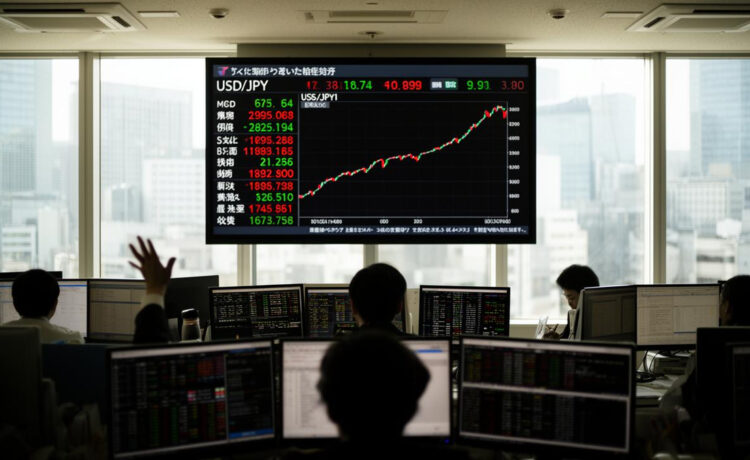
The US dollar plunged against the Japanese yen on Thursday, briefly touching ¥155.34 (approximately $1) intraday — its lowest level since Aug. 3 — with a single-day decline of 2.1%. CME Group noted that dollar put options with a ¥155 strike price became the most actively traded contract of the day, and a definitive break below ¥155 could trigger additional dollar selling.
According to CME Group’s observations, demand for options with a ¥155 strike price continued to build throughout Thursday’s session, with overnight dollar put options seeing the heaviest trading. The derivatives exchange operator said that as dollar-selling options were triggered, the yen’s advance accelerated further.
Market participants noted that ¥155 is viewed as a key resistance level for the yen. When Japanese authorities intervened in April, they failed to push the yen through this threshold, so a break below it would send a strong technical signal. CME Group noted that after the dollar-yen pair fell below ¥156.25, market interest in the ¥155 strike price rose markedly; the ¥156.25 strike had also attracted strong demand earlier in the session.
If the dollar-yen pair falls further below ¥155.23, it would breach the low touched during Japan’s most recent round of yen-buying intervention.
The yen’s rally began building momentum on Wednesday. In the Tokyo foreign exchange market on Thursday afternoon, the dollar-yen decline widened, with the pair quoted at ¥157.37 (approximately $1) at 3 p.m., down roughly 65 sen from ¥158.02 (approximately $1) at noon, and briefly dipping to ¥157.29 (approximately $1) intraday. The day’s reference range was ¥157.29 to ¥158.97 (approximately $1).
Foreign exchange market participants believe that expectations for a potential 50-basis-point rate hike at the Bank of Japan’s monetary policy meeting, along with growing views of consecutive rate increases, are the primary factors underpinning the yen’s strength. A member of the Bank of Japan’s policy board earlier hinted that officials expect to decide on a rate hike at the Sept. 17–18 meeting, with the magnitude potentially exceeding the market’s estimated 25 basis points, and subsequent meetings could follow suit.
Additionally, US Treasury Secretary Scott Bessent said Japan should move away from the reflationary policies of “Taka-nomics,” remarks that raised market vigilance over potential external pressure on Japan’s exchange rate, monetary, and fiscal policies, further fueling the yen’s advance.
The dollar-yen pair had spiked sharply on Wednesday, already prompting speculation that Tokyo authorities may have intervened to support the yen. On Thursday, the yen extended the previous day’s move, with the dollar-yen pair quoted at ¥158.12 (approximately $1) as of 7 a.m. Greenwich Mean Time (3 a.m. EDT on Sept. 12), after an earlier quote of ¥159.91 (approximately $1).
The euro edged higher against the dollar on Thursday, quoted at $1.1599 at 3 p.m., up slightly from $1.1591 at noon, and touched $1.1600 intraday amid dollar-yen selling pressure. The euro-yen pair moved lower, quoted at ¥182.54 (approximately $1.2) at 3 p.m., down roughly 62 sen from ¥183.16 (approximately $1.2) at noon, with an intraday low of ¥182.46 (approximately $1.2). The day’s reference range for euro-dollar was $1.1584 to $1.1600, and for euro-yen was ¥182.46 to ¥184.18 (approximately $1.2).