
We haven’t written much on the U.S. dollar, despite its central role in many economic issues. The reason is simple. When I deliver in-person client presentations and discuss the tariff paradox, I often see blank stares or, worse, eye rolls. But when I explain that a weaker dollar, even though it makes American exports cheaper, can also raise the cost of imports, make things like cars more expensive, and increase mortgage rates, the audience has reluctantly perked up! It’s about which Americans benefit, who bears the cost, and understanding what policymakers aim to achieve, from a nonpartisan perspective.
A strong dollar means each U.S. dollar buys more foreign currency than it otherwise would. That increases Americans’ purchasing power for imported goods and overseas travel. A weaker dollar does the opposite. It makes U.S. exports less expensive for foreign buyers while making imported products more expensive for Americans. Changing its value, therefore, creates winners and losers. The important question is not whether a strong or weak dollar has benefits. Both do. The question is which set of benefits matters more for the U.S. economy.
The argument for a weaker dollar is certainly clear. President Trump has reminded us that a weaker dollar makes U.S. exports cheaper for foreign consumers. If an American manufacturer sells a product for $100, a decline in the dollar’s value can make it less expensive, and therefore more attractive to foreigners, when converted into euros, yen, Canadian dollars, or any other currency. Other U.S. industries that compete with overseas producers can also benefit because imported goods become more expensive relative to domestically produced goods.
There is also a tourism benefit. When the dollar declines, the United States becomes less expensive for foreign visitors. A European, Japanese, or Canadian tourist can exchange fewer units of their domestic currency to purchase the same hotel room, meal, or entertainment experience in America. This can increase foreign tourism and generate additional demand for U.S. businesses. From this perspective, a weaker dollar can be viewed as a price discount offered to the rest of the world on American goods and services.
But another side of the equation also matters. The United States is not primarily an exporting economy. It is an enormous importing economy. The United States recently reported an $88.6 billion monthly trade deficit for July 2026, with $399.3 billion in imports and $310.7 billion in exports. Whatever one’s view of trade policy, those numbers tell us something fundamental: Americans purchase more goods and services from abroad than foreigners purchase from us.
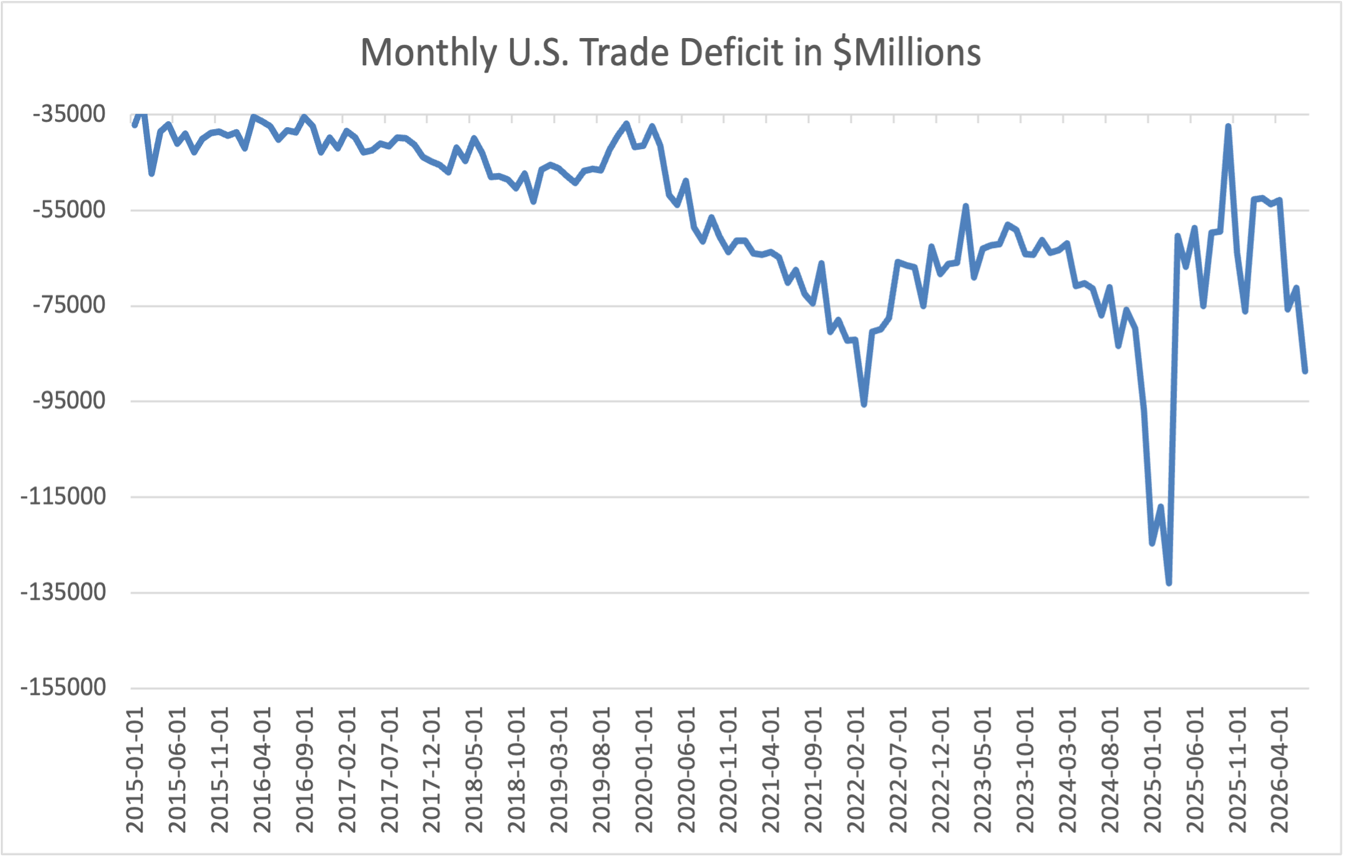
Source: U.S. Bureau of Economic Analysis and U.S. Census Bureau
That raises an uncomfortable question for advocates of a weaker dollar. If America imports substantially more than it exports, wouldn’t a stronger dollar give American households and businesses greater purchasing power overall? If the dollar is strong, imported automobiles, electronics, machinery, energy products, pharmaceuticals, food ingredients, and countless other goods become less expensive in dollar terms. A strong currency essentially allows Americans to buy more from the rest of the world with each dollar they earn.
Although a weaker dollar gives American exporters a price advantage, it also imposes a price disadvantage on American consumers and companies that depend upon imported products and inputs. And since we import more than we export, we cannot ignore that on net, the U.S. would stand to benefit more from a stronger dollar than a weaker dollar.
Inflation and Interest Rates
A weaker dollar also raises the dollar price of imported goods. If an American company purchases foreign steel, machinery, computer chips, chemicals, or other components, a weaker dollar can increase the company’s costs, which are often passed on to consumers in the form of higher prices. In an economy already struggling with inflation, deliberately pursuing a weaker currency can therefore put upward pressure on inflation and make the Federal Reserve’s job more difficult.
Additionally, if investors begin to price in higher inflation due to a weaker U.S. dollar, they will demand higher yields on long-term U.S. Treasury securities to compensate for the erosion of purchasing power. Foreign investors will also worry about currency depreciation. A foreign investor who purchases a 10-year Treasury note is not only investing in a U.S. government security; they are also effectively taking a position on the dollar’s future value.
That means that as foreign investors realize that the trend is toward a weaker U.S. dollar, they are likely to demand a higher interest rate to compensate for that risk or reduce their demand for Treasury securities altogether, which will translate into higher long-term yields.
Long-term rates matter to ordinary Americans. The 30-year fixed mortgage rate closely tracks long-term Treasury yields and mortgage market conditions. Long-term benchmark rates also influence corporate borrowing costs. In other words, the American exporter who celebrates a cheaper dollar may benefit from greater foreign demand, while an American household trying to finance a home, an auto, or a business investment could face higher borrowing costs.
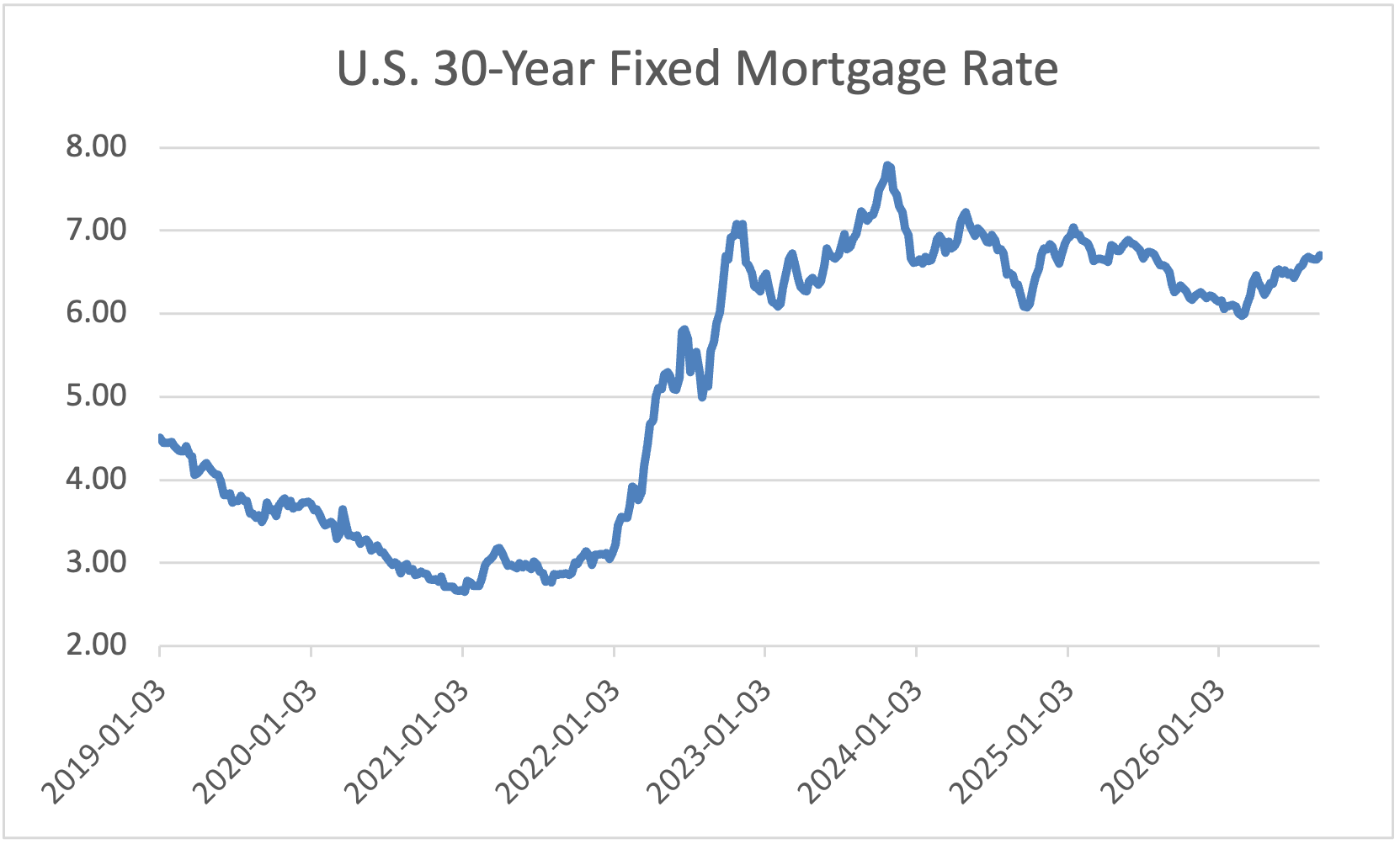
Source: Freddie Mac
What Does History Tell Us About Our Preference for a Stronger or Weaker U.S. Dollar?
For much of the past 50 years, American currency policy has shifted between periods when policymakers tolerated or encouraged dollar depreciation and periods when officials supported a strong U.S. dollar. The experience of the late 1970s also provides another example of the complicated relationship between currency values and inflation. Treasury Secretaries W. Michael Blumenthal and G. William Miller served under President Carter, when the dollar came under some pressure amid high inflation and economic instability. Markets sometimes interpreted U.S. policy as tolerating a declining dollar. But currency weakness could also reinforce inflationary pressures by making imported goods more expensive. The lesson was that U.S. dollar depreciation could have consequences that policymakers did not fully control.
During the 1980s, Treasury Secretary James Baker played a central role in the 1985 Plaza Accord, in which the United States signed an agreement with Japan, West Germany, France, and the United Kingdom to weaken the U.S. dollar. The objective was to address large international imbalances and the competitive pressure that an expensive dollar was placing on American manufacturers.
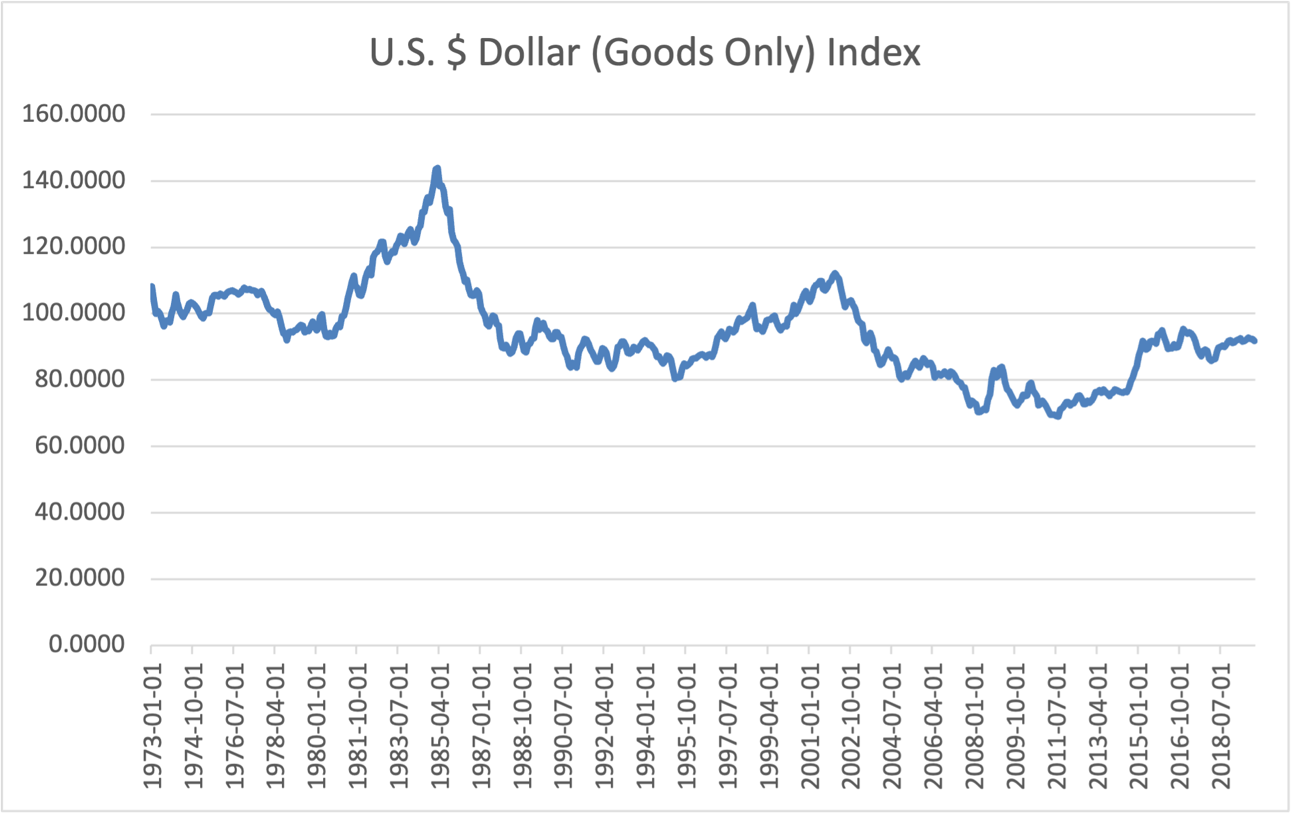
Source: Board of Governors of the Federal Reserve System
The most explicit modern commitment to a strong dollar emerged in the 1990s. Treasury Secretary Robert Rubin famously declared that “a strong dollar is in our national interest,” establishing what became known as the Strong Dollar Policy. His successors, including Lawrence Summers and Paul O’Neill, generally maintained that position. Treasury Secretaries John Snow and Hank Paulson similarly emphasized that the dollar’s value should ultimately reflect our healthy economic fundamentals.
During the global financial crisis (2007-2009), Treasury Secretaries Timothy Geithner and Jack Lew continued to reassure global investors that the United States was not deliberately seeking to devalue the currency to gain a trade advantage. However, notable exceptions to this long-standing rhetoric have occurred.
In 2018, Treasury Secretary Steven Mnuchin, under President Trump’s first administration, drew considerable attention when he told the World Economic Forum that “a weaker dollar was good for us as it relates to trade and opportunities.” He later emphasized the long-term importance of a strong dollar. Still, the episode showed that the traditional strong-dollar consensus could be set aside when trade competitiveness becomes a priority.
Please note that the goods-only U.S. $ Index was discontinued in 2019 and replaced with a new expanded index that includes a trade services component, so we have also included a chart of the revamped index, which covers data from 2006 to the present.
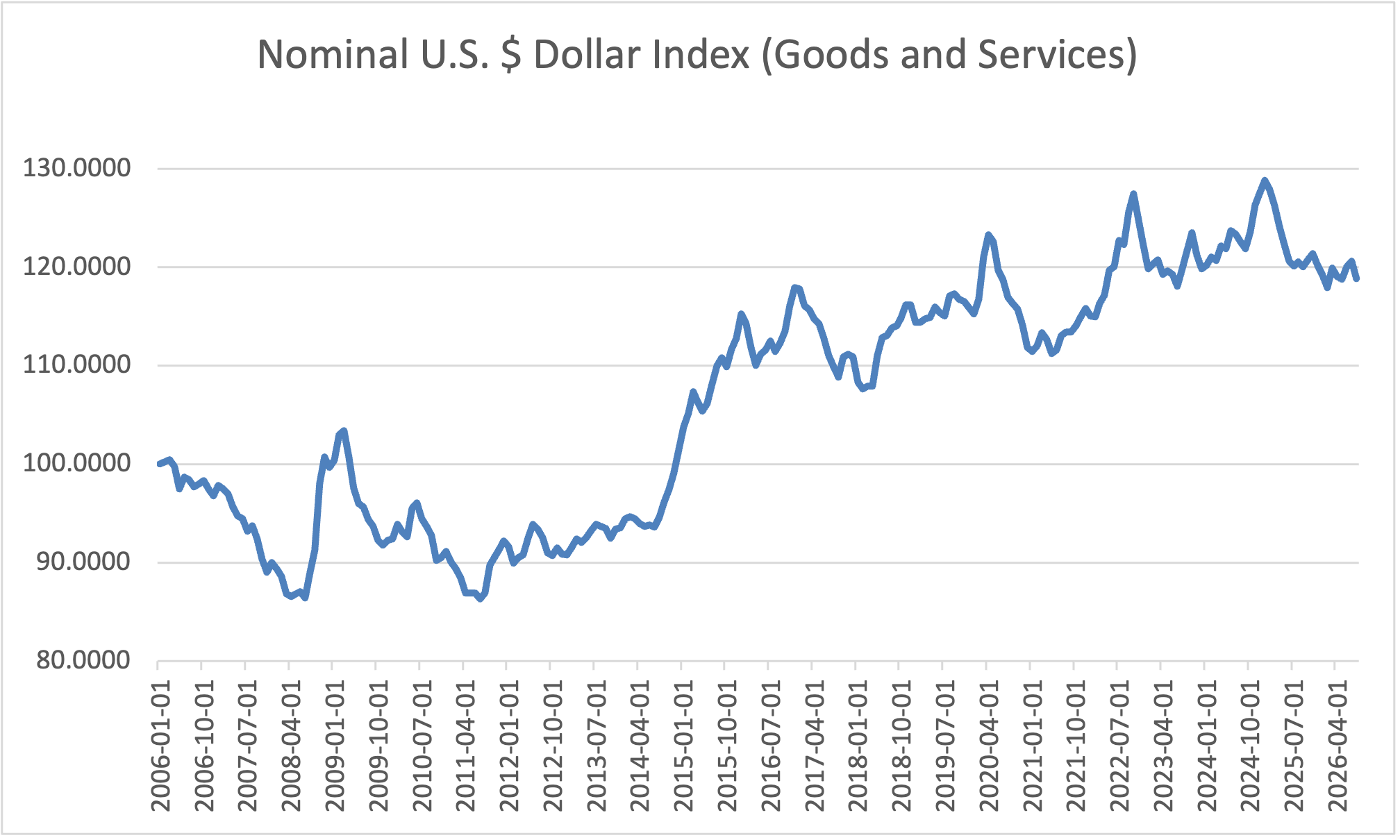
Source: Board of Governors of the Federal Reserve System
Dual visions favoring a strong versus a weak dollar are visible again today. Treasury Secretary Scott Bessent has repeatedly emphasized that the United States maintains a strong-dollar policy and has argued that preserving the dollar’s role as the world’s reserve currency is important. In contrast, President Trump has frequently expressed a preference for a weaker dollar because of its potential benefits for American exports. Still, Treasury Secretary Bessent has tried to reconcile these contradictory views by arguing that the dollar can remain strong because of sound U.S. economic fundamentals, while preventing foreign governments from weakening their currencies to disadvantage American exporters.
Is There Another Way to Reduce the U.S. Trade Deficit Without Weakening the U.S. Dollar?
Yes! This week, we heard President Trump threaten the U.S. Federal Reserve, saying that unless it lowered short-term interest rates immediately, he would stop trading with any country the U.S. has a trade deficit with. Last year, the U.S. incurred a $1.2 trillion trade deficit and had a negative trade balance with 90 countries. If we stopped all trade with those countries, the U.S. economy would collapse, and auto companies, data centers, and most industries, including the housing sector, would need to cease operations and lay off workers because they would no longer have access to the materials needed to continue operating.
This serious threat now rests with the Federal Reserve, which must decide whether to give in to the President’s demand to avoid an economic depression or hope the President was bluffing. But the truth is, if we stopped trading with all 90 of our trade-deficit countries, the trade deficit would be eliminated. The next Federal Reserve policy meeting will be held Sept. 15-16, 2026.
Interestingly, the U.S. Treasury Secretary recently approved a plan to weaken the U.S. dollar against the Japanese yen to help Japan counteract its weaker currency, while still maintaining that he believes in a strong U.S. dollar policy. Behind the scenes, the consensus view was that the U.S. supported this strategy to prevent Japan from selling U.S. Treasury securities to support its currency, to prevent U.S. interest rates from rising.
Summary and Concluding Thoughts
The tariff paradox should not be ignored. If the objective is to make American exports cheaper and reduce the U.S. trade deficit, one strategy might be to eliminate or lower U.S. tariffs to avoid retaliatory tariffs on U.S. exports. However, when the United States imposes tariffs on imported goods, those products become more expensive for American buyers, which reduces demand for U.S. imports and tends to reduce the U.S. trade deficit. However, since the U.S. imports more goods than it exports, higher tariffs tend to increase rather than reduce the U.S. trade deficit, especially as our trading partners retaliate with tariffs on U.S. exports.
Tariffs can create forces that strengthen the U.S. dollar rather than weaken it. If Americans buy fewer foreign goods because tariffs make imports more expensive, demand for foreign currencies may fall, putting upward pressure on the dollar. Thus, a policy designed to protect American manufacturing through tariffs can push the currency in a direction that makes U.S. exports less competitive. This is one reason why currency policy cannot be considered independently of trade policy. And when foreigners buy fewer U.S. goods, they earn less, which tends to lower their demand for U.S. Treasury securities and push U.S. interest rates higher!
Ultimately, the strong-versus-weak-dollar debate is really about what kind of economy America wants. A weaker dollar can help exporters, manufacturers competing with imports, and the U.S. tourism industry. A stronger dollar can also help consumers, import-dependent businesses, travelers abroad, and borrowers by reducing inflationary pressure and preserving purchasing power.
However, since the U.S. imports considerably more than it exports, making imports more expensive has a very real cost for American households. And if dollar weakness contributes to higher inflation expectations, higher Treasury yields, and higher mortgage and consumer borrowing costs, the cost can extend well beyond the checkout counter for many U.S. consumers.
That is why it is difficult to conclude that “a weaker dollar is good because it makes our exports cheaper.” It is true, but only partially true. The other half is that a weaker dollar makes everything America buys from abroad more expensive. Perhaps the better question, therefore, is not whether America should have a strong or a weak dollar. It is whether we can have a strong economy and a strong dollar at the same time. History suggests that when the United States has enjoyed strong productivity, credible economic institutions, deep capital markets, and confidence in its future, the dollar’s strength has been an advantage rather than a burden. The goal should not be to make American exports artificially cheap. It should be to make American products so productive and competitive that the world wants to buy them even when the dollar is strong.
And for American consumers who have to pay the bills, a stronger U.S. Dollar that buys more rather than less is surely a good thing for anyone concerned with our current affordability problem!