In the land of broad emerging market ETFs, where funds like the $30 billion iShares MSCI Emerging Markets ETF (EEM) and the $57 billion Vanguard FTSE Emerging Markets ETF (VWO) navigate, there’s a trio of funds that offers similar access without local currency risk. It’s the passively managed currency-hedged ETFs offering total market EM access.
These funds aren’t household names like their unhedged counterparts, and their total assets are nowhere near what unhedged emerging market ETFs have. Traction has been relatively slow even though these currency-hedged strategies have shown their worth this year in protecting from currency volatility.
The funds are:
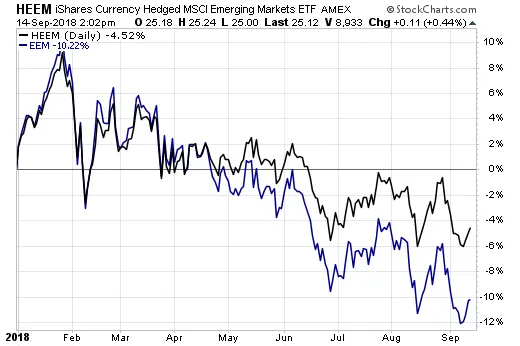
Consider the performance of EEM and its hedged version, HEEM, year-to-date:

Chart courtesy of StockCharts.com
That disparity has been seen across the board, with currency-hedged total market EM ETFs performing roughly twice as well as unhedged funds.
A look into asset flows this year shows that investors are on the fence when it comes to broad emerging market ETFs, as the region, broadly speaking, struggles with countries seeing high inflation, weakened currencies, rising political turmoil, economic contraction and hefty debt burdens. But it also shows that currency-hedged EM ETFs are all net asset losers this year—despite the performance.
Here are asset flows into/out of these ETFs year-to-date:
The question is, why? And it could primarily be a problem of tradition. Investors have long accepted that an allocation to a broad emerging market ETF meant taking in country risk, equity risk and currency risk as part of a whole package.
“Historically, people who bought into emerging markets accepted the currency risk as part of the risk premium,” Chris Dhanraj, head of iShares Investment Strategy for the U.S. ETF business, said. “That’s how people have historically modeled the risk/reward into the portfolio.”
According to him, slow adoption could also be due to an education gap—something that a year like 2018 could help fill as investors are faced with clear outperformance in currency hedged funds.
Dramatic Pickup
“This year, even as emerging markets have sold off, underneath the surface, emerging market currency volatility has picked up pretty dramatically whereas emerging market equity volatility has remained relatively tame,” Dhanraj said. “This spike in currency volatility is a good reminder that when you’re investing internationally, currency risk isn’t just baked into emerging markets. And you can hedge against it.”