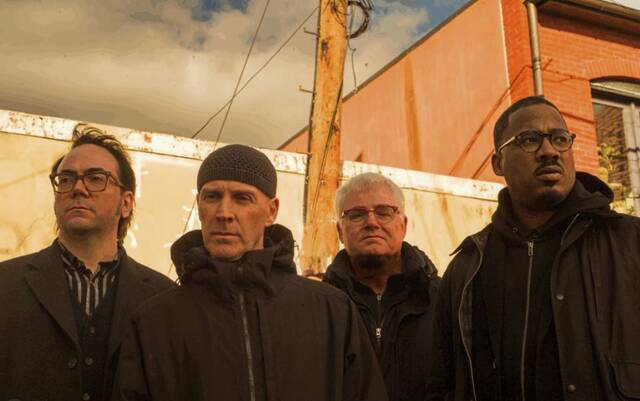
It’s been 10 years since the Messthetics first formed, with the rhythm section of influential post-hardcore band Fugazi (bassist Joe Lally and drummer Brendan Canty) joined by versatile guitarist Anthony Pirog to create several albums fusing punk and jazz.
Saxophonist/composer James Brandon Lewis, who had previously worked with Pirog, had guested with the trio at New York area shows, leading the quartet to release a self-titled album in 2024.
“When you listen back to the first record, it definitely feels a little bit almost like demos,” Canty said. “I still love that record, but it definitely feels more like demos than what this new record feels much more like.”
The new album, “Deface the Currency,” which dropped in February, showcases a band further honed by dozens of shows over the past two years.
“We’re kind of more cautious on the first record, learning how to be in the conversation together and step on each other’s toes kind of thing,” Lally said. “Second record is, we have become this animal, and that’s what you’re listening to. Blam!”
The Messthetics and James Brandon Lewis will be in Pittsburgh on May 7 at City of Asylum on Pittsburgh’s North Side as part of Jazz Poetry 2026. The free show will feature a collaboration with visiting poets, followed by a full set from the band.
In a lively Zoom conversation earlier this month, all four members of the band spoke with TribLive about the new album, the overlap of punk and jazz audiences, their favorite tracks and more. Find a transcript of the conversation, edited for clarity and length, below.
You’ve got this performance in Pittsburgh that’s going to feature improvisational collaborations with a poet. Have you done anything like that before?
Lewis: I’ve been participating with this festival for four or five years at this point, in the spirit of Oliver Lake working with poets. He’s the one who started this festival, Poetry and Jazz Festival at City of Asylum. It’s going to be great. We’ll work with the poets. Normally it’s like a full crash-course day where we rehearse with the poets. We all learn that day. This is the normal routine. I’m hipping the guys right now, as we speak. Poets come in, we meet for lunch, we come up with different textures for them. I normally record it on my phone. Hopefully we’ll all remember those textures later on that night. We’ll collaborate with them, and then we’ll play a full set. That’s how that normally goes. It’s intentionally done that way to get into the flow, spontaneity and all that.
Pirog: We as the Messthetics have done this before with Lonnie Holley.
Lally: Oh yeah.
Pirog: And Akira Sakata.
How does that go compared to a normal set?
Lally: Well, it’s more fun because the pressure is off of us. It goes to the other person.
Lewis: I think with this, normally, and I’ve done some things with Lonnie Holley as well, but I think the main thing is that these poets will be bringing in written stuff. That’s the primary difference. Then we get the poem and we study the poem as much as we can within that flow. So it’s quite different than spoken word poetry versus actual written.
It’s also got to be a little bit different, compared to a normal set which is all instrumental. Is this like putting the words on top of that?
Lewis: I don’t tend to think about it because I’ve been collaborating with poets since undergrad circa 2002-06 but got more serious in 2011. I tend to like to study the poem to understand the nuance rather than just the music and the poetry just floating on top of the music. That’s not really collaborating in my mind. It’s like once the poet gives us their words, and some of them have never worked with musicians before. So first, there’s a conversation to be had. OK, they’ll recite the poem without us. I’m giving you the backstory with how rehearsal will be, where normally I have them read the poem out loud, and we’ll all have copies of the poem. Then I ask them what they may be hearing. What instruments are they hearing or not hearing? It might be all of us, maybe it’s just poet and guitar. So it’s a flow, it’s broken up. So it’s definitely always in communication. And then respecting their line, respecting the line break, respecting punctuation, getting into that flow of understanding the vibe, the spirit of whatever they’re trying to communicate, poetry-wise. So it’s not just like a free-for-all. That’s not how it is at all.
You have the new album out so what do you see as the biggest differences between the first album and the second album together?
Lewis: OK, I’m not going to talk any more. I’ve done enough.
Lally: No one’s stepping up. I will state the obvious, which is we were not a band that played together more than James joining us on a few songs when we came through Brooklyn or the New York area. After making that first record, we did a lot of playing together and found out, kind of fell into what our personality as a band is. We were able to make the second record under that new disguise of exactly who we are as a live band and just who we had become by playing together. Anyone want to take it from there?
Lewis: No, that’s good.
Canty: Basically, the first record was, in some ways, it was just such a new experience of all four of us playing together in a studio. So it was really amazing for it to come together as quickly as it did. We were definitely surprised that everything sonically fleshed out the way it did with James adding all this texture to Anthony’s melodies. I think just the wonder of the sonic possibilities was something that we all grabbed on to, to the point where we really just didn’t want to change it. We recorded everything once, and then they were basically just like rough mixes, and that’s what ended up being on the record. We just protected those rough mixes all the way to the end. Then we went out and played a lot of shows. We toured all over. We went back and forth to Europe a few times, and we did a lot of U.S. stuff. The band just became such a unit for a live, functioning, high-octane performance. We began to really, I think, cherish our time on stage. So that, to me at the time, that’s when the band really developed into a force. And we’re just reinterpreting the things that we had recorded initially, on that first record. I mean, honestly, the first and last song on the new record we’ve had for a really long time. So to me, those are real markers of the way that James’ involvement in the band has really changed and the way that the band has changed in the last couple years just from playing live so much. So they’re just much more high octane, much more live, there’s much more of a vibe. The playing is much better all across the board. So I guess that’s what I would say: it’s just a much more live approach. The second record just feels like a band that’s firing on all cylinders.
For Anthony and James, how do you figure out where your parts are, where the trade-off is. How does that work with you two?
Lewis: I think it’s more like an equal partnership with me and Anthony. It’s like what we always tell the sound guy at the gigs: We’re both playing melody so crank us up. It’s not like a backseat kind of situation. I think he and I also have very similar melodic approaches, where sometimes when you listen to the record, I mean, even on this current record and the last one, our sounds are so unified. I’m like, man, am I even playing on this track? I can’t really tell because we’re just so in tune with each other, and we have been since we’ve known each other. That’s my outlook on it. I think also the beautiful thing about this band, too, is that I think we all lead with humility in serving the music. A real band is understanding that we all need to function towards having the music to be at the forefront of our minds and not our own personal egos. Like Joe said, we make room for each other, especially this record. There’s plenty of room. That’s my thought process.
The song “Clutch” was one of the tracks that I probably enjoyed the most. What went into the making of that song? Was that something that you had been playing on the road before you started recording it?
Canty: That was James 100% on that one. He wrote that whole song.
Lewis: That song went under a different name. That was one of those notebook tunes from like 10 years ago. I’ve only played it once. And I thought, well, let me grab that tune for this ensemble, because I knew that it would, their music would be communicated properly in the way that I envisioned it in my imagination. For instance, that intro, Anthony, I remember he and I having a conversation, and he said James, hey man, I only want you to be yourself, man. You came up with that gorgeous intro. It’s really gorgeous. It sets the tone, the mood for the whole thing. I tend to have these kind of anthems, I call them wounded warrior tunes. (laughs) It’s in my personality to be wounded. But then triumphs. (raises fist victoriously) That’s it, but we all contribute. The sound itself is definitely the sound of this band. The beautiful thing about this ensemble is like getting into who wrote what is fine for the sake of the conversation. But in general, I think we all contribute so much of ourselves to the sound of the music that it’s a moot point. It’s just a conversation point at this point. I think we’re all learning and growing. I just love the energy of this band. We blast. So I hope people are ready, looking forward to getting on the road and just blasting on thes folks.
Even the first song of the album, “Deface the Currency,” it just comes out punching right away. Was that intentional?
Lewis: Yeah, that’s after so many shows, like Joe said, the beast. We let the beast out. (laughs)
I imagine with jazz, people aren’t probably expecting “beast,” right?
Lewis: Hey man, the name of the album is “Deface the Currency.” So we defacing all of that. All of those notions of what they think they’re about to receive. So I don’t know anything about jazz. I just play a saxophone that’s associated with this genre. Nah, I’m joking.
Lally and Canty: (laughs)
Lewis: Hey, listen man, it’s John Coltrane’s centennial. I’m having a hard time navigating this year anyway, so. (laughs)
Canty: People asking you to do stuff?
Lewis: Oh, yeah. I’ve definitely been saying no a lot. How can you have a centennial when people are always talking about the person before it was a centennial? They’re like, oh, now we’re going to honor him. It’s like, well, you mugs talk about him every year. Every year you talk about him.
Canty: That’s real. That’s real, man.
Lewis: What were you going to say, Brendan?
Canty: I was just going to say, our audiences are really mixed. I mean, it’s not just jazz. We play some jazz clubs. But even at the jazz clubs, they sell tickets to everybody.
Lewis: Yeah, it’s mixed.
Canty: Even if we don’t want them there, they sell them tickets.
Pirog: (laughs)
Related
• Corrosion of Conformity’s Pepper Keenan talks about new double album ahead of Pittsburgh show
• The Afghan Whigs’ Greg Dulli on new track, songwriting, local food specialties and more
• 2026 Pittsburgh area concert calendar
That sort of leads to my next question of, where do you see the similarities between the punk and the jazz scenes? Is there a Venn diagram? Where is that overlap between the two?
Canty: In my life, they’re indistinguishable. If people want to bury their brains in the ideas of genres, that’s one thing. But most people don’t want to do that. Most people have a pretty Catholic taste so they listen to all sorts of things. I grew up listening to Flipper and jazz. I’d go see every band, but I just like music and I think everybody in the band would feel the same way. I think that’s one thing that we all share is nobody’s trying to recreate anything. Anthony, why don’t you chime in on that?
Lewis: Exactly.
Pirog: I’m just agreeing with everything you guys are saying. There’s nothing to add. It’s the perfect response. I’m serious.
Canty: Want me to say something? I’m going to say something you can’t agree with.
Pirog: Try me.
Canty: I’m working on it. All right.
What kind of guitar questions should we ask Anthony? Do you guys have anything you want to ask him?
Canty: Just ask him why there’s only six strings on that guitar. How come there’s only six strings on there?
Pirog: There are six strings? What?
Lewis: Talk to him about equipment. Talk about what pedals he used on the album.
Lally: We’ll never hear the end of it.
Pirog: (shakes his head)
Canty: So mean. I’m sorry, Anthony. (laughs)
What’s everybody’s favorite song on the album and why?
Pirog: My favorite song is “Universal Security” just because that in, as far as I remember, that’s the first time we played it all the way through, and we captured the feeling that I imagined or hoped we would. And to also add something that’s that extreme on a record like this is something I’m very proud of, and I’m very proud of the way that we’re interacting when the melody is happening. That’s a special one for me.
Canty: I’m gonna disagree with you. That’s my least favorite track on the record.
Pirog: I’m supposed to disagree with you. It’s supposed to be the other way around.
All: (laugh)
Canty: Yeah, but you walked into that one.
Pirog: OK, I’m just gonna sit here. Someone else, come on. I think he asked everyone for their favorite track.
Lewis: Go ahead.
Lally: I’m also going to say “Universal Security,” because for me, it’s just such a different type of track. It doesn’t have sort of parts upon parts, which many tracks have. It’s just such a different way to interact with the song for me, that I guess it just stands out as being so different than a lot of stuff we’ve recorded. It’s about getting the feeling of what’s happening more than anything else. And just being able to sort of nail it when we needed to is, I don’t know, it just felt really good to be able to do a song like that. Don’t know how to talk about it.
Canty: I like “Deface the Currency” just because it feels more written and structured and takes you on a little journey from five different parts. For me, it just covers a lot of ground in four and a half minutes.
Lewis: Yeah, I guess I’m gonna be a bit of a sap. I like “30 Years of Knowing. That’s my favorite tune because I just started thinking about the ocean and just drifting out. It’s nice. A relaxed vibe.
If you go
Who: The Messthetics and James Brandon Lewis
When: 7 p.m. May 7
Where: City of Asylum, North Side
Tickets: Free, cityofasylum.com