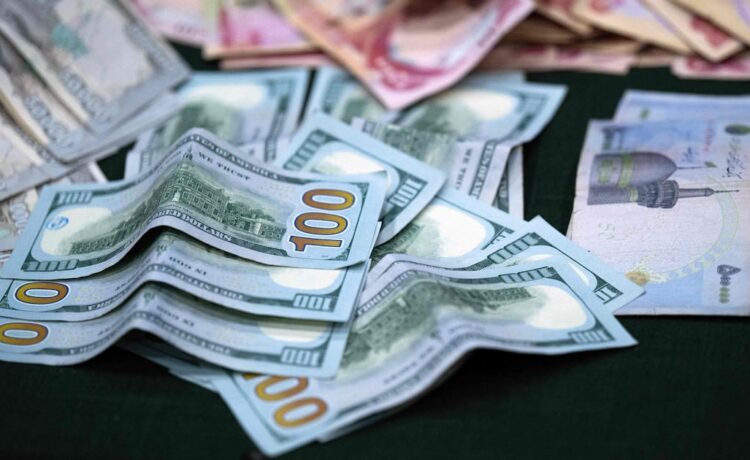
Washington has suspended security co-operation and US dollar shipments to Iraq from its oil sales, demanding that Baghdad forms a new government without Iranian influence and arrests militia members accused of attacking the US embassy and troops, Iraqi officials have said.
Despite more than five months having passed since the national elections in Iraq, political parties have failed to form a new government because of disagreements within the ruling Shiite coalition over the nomination of a candidate for prime minister.
Earlier this year, Washington threatened economic measures, including sanctions against state institutions and cutting off its oil revenue deposited in the US, should armed groups backed by Iran be included in the next government.
The situation took a turn for the worse when pro-Tehran militias joined the Iran war at the end of February, launching missile and drone attacks against US assets in Iraq, including the embassy in Baghdad, the consulate in the Kurdistan Region and a diplomatic logistic centre at Baghdad International Airport. They have also claimed attacks against US troops in several Gulf states and Jordan.
“The Americans conveyed the decision to senior politicians that the hard currency, which is usually flown to Iraq, will stop until forming the next government and arresting militia members for attacking the US embassy and troops in Iraq,” an Iraqi diplomat said.
The Americans have also “suspended participation in security meetings, which is essential for Iraq for the co-operation in this field, including intelligence sharing,” he added.
An official at the Central Bank of Iraq confirmed that dollar shipments have stopped, but said US transactions to cover the import of goods are still in place.
Another government official said Washington’s decision “is not final and that discussions are still under way with the Iraqi government”.
Since the 2003 US-led invasion that toppled Saddam Hussein, the US has exercised de facto control over Iraq’s oil revenue.
Every dollar Iraq gains from selling crude oil enters an account at the Federal Reserve Bank of New York, from which Baghdad makes withdrawals to pay government salaries and imports. The New York bank supplies Iraq with hard currency for foreign exchange transactions.
Oil revenue makes up nearly 95 per cent of the federal budget and the country depends heavily on imports to meet the demand for food and goods for key sectors of the economy.
The latest development is another example of US President Donald Trump’s determination to end Iran-linked groups’ influence in Iraq, which has long walked a tightrope between its two closest allies, Washington and Tehran.
Iraq’s cabinet formation remains stalled amid negotiations mainly between Shiite political parties on who will lead the next government.
On April 11, Nizar Amedi, a Kurd and former minister of environment, was elected as President. The Iraqi constitution stipulates the president has 15 days to give the nominee of the largest parliamentary bloc the responsibility of forming a government.
The main nominees to become prime minister are Nouri Al Maliki, who held the role before but has been rejected by Washington because of his ties to Tehran and its proxies. Current Prime Minister Mohammed Shia Al Sudani could also be asked to continue in the role. Other compromise candidates are being considered.
The Shiite Co-ordination Framework, a coalition of Iran-aligned parties that forms the largest bloc in Parliament, met late on Monday in what was seen to be a decisive meeting to discuss nominations, but failed to select a candidate.
Among the prominent compromise candidates are: Bassim Al Badri, the Head of Iraq’s Commission for Accountability and Justice supported by Mr Al Maliki, and Mr Al Sudani’s office manager Ihssan Al Awadi, according to politicians.
Co-ordination Framework secretary general Amir Al Amiri said the group “needs more time” to continue the discussions and that the next meeting will be on Wednesday.