This article by SinEmbargo’s editorial desk originally appeared in the September 6, 2026 edition of SinEmbargo, one of Mexico’s leading independent digital news outlets.
Mexico City, September 6 (SinEmbargo).— The Secretariat of Finance and Public Credit (SHCP) on Sunday rejected The Economist’s diagnosis of Mexico’s financial situation and asserted that the country maintains its investment grade and is advancing in fiscal consolidation, after the British newspaper questioned market confidence in the government of Claudia Sheinbaum Pardo.
“The article’s comments on Mexico’s public finances and market position are based on a selective and, in several respects, outdated reading of the data. The article omits the metrics that matter most for a market assessment: the full breadth of the sovereign rating’s coverage, the relevant spread between countries, the trajectory of fiscal consolidation beyond 2024, the most recent investment and trade data, and the actual design of the recent fiscal measures,” the agency stated through a communiqué published on social media.
In response to the article titled “Mexico is struggling to win over bond markets,” the Finance Ministry maintained that the available indicators show a picture different from the one put forward by the outlet, particularly regarding sovereign risk, public finances, and the external sector.
Compared with the full record, the evidence points to a sovereign issuer that maintains its investment grade across the board, whose relative risk premium has compressed rather than widened, whose fiscal consolidation is advancing on a scale unprecedented in decades, and whose external sector is reaching record levels in the very areas the article characterizes as contracting.
Mexico’s Finance Ministry (SHCP)
As part of its response, the SHCP stressed that Mexico retains its investment grade with the eight agencies that rate its sovereign debt. Seven maintain a stable outlook and only Standard & Poor’s (S&P) places it in negative territory; moreover, the majority place the country one or more notches above the threshold for losing that category.
“Mexico has an investment-grade rating from the eight agencies that cover its sovereign debt: Moody’s, Standard & Poor’s (S&P), Fitch, Morningstar Dominion Bond Rating Service, Kroll Bond Rating Agency, Japan Credit Rating, Rating & Investment Information, and HR Ratings, and seven of those eight currently maintain a stable outlook,” it indicated.
It also noted that the spread of Mexican bonds against comparable U.S. Treasury instruments went from around 193 basis points in September 2024 to 170 currently. In turn, five-year sovereign Credit Default Swaps (CDS) stand at 80 basis points, 40 less than before Claudia Sheinbaum took office.
On the fiscal front, the SHCP took issue with The Economist’s use of data that only goes up to 2024. It specified that the deficit fell to 4.3 percent of Gross Domestic Product (GDP) at the close of 2025 and that the target for 2026 is to bring it to 4.1 percent, while net public debt went from 51.9 percent of GDP in 2024 to 51.5 percent in July of this year.
Hacienda also rejected the claim that investment is on a downward trend and pointed out that gross fixed investment posted year-on-year gains in April, May, and June.
On the external sector, the agency emphasized that the article’s “most significant factual inaccuracy” concerns nearshoring expectations that, according to the outlet, had been frustrated. By contrast, it noted that Mexican exports reached 471.4 billion dollars between January and July 2026, an all-time high for that period and a year-on-year growth of 27.7 percent.
In July alone, foreign sales totaled 81.4 billion dollars, with an annual increase of 43.7 percent, the highest monthly growth rate recorded in 62 months. The United States, moreover, accounted for 83 percent of Mexico’s total exports.

The article that prompted Hacienda’s response argues that the presentation of the 2027 Economic Package will be a test of the fiscal credibility of Claudia Sheinbaum’s government before the markets. The British weekly bases its analysis on the ratings agencies’ outlooks, the country’s financing costs, and the level of the deficit, which in 2024 reached 5.7 percent of GDP.
To this picture it adds the growth of public debt, the weight of pensions, social programs, and debt service within the budget, as well as the resources allocated to Petróleos Mexicanos (Pemex). According to its diagnosis, these pressures reduce the margin available for public investment at a time when the economy requires greater resources to boost its growth.
The Economist also attributes part of investors’ caution to external and internal factors. Among them, it mentions the uncertainty surrounding the future of the Treaty between Mexico, the United States, and Canada (USMCA) and holds that the expectations generated by nearshoring have not materialized to the magnitude expected. It also notes that reforms such as the election of members of the Judiciary have raised doubts about the rule of law.
Despite those criticisms, the publication considers it unlikely that Mexico will lose its investment grade, owing to the size and diversification of its economy and its access to the U.S. market. Nonetheless, it warns that reducing the cost of the debt will require strengthening market confidence, while the government seeks to reduce the deficit, raise revenue, and achieve Pemex’s financial self-sufficiency.
-
President Sheinbaum’s daily press conference, with comments on social programs, Health House-to-House, poverty reduction, Fobaproa, the PRIAN, and grassroots governance.
-
Two years into her term, President Claudia Sheinbaum has consolidated women in key posts across her administration.
-
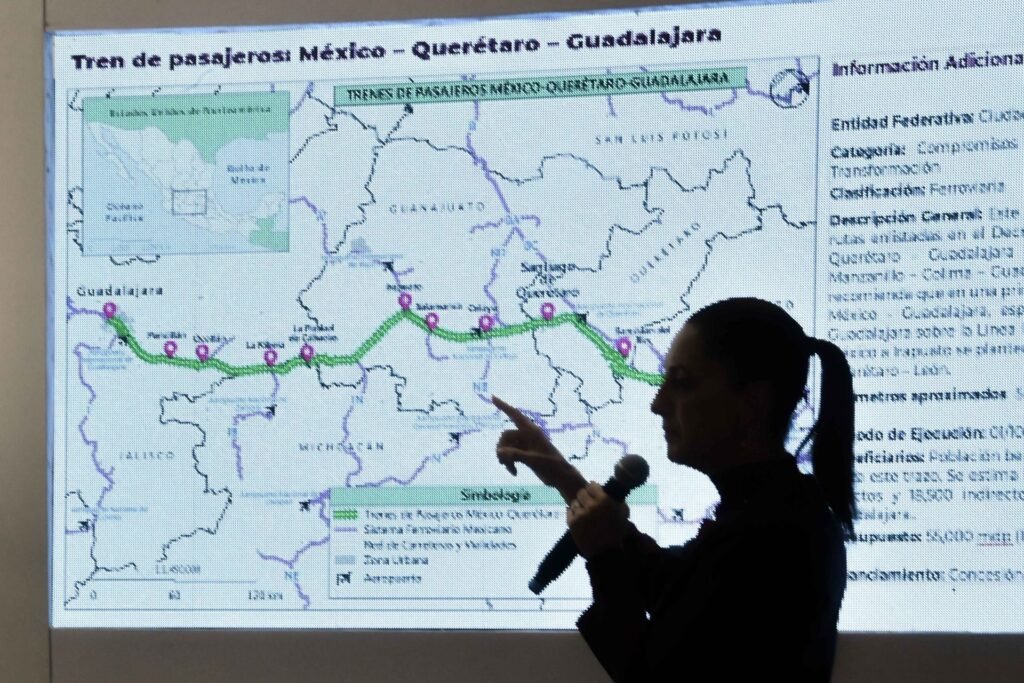
After decades of abandonment, Mexico is rebuilding its passenger railway: the Mexico City–Guadalajara line breaks ground in 2027, another stretch of a national network being revived to connect most major cities.