

Nasdaq plans to go live with trading equities 23 hours day for five days a week on 6 December 2026 as part of its Always‑On market initiative to advance the modernization of markets
Adena Friedman, chair and chief executive of Nasdaq, said on the first quarter results call on 23 April 2026 that the U.S. Securities and Exchange Commission approved the group’s proposal for 23/5 trading early in the second quarter. She said: “We’re excited to be leading the transition to an Always-On market. With the projected launch on 6 December 2026, we are excited to set a new standard for how regulated markets operate in an increasingly global and digital economy.”
Nasdaq 100 futures already trade 24/5. However, Nasdaq currently operates equities trading between 4am ET and 8pm ET, with approximately 2% of total volume occurring outside these hours, according to Friedman, which the industry wants to grow.

Adena Friedman, Nasdaq
“As we go forward, we are making sure that as of December 6, the consolidated tape is available, our market data will be available, so you will have a more lit market environment 23/5,” she added.
The group will also expand hours for MarketWatch, which provides real-time surveillance, the hours of the market operations team and operations. Investor education is also important, so Nasdaq will work with retail brokers to make sure their clients are ready to trade.
“The idea of being able to trade the Nasdaq 100 future, create the ETF and trade the underlying in domestic hours for those stocks is exciting,” Friedman added. “I see it as a natural next step, but it will take time to make a lot of penetration.”
Another part of the Always‑On market initiative is to launch trading of tokenized equities, which has been approved by the SEC. Nasdaq will continue to collaborate with DTCC, the U.S. post-trade infrastructure, to build the technology needed to launch tokenized equities.
Friedman said Nasdaq is working actively with the DTCC and the industry to make sure the firm does this in lockstep, and in an organized way.
“I think the DTCC has significant efforts underway, and they have expressed an interest in trying to get a first trade before the end of the year,” she added.
“We’re advancing the Nasdaq equity token that takes modernization a step further by putting issuers at the center of ownership rights,” she added. “We expect to provide early benefits of the Nasdaq token design in the first half of 2027.”
In capital markets, Nasdaq is experiencing demand for solutions and services related to the transition to Always-On markets and the tokenization of assets. The progress towards Always-On markets also creates meaningful opportunities for Nasdaq’s data business, according to Friedman, and enables trading in regions where demand for Nasdaq proprietary market data is already rising.
Index business
Nasdaq is expanding access to the Nasdaq 100 index through new partnerships with BlackRock and State Street, while it previously only had a partnership with Invesco. The pricing terms related to the index license for these new U.S.-listed Nasdaq 100 exchange-traded funds will be consistent with the Invesco QQQ ETF.
Friedman said the Nasdaq 100 is becoming a core component of an investment strategy among asset owners and insurance companies and the firm wants to distribute the index through the channels they usually use.
“We are excited to continue to expand distribution of our flagship index to new investors across the U.S. and globally with all our high-quality partners,” added Friedman. “This feels like the right next step for us.”
She continued that Nasdaq will continue to create new marquee products with Invesco. For example, Invesco recently launched an equal weight ETF based on the Nasdaq 100 index.
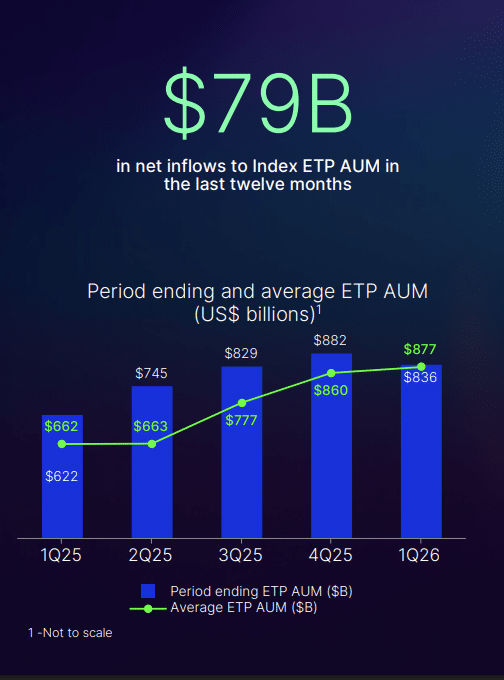
Average index exchange-traded product (ETP) assets under management reached a record $877bn in the first quarter. ETP assets at the end of the first quarter was $836bn.
Source: Nasdaq
There were $6bn in net inflows in the first quarter which took total net inflows in the last twelve months to $79bn. Friedman described the first quarter flows as “modestly positive,” and impacted by sector rotation and a risk-off environment tied to market uncertainty in March. Nasdaq views this impact as short-term tactical behavior and not representative of structural trends.
“Although we don’t view early quarter flows as predictive, we are encouraged by the momentum we’ve seen to date,” added Friedman. “In the second quarter, there were $15m of net ETP inflows as of April 20.”
The index business launched 31 new products in the first quarter, including 12 international products and 11 in the institutional insurance annuity segment. Institutional adoption of index products grew among annuity providers, contributing to a 30% increase in insurance-related revenues.
In addition, international demand from Europe, Middle East and Africa and Asia Pacific contributed to 19% of total ETP assets under management.
Friedman said: “Product innovation remains a key growth driver, with products launched over the past five years accounting for 46% of net inflows over the last twelve months.”
Nasdaq is also aiming to advance the transparency of private markets with the launch of Nasdaq Private Capital Indexes, which are designed to enable institutional investors and consultants to benchmark performance, analyze exposure, and navigate private markets. These are constructed from more than 14,000 institutional private market funds representing over $11.4 trillion of global assets under management sourced from eVestment’s LP reported data set.
The business had 14% year-on-year revenue growth in the first quarter of this year.
AI
Source: Nasdaq
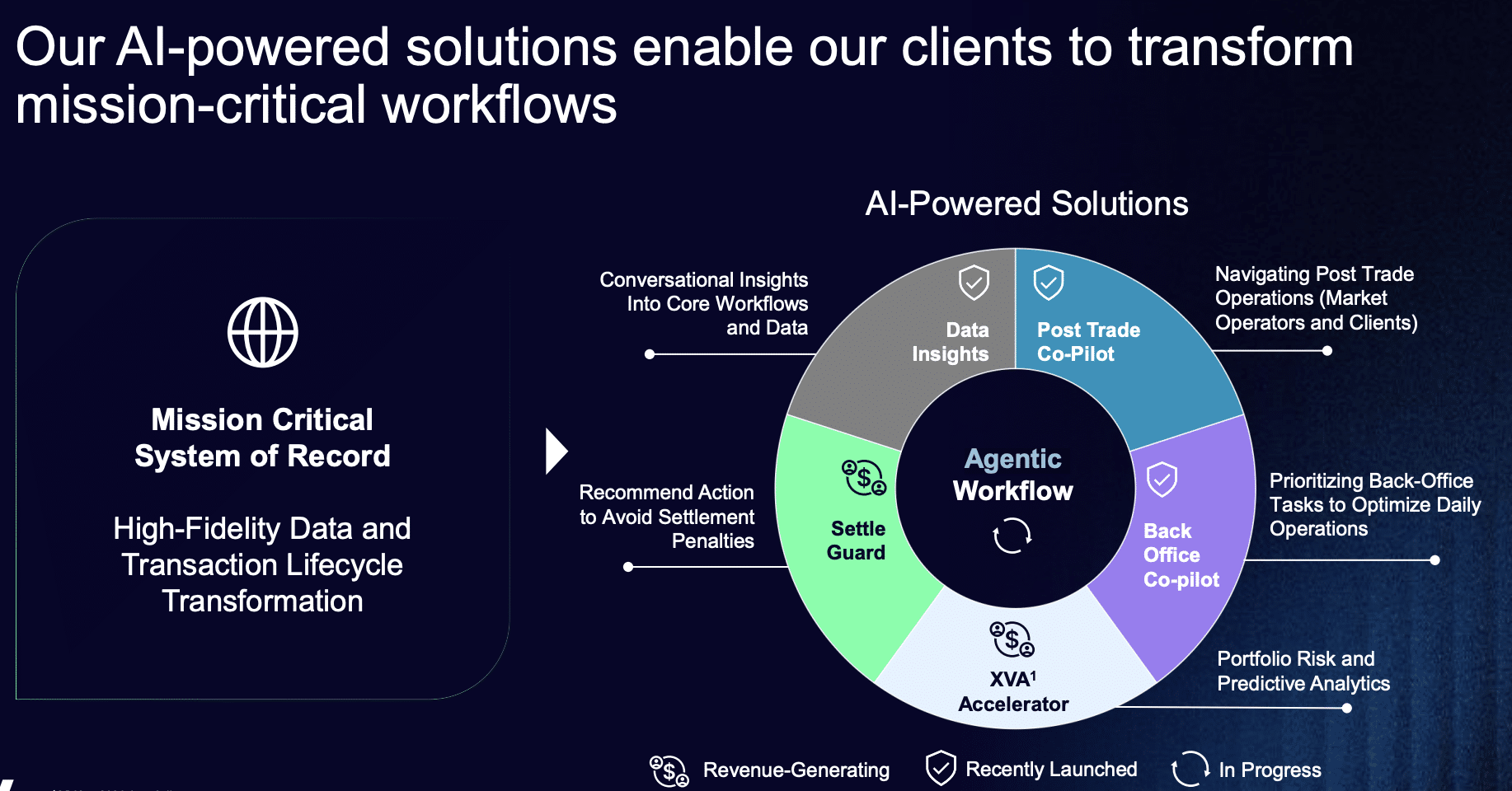
Friedman said investment in AI continues to be a meaningful driver of economic activity, especially in the United States. Smart regulation is also starting to take shape across the capital markets and banking industry, so clients are moving forward with investments in the modernization of their core infrastructure
“We’re experiencing increasing demand for cloud-based, mission critical solutions that include AI features to support workflow automation,” she added.
AI-ready data has been adopted by global asset managers, general partners and institutional investors representing over $9 trillion in assets under management, according to Friedman. She said this helped drive a 29% year-over-year increase in bookings in Corporate Solutions in the first quarter.
Nasdaq Verafin’s agentic AI workforce is being deployed by more than 500 clients, up 40% since the firm’s investor day in February this year. Later this quarter, Verafin will launch new drug trafficking analytics, which embeds generative AI directly into its model and aggregates open source intelligence, social media and third party research to help clients more effectively detect potential suspicious activity.
In the second quarter Nasdaq will release its generative AI platform extension which connects news and market events to trade data. Friedman said: “In beta, this capability has proven to be an effective solution for clients to uncover risks.”
In addition, Nasdaq has an internal program to drive AI adoption within its operations, dubbed “AI on the business.” For example, AI is being used to automate key elements of the product development life cycle, to manage client interactions and to automate some processes in finance, marketing, legal and HR.
“It’s an exciting time to understand and tap into the benefits that AI technology can provide,” said Friedman. “The most exciting part is speeding up the ability to deliver new capabilities to clients and to make sure the code we are delivering is clean and fit for purpose.”
As a result of using AI, the group aims to achieve $100m of expense efficiencies by the end of 2027. The majority of the cost savings will show up in 2027 because Nasdaq is also making investments in AI to ensure the group can achieve those efficiencies.
Source: Nasdaq
Market Services
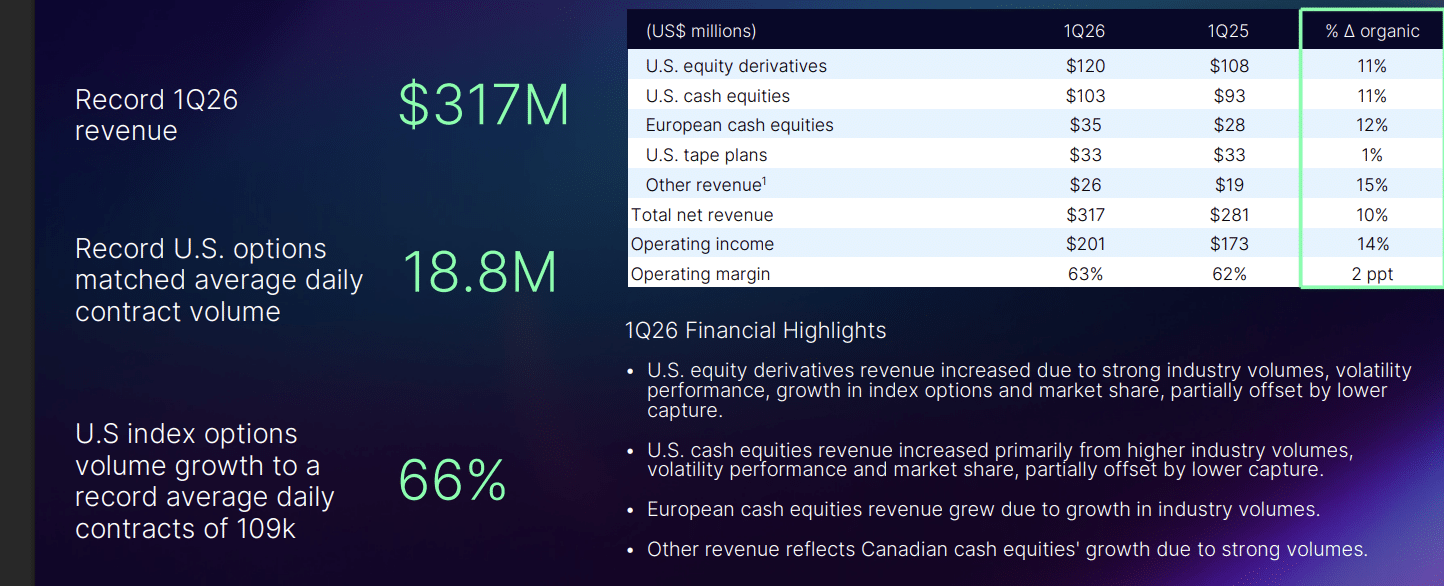
Nasdaq Market Services generated record net revenues in the first quarter which the group said was driven by record volumes in U.S. equities, U.S. options and elevated volumes in the European market.Index options revenue more than doubled year-over-year.
Th firm has filed a proposal with the SEC to list and trade outcome‑related options tied to the Nasdaq 100 index. Friedman described them as binary options on which investors predict whether the index will go up or down. She said: “It is a way to bring the notion of a prediction market construct into a regulated market.”
Financials
Friedman described the first quarter of this year as one of the strongest starts to the year in the company’s history. She said: “We delivered the highest first quarter organic growth since 2021 across net revenue solutions revenue and operating income, as well as our highest ever quarterly revenue growth in the financial technology division.”

Sarah Youngwood, Nasdaq
First quarter net revenue was $1.4bn, an increase of 14% over the first quarter of 2025, or 13% on an organic basis.
Sarah Youngwood, chief financial officer, said on the call: “Nasdaq delivered exceptional first quarter performance with double-digit growth across our three divisions and particular strength in financial technology.”
Nasdaq returned over $700m to shareholders in the first quarter, including nearly $550m of share repurchases.

NEWSLETTER SIGN UP
And receive exclusive articles on securities markets